
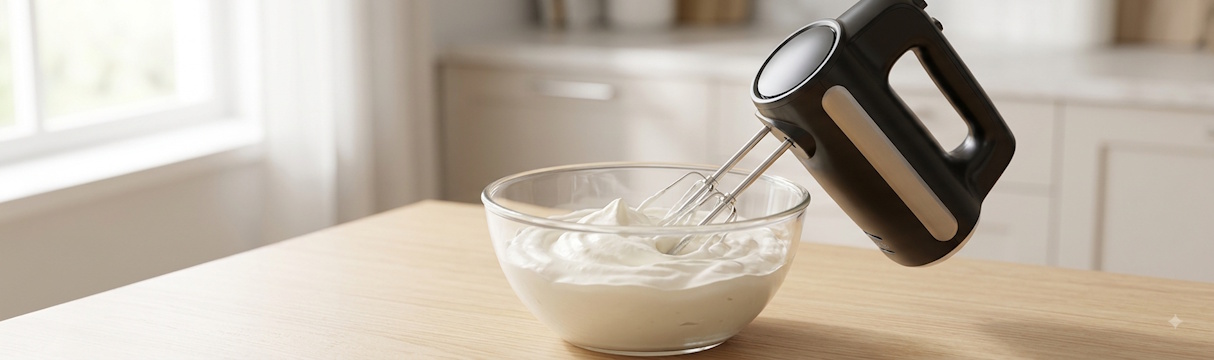
The best cordless hand mixer overall is the KitchenAid Go Cordless Hand Mixer, thanks to a 500+ monthly buyer track record, an “Overall Pick” badge, and a 60-minute battery that beats most cordless rivals on the market. If you want the same no-cord convenience for a lot less money, the Hamilton Beach Professional Cordless Hand Mixer gets you there for roughly $53 less.
Both models cut the cord entirely, so you’re not hunting for an outlet or untangling a cable mid-bake. But they land in very different price tiers, and the details that separate them matter more than the marketing copy lets on.
Cordless kitchen tools have moved well past the gimmick stage. Battery tech has caught up enough that a hand mixer no longer needs a permanent tether to deliver real mixing power, and both KitchenAid and Hamilton Beach now sell cordless versions right alongside their classic corded lineups.
That said, cordless isn’t automatically the right call for everyone. If you mix heavy bread dough daily or run a home bakery out of your kitchen, a corded mixer or full stand mixer still has the edge in raw sustained power. This guide is built for the far more common case: everyday baking where cord-freedom matters more than maximum wattage.
Quick Answer: Want the short version? The KitchenAid Go Cordless Hand Mixer is the stronger all-around pick; the Hamilton Beach Professional Cordless Hand Mixer is the budget-friendly alternative.
Jump to:
- Top Cordless Hand Mixer Picks at a Glance
- What Makes the Best Cordless Hand Mixer?
- Battery Operated Hand Mixer Basics: What to Check
- Rechargeable Hand Mixer Design Matters
- Why a Wireless Hand Mixer Beats Fighting a Cord
- In-Depth Cordless Hand Mixer Reviews
- Side-by-Side Comparison
- Quick Decision Guide
- Which One Should You Choose
- FAQ
- Final Verdict
Top Cordless Hand Mixer Picks at a Glance
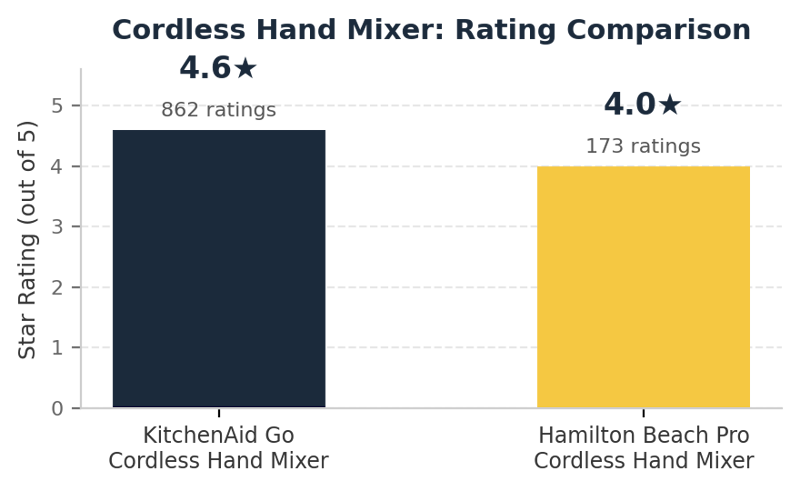
Before the deep dive, here’s how these two cordless hand mixer options stack up on the numbers that actually matter: rating, real buyer volume, and price.
| Product | Rating | Bought/Mo | Price | Buy |
|---|---|---|---|---|
| KitchenAid Go Cordless Hand Mixer (KHMR762) | 4.6★ (862) | 500+/mo | $139.95 | Check Price |
| Hamilton Beach Professional Cordless Hand Mixer (62673) | 4.0★ (173) | Not disclosed | $87.09 | Check Price |
What Makes the Best Cordless Hand Mixer?
The best cordless hand mixer isn’t just whichever one dropped its cord. It needs enough torque to actually finish a batch of cookie dough, a battery that survives a full baking session, and a body that doesn’t feel top-heavy once the battery pack is attached.
Real buyer volume and rating count matter more than a manufacturer’s spec sheet here. A model with 862 verified ratings at 4.6 stars has survived real kitchens, real dough, and real dead-battery moments — that’s a much stronger signal than wattage alone.
If your baking leans toward bread dough or thick cookie batches several times a week, a hand mixer — cordless or not — will eventually hit its limit. Our best budget stand mixer guide covers options built for that heavier torque a hand mixer can’t match.
Weight and balance matter more than most buyers expect going in. Adding a battery pack shifts a mixer’s center of gravity, and a few extra ounces near the handle can turn a five-minute whipping job into an uncomfortable one. Both mixers here stay under 3 pounds, which keeps them manageable for most home bakers.
Battery Operated Hand Mixer Basics: What to Check
Every battery operated hand mixer lives or dies by two numbers: continuous runtime and recharge time. Both mixers here claim roughly 60 minutes on a full charge, but they get there differently.
The KitchenAid ships with a swappable 12V MAX battery and a USB-C cable, so a spent battery is a quick charge-and-swap, not a dead mixer. The Hamilton Beach uses a built-in pack with a 10-minute quick-charge option covering about one batch of cookies — handy in a pinch, but not a substitute for a full charge.
- Full charge runtime: Look for at least 45-60 minutes of continuous use.
- Quick-charge option: A 10-15 minute top-up should get you through one recipe.
- Removable vs. built-in: Removable batteries let you keep a spare charged and ready.
Battery degradation is the part most spec sheets leave out. Like any rechargeable device, a cordless hand mixer’s battery holds less charge over time, so a model with a swappable pack has a real advantage: replace the $20-30 battery in a couple of years instead of retiring the whole mixer.
Rechargeable Hand Mixer Design Matters
A rechargeable hand mixer is only as convenient as its charging setup. Some models force you to plug the entire mixer into the wall to charge, which defeats some of the cordless appeal since it’s tied to an outlet again, just less often.
The KitchenAid’s battery pops out and charges separately via USB-C, so the mixer itself never needs to sit plugged in. The Hamilton Beach charges through its own base cord, which is simple but means the whole unit is out of action while it tops up.
Charging port type is worth checking before you buy, too. A USB-C rechargeable hand mixer can share a charger with your phone or laptop in a pinch, while a proprietary charging cord means one more cable you can’t easily replace if it’s lost or damaged.
Why a Wireless Hand Mixer Beats Fighting a Cord
A wireless hand mixer sounds like a small upgrade until you’ve actually used one near a sink, on an island with no nearby outlet, or while someone else is cooking on the only free counter plug. The freedom to move is the entire point.
Both mixers here also include a Soft Start or Slow Start feature, which ramps up to your chosen speed gradually instead of blasting flour across the counter the second you press the button. It’s a small detail that makes a real difference with powdered sugar and flour.
Storage is the other quiet benefit. Without a cord to coil up, a cordless hand mixer tucks into a drawer or stands upright on its own base, which matters if your kitchen is short on cabinet space or you’re tired of a tangled cord catching on other utensils every time you reach for it.
In-Depth Cordless Hand Mixer Reviews
KitchenAid Go Cordless Hand Mixer (KHMR762) Review
| KitchenAid Go Cordless Hand Mixer — Specs | |
|---|---|
| Price | $139.95 |
| Rating | 4.6★ (862 ratings) |
| Speeds | 7 speeds + Soft Start |
| Battery | 12V MAX removable, up to 60 min. runtime, USB-C charging |
| Wattage | 60 watts |
| Weight | 2.6 lbs |
| Included | 2 stainless steel Turbo Beater II accessories, battery, USB-C cable, wall adapter |
This cordless hand mixer earned Amazon’s “Overall Pick” badge and a 4.6-star average across 862 ratings — the strongest trust signal of any model in this comparison. The 12V MAX battery is rated for 60 minutes of continuous runtime, and because it’s removable, a dead battery means a quick USB-C top-up rather than a mixer stuck on the counter.
Taste of Home’s hands-on test found it whipped egg whites to soft peaks reliably, though it wouldn’t satisfy a meringue-obsessed baker chasing stiff peaks. Real buyers echo that verdict: it’s plenty strong for cookie dough, frosting, and mashed potatoes, but a few note it runs slightly heavier in the hand once the battery’s attached, and you do have to remember to charge it between sessions.
The freestanding design is a small but genuinely useful touch: set it down between mixing steps and the beaters stay lifted off the counter instead of resting in a puddle of batter. Taste of Home’s testers even found an unexpected use for the low-speed setting — shredding cooked chicken for pulled sandwiches, a trick that works because the soft-start ramp gives you enough control to avoid flinging meat across the kitchen.

Free delivery available with Amazon Prime
Hamilton Beach Professional Cordless Hand Mixer (62673) Review
| Hamilton Beach Professional Cordless Hand Mixer — Specs | |
|---|---|
| Price | $87.09 |
| Rating | 4.0★ (173 ratings) |
| Speeds | Infinite speed dial + LCD readout |
| Battery | Built-in, up to 60 min./600 cookies full charge, 10-min. quick charge |
| Wattage | 50 watts |
| Weight | 2.8 lbs |
| Included | 2 twisted wire beaters, whisk, snap-on storage case, charging cord |
This cordless hand mixer trades some polish for a lower price and an unusual control scheme: instead of fixed speed numbers, an infinite dial lets you land on any point between slow stir and full whip, with an LCD screen confirming exactly where you are. A baker on Baking-Forums.com switched to this model after a Breville’s beater coating started flaking and reported almost no splattering thanks to the slow start.
Real buyer feedback is more mixed than the KitchenAid’s. Several reviewers praise the power and battery life for the price, but others report charging reliability issues — batteries that show full but die on first use, or units needing multiple warranty replacements.
Amazon’s own review summary also flags noise level as a recurring complaint, with some buyers describing it as noticeably louder than a typical corded mixer. It’s a legitimate budget pick, just one worth going in with eyes open.
Hamilton Beach backs this model with a 5-year warranty, which is worth factoring into the value equation given the charging complaints — a defective unit is a straightforward replacement, not a $87 loss. The infinite dial also has a real practical upside over fixed-speed mixers: you can dial in exactly the right speed for delicate whipped cream instead of jumping between preset increments that are either too slow or too fast.

Free delivery available with Amazon Prime
Side-by-Side Comparison
Here’s every spec that matters, lined up side by side.
| Feature | KitchenAid Go Cordless | Hamilton Beach Pro Cordless |
|---|---|---|
| Price | $139.95 | $87.09 |
| Rating | 4.6★ (862) | 4.0★ (173) |
| Badge | Overall Pick | Overall Pick |
| Speed control | 7 fixed speeds | Infinite dial + LCD |
| Battery type | Removable, USB-C | Built-in |
| Wattage | 60 watts | 50 watts |
| Weight | 2.6 lbs | 2.8 lbs |
| Where to buy | Check Price | Check Price |
Cleaning and Care Tips
The beaters and whisk attachments on both mixers are dishwasher-safe, but the motor housing and battery compartment are not — wipe those down with a damp cloth instead of submerging them. Batter tends to creep up into the beater sockets, so a quick rinse of the attachments right after use saves a lot of scrubbing later.
Never charge either mixer with a damaged cable, and avoid leaving the battery on the charger indefinitely once it hits full — most lithium-ion batteries, including the ones in these mixers, last longer with occasional full discharge cycles rather than a permanent trickle charge.
Quick Decision Guide
Still torn? Here’s the short version. If you bake often enough that battery reliability and beater power genuinely matter, pay the extra $52.86 for the KitchenAid.
If you bake occasionally and just want the cord gone without a big spend, the Hamilton Beach covers the basics fine. Neither choice is a bad one — it really comes down to how often that mixer leaves the drawer.
Ask yourself three quick questions before deciding:
- How often do I bake? Weekly or more favors the KitchenAid’s track record.
- Do I need a battery swap? If charging downtime is a dealbreaker, the removable battery wins.
- What’s my real budget? $87 and $140 both make sense — just match it to how much you’ll actually use it.
A hand mixer is also just one piece of a well-stocked kitchen. Our guide to kitchen appliances every new home needs covers where a hand mixer fits alongside the rest of your setup.
Which One Should You Choose
Choose the KitchenAid Go Cordless Hand Mixer If…
- You bake regularly and need a mixer that holds up over hundreds of uses.
- You want swap-ready power so a dead battery never stops a recipe mid-mix.
- You already own other KitchenAid Go cordless tools and want a shared battery system.
Choose the Hamilton Beach Professional Cordless Hand Mixer If…
- Budget is the priority and $87 fits better than $140.
- You bake occasionally and don’t need the KitchenAid’s heavier-duty track record.
- You prefer a dial over fixed, numbered speed settings.
Either way, a cordless hand mixer only covers light-to-medium mixing. For heavier prep like kneading or chopping vegetables in bulk, pairing it with our best food processor picks closes that gap without needing a full stand mixer.
One more practical note: both mixers ship with two beaters as standard, so if a recipe calls for kneading a soft dough, check whether dough hooks are included or sold separately before you commit. The KitchenAid’s Turbo Beater II set is whisking-focused, while some Hamilton Beach bundles include dough hooks depending on the retailer package.
Frequently Asked Questions
Is a cordless hand mixer as powerful as a corded one?
Most cordless hand mixers today match a corded model for everyday tasks like batter, frosting, and whipped cream. Where they still fall short is sustained heavy-duty work like thick bread dough, where a corded model’s constant power supply has an edge.
The wattage numbers can be misleading on their own — a 60-watt cordless motor and a 300-watt corded motor aren’t directly comparable, since cordless designs are engineered around DC motors that deliver torque more efficiently per watt than older corded AC motors. Judge by real-world test results and buyer reviews rather than the watt rating alone.
- Cookies, cake batter, frosting: Cordless handles these fine.
- Whipped cream, egg whites: Both mixers here manage soft peaks reliably.
- Dense bread dough: Better suited to a stand mixer, cordless or not.
How long does a cordless hand mixer battery last?
Both mixers in this comparison claim roughly 60 minutes of continuous runtime on a full charge, which typically covers several recipes in one baking session. A quick 10-minute charge on the Hamilton Beach adds about one more batch of cookies in a pinch.
Runtime naturally drops as the battery ages, the same way a phone battery holds less charge after a couple of years of daily use. Neither manufacturer publishes an exact cycle-life figure, but a swappable battery design — like the KitchenAid’s — means you can replace just the pack later instead of the whole mixer.
Is a cordless hand mixer worth it?
If a dangling cord has ever gotten in the way of your bowl, tangled around the stand, or kept you tied to one outlet, a cordless hand mixer is worth the switch. The main tradeoff is remembering to charge it, which is a minor habit change against real everyday convenience.
The clearest sign it’s worth it: both mixers in this comparison carry an “Overall Pick” badge and hundreds of verified ratings between them, which means real buyers are choosing cordless over corded and sticking with it, not just trying a novelty and returning it.
Final Verdict
Both of these cordless hand mixer picks deliver on the core promise: no cord, no tangles, no hunting for an outlet mid-recipe. The KitchenAid Go Cordless Hand Mixer is the stronger all-around buy, backed by 862 ratings, a swappable battery, and an “Overall Pick” badge that reflects real, sustained demand. A Slickdeals thread even flagged it at a 28% discount, so it’s worth checking current pricing before you buy.
The Hamilton Beach Professional Cordless Hand Mixer is the right call if budget matters more than polish — just go in aware of the mixed battery-reliability feedback. Whichever you pick, check the current price below; cordless kitchen gadgets see frequent deal swings.
Free delivery available with Amazon Prime on both picks.
As an Amazon Associate, HomeApplianceOwl earns from qualifying purchases made through links on this page, at no extra cost to you.