

Keurig mini reviews mostly agree on one thing: the Keurig K-Mini at $71 is the best coffee maker you can buy if you drink one cup a day and counter space is tight. It brews in under two minutes, fits in a 4.5-inch gap, and works with every K-Cup on the market. It also has a water-fill quirk almost nobody documents, a door a few buyers worry will crack, and an occasional power hiccup worth knowing about before you order.
This roundup of keurig mini reviews pulls from Amazon’s own AI-generated buyer summary, individual verified purchases dated as recently as August 2026, and lab data from Tom’s Guide. No single hands-on unit was involved; Owen Nash verifies every pick through live listings and professional lab sources rather than in-house use, cross-checking claims against real Amazon review data before anything goes into the verdict below.
Keurig Mini Reviews: Quick Verdict
| Factor | Verdict |
|---|---|
| Rating | 4.2★ (108,970 ratings); bought-in-past-month figure not disclosed on the live listing |
| Price | $71.00 (Black), 29% off the $99.99 list price |
| Brew Speed | ⭐⭐⭐⭐⭐ (under 2 minutes once pre-heated) |
| Footprint | ⭐⭐⭐⭐⭐ (4.5 inches wide) |
| Water Reservoir | ⭐⭐⭐ (none built in; single-serve chamber only) |
| Reliability | ⭐⭐⭐ (mostly solid; Amazon’s own summary flags a durability minority) |
| Value (with pods) | ⭐⭐⭐ (cheap machine, expensive habit without a reusable pod) |
| Best For | Solo drinkers, dorms, small offices, first-time Keurig buyers |
Note that this verdict covers the base K-Mini only. If you’re actually shopping for the travel-focused model, skip ahead to the keurig k mini go review section further down, since the two run different specs and different prices.
Free delivery available with Amazon Prime
Keurig K-Mini Specs
The full spec sheet these keurig mini reviews are based on, pulled from the current Amazon listing:
| Spec | Detail |
|---|---|
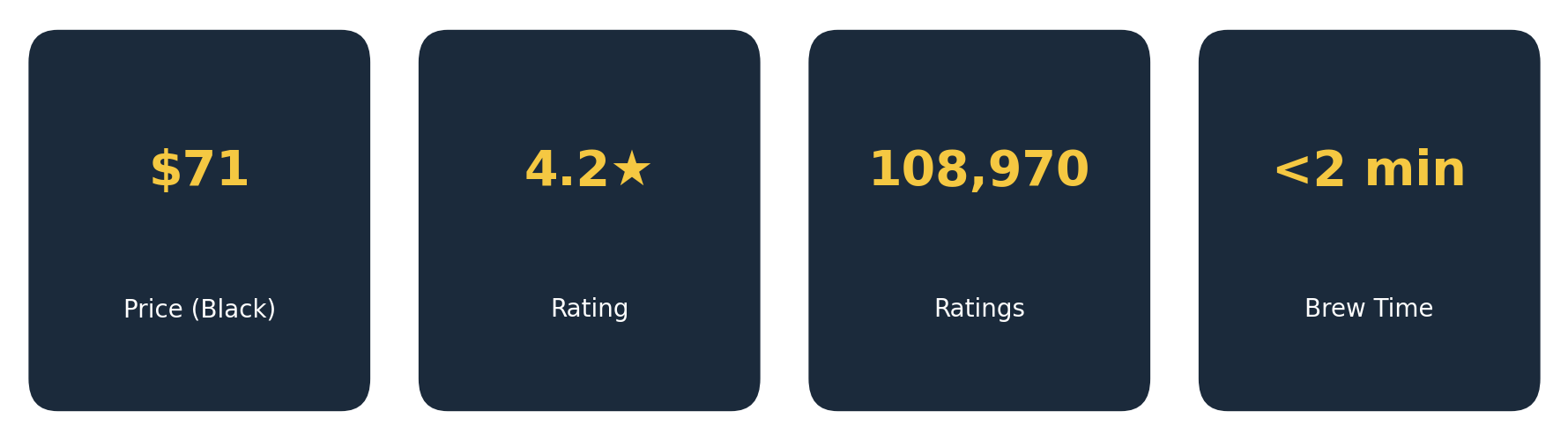
| Price (Black) | $71.00 (29% off $99.99) |
| Rating | 4.2★ / 108,970 ratings |
| Dimensions | 4.5 x 11.3 x 12.1 inches |
| Weight | 4.6 lbs |
| Brew Sizes | 6, 8, 10, 12 oz, set by how much water you add |
| Water Reservoir | None (single-serve chamber, refill every cup) |
| Compatible Pods | All standard K-Cup pods, plus reusable K-Cups |
| Brew Time | Under 2 minutes once the machine is warm |
| Travel Mug | Yes, up to 7 inches with the drip tray removed |
| Auto-Off | 90 seconds after brew |
| Brew Strength Control | No |
| Programmable Timer | No |
Two rows on that sheet drive most of the questions in keurig mini reviews: no reservoir, and no strength control. The keurig k mini water reservoir gap is the bigger of the two for daily use, since it’s the one that actually changes your morning routine rather than just your coffee’s flavor.
Keurig K Mini Water Reservoir: Why There Isn’t One
The single most-searched question in keurig mini reviews isn’t about taste. It’s about the keurig k mini water reservoir, or more precisely, the lack of one. The K-Mini uses a single-serve chamber instead: fill it, brew, empty, repeat.
There’s no removable tank to keep topped up for a run of cups.
That design choice has a side effect almost no other keurig mini reviews mention. One verified buyer, brewing for a five-person office Keurig comparison, found the machine refuses to start at exactly the 6oz minimum fill line. It needs a few extra ounces past the marking to actually trigger a brew cycle.
Fill precisely to the line and nothing happens; fill slightly over it and it works every time. It isn’t a defect so much as an undocumented tolerance in the fill sensor, but it will confuse anyone expecting the printed line to be exact.
There’s a second small design gripe tied to the same fill process. A 4-star verified reviewer flagged the flip-open door covering the water fill point as thin and flimsy, worried enough about cracking it that they handle it carefully every single brew. It hasn’t failed for them, but it’s the kind of plastic part that wears out first on a $71 machine, and it’s rarely mentioned in other keurig mini reviews at all.
- No reservoir means no batch brewing. Fine for one cup a day, tedious for two or three cups in a single morning.
- Fill slightly past the 6oz line, not exactly to it, or the brew cycle may not start at all.
- Handle the fill door gently. It’s the thinnest plastic part on the machine and the one most likely to show wear first.
If refilling before every cup is a dealbreaker, the Keurig K-Elite solves it with a full removable reservoir at a larger footprint, a reasonable trade if counter space allows for it.
Keurig K Mini Go Review: How It’s Different
A short keurig k mini go review is worth including here because the two names get confused constantly. The Keurig K-Mini Go (K22) is a separate, travel-oriented model, not a color variant of the base K-Mini reviewed on this page.
Consumer Reports‘ independent lab evaluation found the Go delivers its first cup especially quickly after power-on, reflecting a different design goal: fast readiness for travel and outdoor use, rather than the base K-Mini’s small-kitchen footprint focus. That distinction matters if you’re comparing the two by specs alone, since a fast-startup travel machine and an always-plugged-in kitchen mini optimize for genuinely different mornings.
If your Amazon listing or product box says “K-Mini Go” rather than plain “K-Mini,” you’re looking at that travel model, not this one. The core brewing mechanics are close cousins, but the Go’s shell, portability features, and price point are its own thing, worth a dedicated look if travel is the priority rather than a fixed spot on a kitchen counter. This keurig k mini go review section exists specifically so the two don’t get conflated in the comparisons below.
What Do Real Buyers Say?
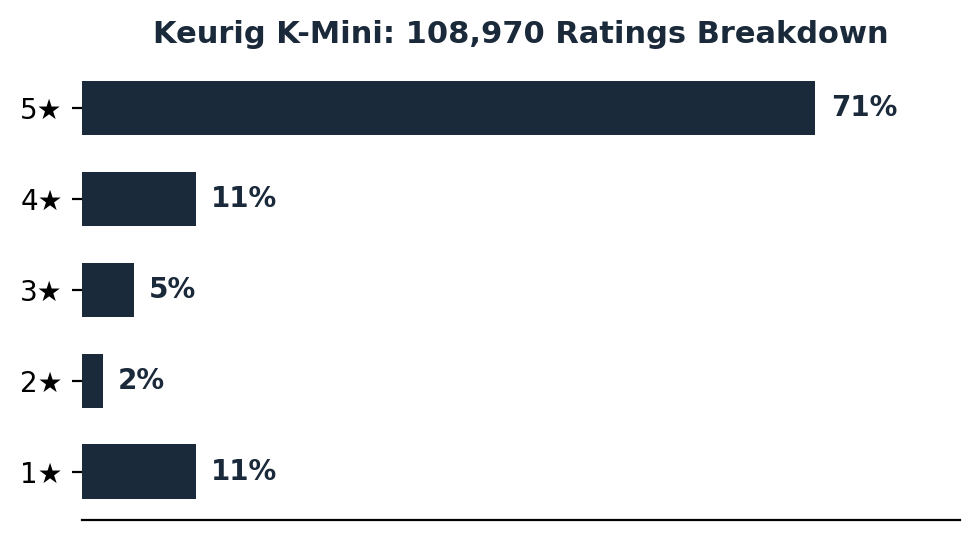
Amazon’s own AI-generated summary of the K-Mini’s 108,970 ratings is more candid than most keurig mini reviews get. Buyers consistently praise the size and space-saving footprint, but brew speed, temperature, and overall value all draw mixed feedback. Durability and reliability come up often enough in that same summary that they’re worth taking seriously, not dismissed as a handful of unlucky units.
Individual verified reviews back that up in both directions. One 5-star buyer from July 2026 described the machine as reliable “99 percent of the time,” with an occasional exception: twice in roughly two years, it wouldn’t power on and needed several hours before it would start again.
Another buyer’s five-star praise came with a same-week addendum. Their unit stopped brewing entirely after only four uses and had to be returned, a sharp contrast to the first review’s rare-but-recoverable hiccup.
Not every account of the K-Mini’s quirks holds up equally, either. Some reviews describe water splattering during brewing or a noisy pump cycle. One verified buyer specifically pushed back on both claims, reporting no splatter and noise no louder than their full-size Keurig at home.
The honest takeaway is that most units perform exactly as advertised, a minority don’t, and neither extreme should be treated as the whole story. That mixed picture, more than any single complaint, is what these keurig mini reviews should leave you with.
How Loud and How Hot Does It Brew?
Lab measurements from Tom’s Guide, one of the outside sources these keurig mini reviews draw on for lab-verified figures, put the K-Mini’s brew cycle at roughly 80 decibels at its loudest point, the sputtering sound as it finishes filling a cup, making it one of the noisier machines in Keurig’s lineup rather than one of the quietest. That’s a genuinely useful number for anyone brewing near a sleeping housemate, since 80 decibels sits close to a running garbage disposal, loud enough to notice through a thin apartment wall.
That same lab work found the K-Mini actually brews hotter than expected, in the 180 to 189°F range across multiple cups, and clocked it as having the longest brew time of any Keurig model in their lineup. Temperature consistency isn’t the underlying problem, then. The lukewarm complaint that shows up in some individual reviews is specifically a first-cup, cold-start issue rather than general underheating.
In practical terms, expect a kettle-like pump noise for 60 to 90 seconds per brew, with a louder sputter right at the end. Fine for a normal kitchen. Noticeable in a quiet bedroom or studio apartment.
Keurig K Mini Reusable Pods: The Real Cost Savings
The machine costs $71. That’s the number everyone sees. Here’s the number most keurig mini reviews skip: one K-Cup pod at roughly $0.75 a day costs about $274 a year, close to four times the price of the machine, every single year, indefinitely.
A basic drip machine running ground coffee costs closer to $0.30 to $0.40 per cup. Over two years, the K-Mini on pods runs roughly $548 in running costs alone, versus around $220 for drip. The fix is a reusable My K-Cup pod, generally $10 to $15, which drops cost per cup to drip-machine territory while keeping the K-Mini’s one-button convenience.
If you’re already planning to buy one, that math tilts firmly in the K-Mini’s favor. If you’re not, the $71 price tag is only the entry fee, and it’s worth doing the keurig k mini reusable pods math before you decide either way.
One more real-world data point worth knowing: reusable K-Cup accessories built specifically for this machine, like the Reusable K Cups for Keurig K-Mini 3-piece set, carry over 4,300 verified ratings on Amazon. This isn’t a niche workaround; it’s a mainstream accessory purchase most K-Mini owners eventually make once the yearly pod math sinks in.
Keurig K Mini vs K Mini Plus (Now Sold as K-Mini Mate Plus)
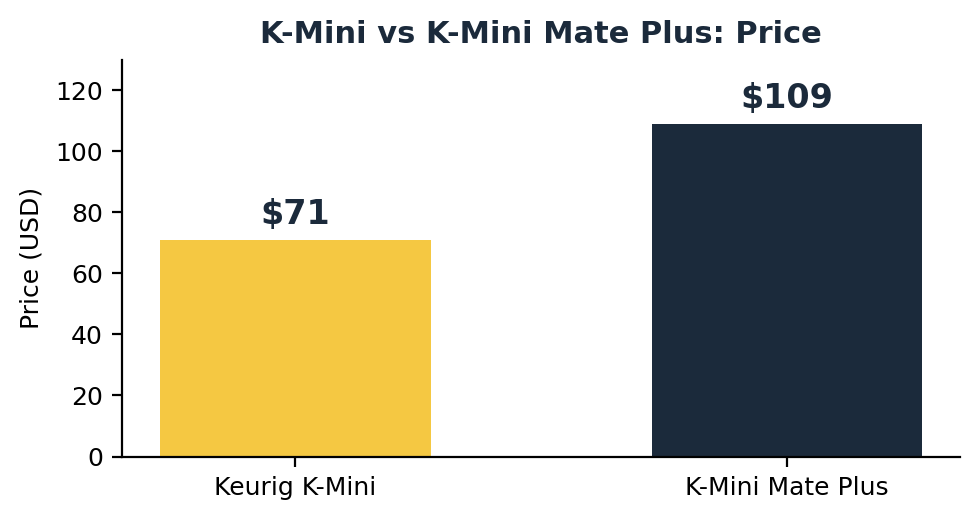
The original K-Mini Plus is no longer sold new. Only used units remain, and it’s absent from Keurig’s own site. The current version in that product slot is the Keurig K-Mini Mate Plus, and comparing keurig k mini vs k mini plus really means comparing the base K-Mini against this successor: a 50oz removable reservoir (versus the base model’s single-cup chamber), brew-over-ice and strong-brew settings, at $109.00.
That’s a bigger jump than the Mate Plus’s earlier list price suggested. Live verification puts it $38 above the base K-Mini, wider than the roughly $13 gap it carried at launch. If you drink more than one cup a day, the 50oz reservoir alone still makes a case for the premium: refilling once every several cups instead of every single one is a real quality-of-life difference over hundreds of uses.
Brew-over-ice is a genuine bonus if iced coffee is a regular habit; strong-brew directly answers the base K-Mini’s biggest flavor complaint. If you’re a strict one-cup-a-day drinker who only cares about footprint and price, the base K-Mini remains the better buy at the wider gap.
One caveat on trust signals: the Mate Plus is a newer, far less-reviewed listing, 368 ratings against the base K-Mini’s 108,970, so its 4.5★ average carries meaningfully less statistical weight so far, even with an active Amazon’s Choice badge.
It’s also worth flagging that the Mate Plus’s listing is currently fulfilled by a third-party seller rather than sold directly by Amazon, which doesn’t affect the return policy but is worth knowing if you specifically prefer buying first-party. The base K-Mini reviewed on this page ships and sells directly through Amazon.com, a small but real difference between the two listings that most side-by-side comparisons skip entirely.
Keurig also sells the wider K-Compact, which trades the K-Mini’s slim 4.5-inch profile for an 8.2-inch body in exchange for a genuine removable reservoir, worth a look if you want more than one cup without babysitting a tank, and don’t mind the larger footprint. If your listing or box says “K-Compact” rather than “K-Mini,” you’re looking at that different machine.
Cleaning and Maintaining the Keurig K-Mini
No honest keurig mini reviews skip upkeep, since it’s the part most buyers overlook until the coffee starts tasting off. The K-Mini’s water chamber is fixed in place, so unlike a machine with a removable tank, you can’t just pull it out and rinse it. Descaling solution or a vinegar-water mix run through the brew cycle is what clears mineral buildup from the internal lines.
Plan on descaling every three to six months depending on your tap water’s hardness. Skip it too long and expect slower brew cycles or a metallic taste creeping in, both classic scale-buildup signs on any single-serve brewer, not a K-Mini-specific flaw.
The drip tray is the easy part. It lifts out for a hand wash, and doing that weekly rather than only when it looks dirty keeps coffee residue from building up around the base. There’s no cleaning-cycle reminder light on this model, so a recurring quarterly phone reminder is the simplest way to stay on schedule.
None of this maintenance is unique to the K-Mini specifically; it’s the same routine any keurig mini reviews you read elsewhere should recommend for a single-serve chamber with no removable tank.
Is the Keurig K-Mini Worth It?
Across every source these keurig mini reviews draw on, the verdict comes down to one simple check: does your morning routine actually match what this machine is built for?
Buy it if you drink one cup a day, counter space is genuinely limited, you want zero complexity, and you’ll use a reusable pod or accept the pod cost going in with open eyes. Nothing else does what it does at this price and size, and the keurig k mini reusable pods math above is worth revisiting before you commit either way.
Skip it if you drink multiple cups daily, want brew strength control, want a pre-programmed cup waiting for you, or don’t want to think about pod math. The K-Mini Mate Plus, K-Compact, or a basic drip machine will serve you better in those cases, and it’s worth reading the full keurig k mini vs k mini plus breakdown above before deciding which one actually fits.
Picture your actual morning, not an ideal one. Reaching for the same mug at the same time every day means the K-Mini’s one-cup rhythm won’t bother you. Two or three people wanting coffee inside the same ten minutes means the refill-every-cup design gets old fast, and that’s exactly when the Mate Plus’s reservoir starts earning its higher price.
Weighing a completely different setup instead? Our Ninja vs Keurig comparison covers how pod machines stack up against Ninja’s combo brewers, and Keurig vs Nespresso breaks down the two biggest pod ecosystems side by side.
New to pod coffee makers generally? Start with our best coffee makers for beginners guide, or see our coffee maker buying guide for the full decision framework.
If kitchen space is the wider concern rather than coffee specifically, our best small kitchen appliances guide covers compact picks across every category, not just coffee makers.
Free delivery available with Amazon Prime
Frequently Asked Questions
Is the Keurig K-Mini worth it?
Yes, for solo drinkers who want the smallest, simplest coffee maker available. At $71 it brews in under two minutes and fits on nearly any countertop. It’s not worth it if you drink multiple cups a day, want brew strength control, or plan to run disposable pods exclusively without budgeting for the real running cost.
Does the Keurig K-Mini have a water reservoir?
No. The K-Mini uses a single-serve internal chamber, so you add the exact amount of water you want to brew each time rather than filling a reservoir to store. Fill it slightly past the 6oz minimum line, not exactly to it, or the machine may not start the brew cycle.
The K-Mini Mate Plus adds a removable 50oz reservoir if that’s a dealbreaker.
Can the Keurig K-Mini use reusable pods?
Yes. Any standard reusable K-Cup pod works with the K-Mini, with no DRM lock-out. A reusable pod cuts cost per cup from roughly $0.75 down to around $0.35 and lets you brew any ground coffee you choose, worth doing from day one given how quickly disposable-pod costs add up.
The keurig k mini reusable pods math covered earlier on this page walks through exactly how much that adds up to over a year.
HomeApplianceOwl.com is a participant in the Amazon Services LLC Associates Program. As an Amazon Associate, Owen Nash earns from qualifying purchases at no extra cost to you. Prices shown are approximate and subject to change. Last updated August 2026.