
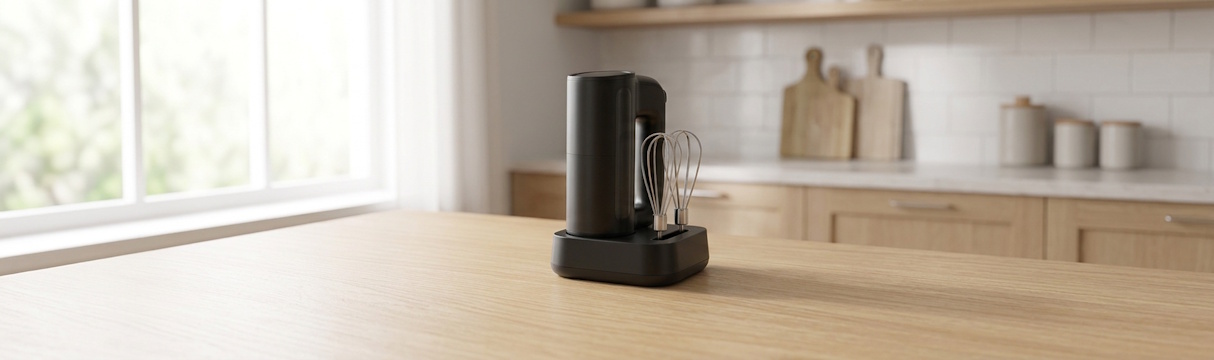
The KitchenAid Go Cordless Hand Mixer earns its Amazon’s Choice badge honestly, and it’s genuinely quiet and well balanced in the hand, but a specific flaw keeps showing up in verified buyer reviews before anyone spends $139.95 on it. We pulled the live listing, read through the actual reviews (positive and critical), and cross-checked the pattern against Walmart’s own review data before writing a word of this. If you just want the current price, check it here, then come back for what the reviews say once the novelty of going cordless wears off.
Table of Contents
- KitchenAid Go Cordless Hand Mixer: Spec Snapshot
- KitchenAid Go Hand Mixer: Full Spec Breakdown
- The Flaw Buyers Keep Running Into
- KitchenAid Go Cordless Hand Mixer Review: What Real Buyers Say
- Is KitchenAid Go Cordless Worth the Price?
- KitchenAid Cordless Hand Mixer Review: How It Stacks Up
- Who Should Buy It (and Who Shouldn’t)
- FAQ
- Final Verdict
KitchenAid Go Cordless Hand Mixer: Spec Snapshot
Here’s what you’re actually paying for with the KitchenAid Go Hand Mixer. Model KHMR762, Matte Black, verified on Amazon this week with delivery confirmed to a US address.
A quick note on how this page gets built, since it matters for trusting anything below. We pull live pricing and rating data directly from the current Amazon listing rather than a cached snapshot, then read through a genuine sample of the customer reviews, including the critical ones filtered separately from the five-star pile.
Where a claim shows up in only one review, we treat it as one person’s experience. Where it shows up across multiple, independent reviewers, or corroborated on a second retailer entirely, we call it a real pattern and say so.
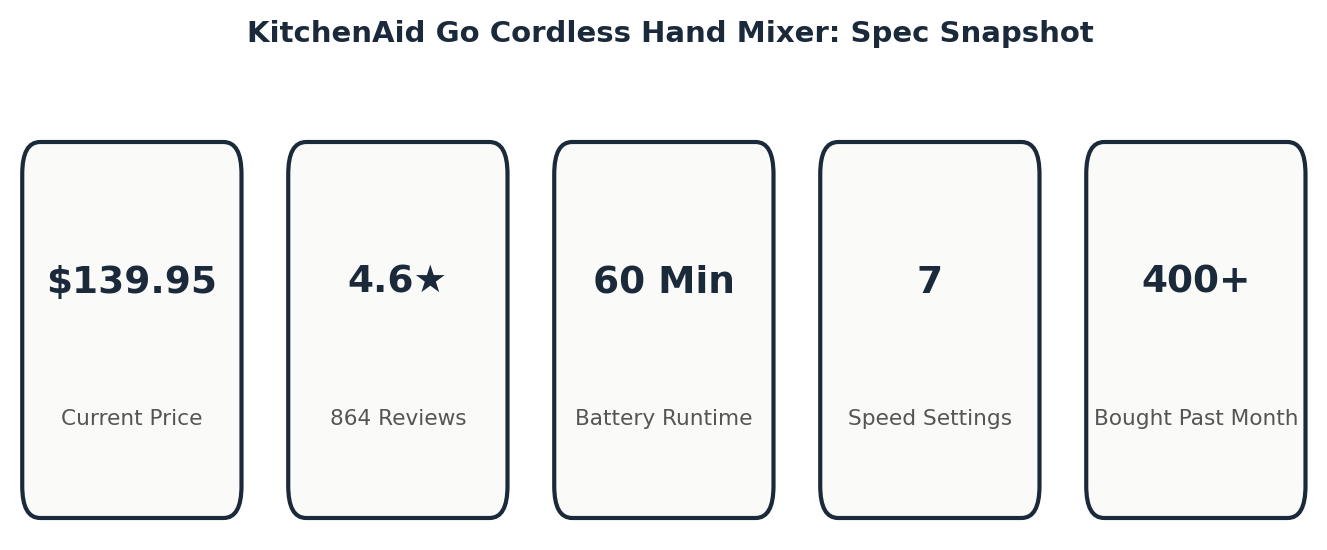
| KitchenAid Go Cordless Hand Mixer (KHMR762) | |
| Price | $139.95 |
| Rating | 4.6 out of 5 (864 reviews) |
| Badge | Amazon’s Choice |
| Bought Past Month | 400+ |
| Battery | 12V MAX removable, up to 60 min continuous runtime |
| Speeds | 7, with Soft Start |
| In the Box | Mixer, 2 turbo beaters, 1 battery, USB-C cable, wall adapter |
That 60-minute runtime figure is the manufacturer’s max initial rating, measured without a workload, so real-world time is shorter once you’re actually creaming butter or whipping cream. More on that below, because it matters more than the spec sheet lets on.
KitchenAid Go Hand Mixer: Full Spec Breakdown
The pitch behind the KitchenAid Go Hand Mixer is simple. Take a hand mixer, remove the cord, and let it share a battery with the rest of KitchenAid’s Go Cordless lineup, which includes a personal blender and a hand blender. Pull the battery off the bottom of any Go tool and it slots into any other one.
If you already own a Go blender, you’ve got a spare battery sitting in a drawer somewhere. KitchenAid has since extended the same battery to a cordless blade grinder too, so the lineup is growing rather than staying a one-off gimmick.
The self-standing design is the detail people notice first once it’s out of the box. Set it down on the counter and the beaters lift clear, so no batter puddle forms under the mixer the way it does with most corded models. Soft Start ramps the beaters up gradually instead of snapping straight to full speed, which is the whole reason your kitchen counter doesn’t end up wearing the first two seconds of pancake batter.
Seven speeds cover the usual range, from a slow stir for folding in chocolate chips up to a high setting for whipping cream or egg whites. The two stainless steel turbo beaters are dishwasher-safe and eject with a single button, no tugging required.
Charging happens over USB-C, which is a small thing but a real one. Nobody wants to hunt down a proprietary brick charger three years from now.
The KitchenAid Go Cordless Hand Mixer’s weight is the part nobody mentions until they’re holding it for ten straight minutes. With the battery slotted in, this sits noticeably heavier in the hand than a basic corded hand mixer, closer to what you’d feel holding a mid-size cordless drill.
It’s not uncomfortable, but if you’ve got wrist issues or you’re mixing one-handed while stirring something else on the stove, that extra weight is worth knowing about ahead of time rather than discovering it mid-recipe.
Indicator lights on the battery itself show remaining charge at a glance, which sounds minor until you’re halfway through a double batch of cookies and need to know whether to finish the bowl or swap batteries first. A full charge from empty takes a couple of hours over USB-C. Most owners report topping it off between uses rather than running it flat, the same way people treat a phone.
None of this comes with a case. The KitchenAid Go Hand Mixer sits in a drawer or on the counter with its two beaters wherever they fit, which is a minor gap compared to the storage cases some competitors include, but not one that shows up as a complaint in the actual reviews.
The Flaw Buyers Keep Running Into
This is the part most product pages skip. Three separate verified buyers of the KitchenAid Go Cordless Hand Mixer, independently, describe the same problem: the beaters don’t stay locked in during use.
One reviewer put it plainly, saying the beaters come out mid-mix and called it highly annoying. A second buyer traced it to the beater design itself, noting the shaft is thin enough that creaming butter and sugar comes out inconsistent from batch to batch.
It’s not an isolated complaint either. Walmart’s own review summary for this same KitchenAid Go Cordless model lists a con that matches almost word for word: it may not stay securely in place during use.
That’s two separate retailers, two separate review pools, landing on the same issue. When that happens, it stops being one unlucky unit and starts being a real characteristic of the design.
The second thread running through the critical reviews is battery drain under real load, not the lab-measured 60 minutes on the box. One buyer used it twice for scrambled eggs and watched the charge drop by half.
Another described the motor straining on a stiff, cold-butter shortbread dough until it noticeably slowed down. Neither of these is a defect. It’s a cordless motor doing cordless-motor things when asked to do a stand mixer’s job.
What’s easy to miss reading these complaints in isolation is that the beater-retention issue and the power ceiling are connected. A beater that’s slightly loose in its socket will work itself further out under resistance, and resistance is exactly what a stiff dough or cold butter creates.
Buyers hitting the beaters-popping-out problem are disproportionately the same ones pushing the mixer past what a hand mixer, corded or not, was ever meant to do. That doesn’t make the complaint less real. It just means the fix, for most people, is choosing recipes that match the tool rather than waiting for a firmware update that isn’t coming.
KitchenAid Go Cordless Hand Mixer Review: What Real Buyers Say
864 ratings sit behind the KitchenAid Go Cordless Hand Mixer listing right now, and the shape of that data is worth seeing rather than just being told about.
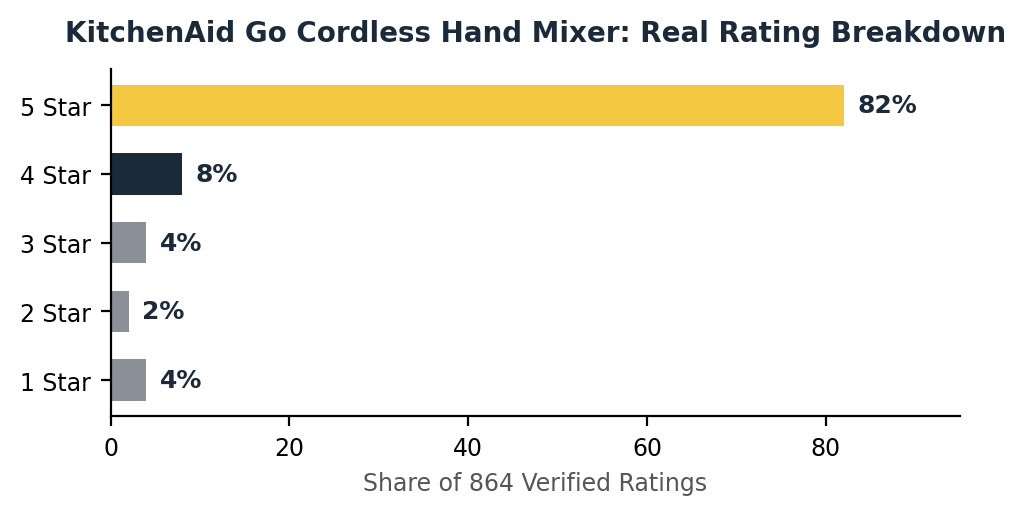
Across this KitchenAid Go Cordless Hand Mixer review, 82 percent land at five stars, and reading through them, the praise clusters around a few specific things. It’s quiet enough to hold a conversation while it’s running, and it doesn’t feel top-heavy the way some cordless tools do once you add the weight of a battery.
The matte black finish resists fingerprints better than most owners expected sitting out on a counter all day, which sounds minor until you’re the one wiping it down every morning.
The 14 percent sitting at one, two, or three stars is small in volume but consistent in what it names: beater retention, motor strain on dense mixtures, and battery drain that outpaces the advertised runtime.
A Slickdeals thread tracking this exact model’s price history carries the same split in its comments. One commenter called it a solution in search of a problem, arguing most kitchens have outlets everywhere anyway. Someone else pushed back, saying the point isn’t the outlet, it’s not fighting a cord while the beaters are already running.
One five-star review stuck with us more than the others. A buyer wrote that they got this for their wife expecting a modest upgrade over her old corded mixer, and instead it took over as the one she reaches for every time.
The detail that made it feel real rather than staged was small: she noticed she could hold a conversation while it ran, which isn’t something you’d think to mention unless it had actually surprised you. That’s the kind of buyer this mixer was built for, and going by the review data, there are a lot of them.
It’s worth being honest about what 864 reviews does and doesn’t tell you. It’s a healthy sample size for a hand mixer in this price range, larger than the Hamilton Beach alternative below by a wide margin, but it’s still self-selected toward people motivated enough to leave a review at all.
The 82 percent five-star share is real. It’s just not the same thing as a guarantee that your specific unit won’t have a loose beater.
Is KitchenAid Go Cordless Worth the Price?
Yes, for most people baking two or three times a week, the KitchenAid Go Cordless Hand Mixer is worth the $139.95. I’ll say that plainly instead of dancing around it. The convenience of not chasing an outlet while your hands are covered in cake batter is a bigger deal in practice than it sounds on paper, and the 82 percent five-star share backs that up.
Where it stops being worth it is the moment your baking regularly involves stiff dough. If you’re making bread weekly, or you’re the person at the office bake sale known for dense, chewy cookies, the motor here will strain exactly the way the critical reviews describe.
Buy a stand mixer instead, or stick with a corded hand mixer that isn’t limited by battery output. There’s no version of this product that changes that math, no matter how much you like the cordless idea.
The KitchenAid Go ecosystem angle is real too, and worth factoring into the price. If you’re already eyeing a cordless personal blender for smoothies, one battery running both tools brings the effective cost down over time compared to buying two separately-powered cordless appliances.
Compare that $139.95 against what you’d spend replacing a mixer every couple of years because the cord finally frayed at the strain relief, which is the single most common way a cheap corded hand mixer actually dies. That’s not a knock on corded mixers generally. It’s just a real cost that rarely gets counted when people compare sticker prices side by side.
KitchenAid Cordless Hand Mixer Review: How It Stacks Up
The closest cordless competitor on the market right now is the Hamilton Beach Professional Cordless Hand Mixer, model 62673. Any honest KitchenAid cordless hand mixer review has to put the two side by side, and we’ve already run a full head-to-head comparison between them, but here’s the short version.

Hamilton Beach undercuts KitchenAid by almost $52 and still carries its own Amazon’s Choice badge, but its 4.0-star average against only 173 reviews is a much thinner track record than KitchenAid’s 4.6 stars across 864. Amazon shows 400+ bought in the past month for the KitchenAid listing. Hamilton Beach’s listing doesn’t disclose that figure at all, and that gap says more about what Amazon chooses to surface than about either product’s actual popularity.
If price is the deciding factor, Hamilton Beach wins outright. If you want the longer, more proven track record and you’re already inside the KitchenAid Go battery ecosystem, the extra money buys real peace of mind.
For anyone whose baking regularly crosses into bread dough territory, neither cordless mixer is the right tool. Our best budget stand mixer guide covers models built for exactly that kind of heavy, sustained load.
There’s also a third option worth naming even though it’s not cordless at all. KitchenAid still sells a classic corded 7-Speed Hand Mixer, and it sidesteps the entire battery question by staying plugged in the whole time. No charge to manage, no runtime ceiling, no half-drained battery mid-recipe.
The tradeoff is the cord itself, back to fighting it across the counter and around the mixing bowl. If the beater-retention complaints above are the deciding factor for you, the corded sibling uses a different beater mechanism and doesn’t carry the same reported issue.
Who Should Buy It (and Who Shouldn’t)
Buy the KitchenAid Go Cordless Hand Mixer if you bake cakes, quick breads, frosting, and whipped cream on a regular basis and you’re tired of a cord getting in the way while you move between the bowl and the stovetop. Buy it if you already own another KitchenAid Go tool and the shared battery makes the math work. Buy it if quiet operation actually matters in your kitchen, whether that’s an open-plan apartment or a baby asleep down the hall.
Skip it if bread dough, thick cookie dough, or anything approaching a stand mixer’s workload is part of your regular routine. Skip it if you’ve read this far and you’re still thinking about the beater-retention complaints as a dealbreaker, because that reaction is telling you something.
And skip it if $139.95 for a hand mixer feels steep regardless of the battery-sharing angle. A good corded model does the same core job for less.
One scenario worth calling out specifically: multi-generational households where more than one person uses the kitchen. A cord seems like a small thing until you’re the third person that week untangling it from a drawer handle, or moving a plugged-in mixer around an island because the nearest outlet is on the wrong side. That everyday friction is exactly what this mixer removes, and it’s easy to underweight until you’ve actually lived with it for a few weeks.
FAQ
Is the KitchenAid Go Cordless Hand Mixer worth it?
Yes, if your baking is mostly cakes, frosting, and batters rather than dense dough, since the convenience genuinely outweighs the tradeoffs for that use case.
It handles cake batter, frosting, whipped cream, and egg whites without issue. The KitchenAid Go Cordless Hand Mixer struggles with bread dough, stiff cookie dough, and large batches, for the reasons covered above.
How long does the battery last on the KitchenAid Go Cordless Hand Mixer?
KitchenAid rates it at up to 60 minutes of continuous runtime, but that figure is measured without a workload, so real baking sessions will pull less.
| Charging | USB-C, no proprietary cable |
| Battery | Removable, shared across the KitchenAid Go lineup |
| Real-world drain | Faster than the 60-min spec on dense or repeated tasks |
Can the KitchenAid Go Cordless Hand Mixer handle heavy dough?
Not reliably. Multiple verified buyers report the motor straining and slowing down on stiff, cold-butter dough, which matches what the 7 speeds and battery-powered motor are actually built for.
Everyday batters, glazes, and light-to-medium mixing are a good match. For bread and heavy cookie dough, a stand mixer is the better tool, full stop.
Final Verdict
The KitchenAid Go Cordless Hand Mixer does what it promises for the baker it’s actually built for. It’s quiet, it’s balanced, and going cordless genuinely changes how you move around a kitchen mid-bake.
The beater-retention issue is real and corroborated across two separate retailers, and it will bother you if you bake dense dough regularly. For everyone else, at $139.95, it’s a fair trade.
If you’re still deciding between the KitchenAid Go Cordless Hand Mixer and the Hamilton Beach alternative, or wondering whether a stand mixer makes more sense for your baking habits, the two links below cover both of those questions directly rather than leaving you to guess.
Free delivery available with Amazon Prime
Disclosure: HomeApplianceOwl is a participant in the Amazon Associates program. We may earn a commission from qualifying purchases made through links on this page, at no additional cost to you.