
Most people buy a coffee maker the way they buy a phone case: whatever’s popular, whatever’s cheap, whatever shows up first. Then it sits on the counter making coffee that’s fine, not memorable, for the next three years.
A real coffee maker buying guide starts somewhere narrower: how many cups do you drink on an average Tuesday, and how many other people in the house drink coffee too? That single answer rules out more wrong options than any spec sheet will.
There’s no universal “best” coffee maker, only the best one for how you actually drink coffee. A machine built for a household of one looks nothing like a machine built for a family running three different orders before 8 a.m.
If you already know you want something manual and you’re just here to compare a couple of names, the Bodum Chambord French Press is the one most readers in this exact spot end up buying. It’s Amazon’s Overall Pick in the category, it’s been on the market long enough that replacement parts are easy to find, and at 1,000+ purchases a month it’s not a niche pick. If that’s not quite your situation, keep reading: the next few sections narrow it down properly.
What This Guide Covers
- Coffee Maker Buying Guide: Where to Start
- Top Picks at a Glance
- Best Coffee Maker for One Person (and Every Household Size)
- Budget Coffee Makers: What You Get at Each Price Point
- What to Look for in a Coffee Maker
- Brew Style: Drip, Single-Serve, Espresso, Pour-Over, or Cold Brew
- Coffee Maker for Small Space Kitchens
- Common Coffee Maker Buying Mistakes to Avoid
- How to Pick a Coffee Maker for Your Kitchen and Lifestyle
- Which Coffee Maker Is Right for You?
- Best Coffee Maker Under $100: What You Actually Get
- Frequently Asked Questions
- Final Verdict
Coffee Maker Buying Guide: Where to Start
A coffee maker buying guide starts with three numbers: daily cup volume, household size, and budget ceiling. A solo drinker on a tight schedule wins with a single-serve pod machine, on cost-per-cup and counter space. A household of three or more wins with a full-size drip machine and thermal carafe, on speed and consistency.
Everything else in this guide, budget, features, brew style, counter space, narrows the field from there. None of it matters until those three numbers are settled first.
One thing worth knowing before you start comparing models: most “best coffee maker” roundups are ranked by affiliate commission, not by fit. A $400 espresso machine and a $60 drip maker can both be “the best,” depending entirely on which of the three numbers above matters most to you.
Top Picks at a Glance
These four cover the manual and semi-manual side of brewing: the machines people search for by name once they’ve already decided drip isn’t for them. Full specs and buyer feedback for each are below in the brew style section.
This coffee maker buying guide treats these as starting points, not a locked shortlist. If none of the four fit your household size or budget, the sections below will point you toward a different style entirely.
| Top Picks at a Glance | ||||
| Bodum Chambord French Press | 4.6★ (28,811) | 1K+/mo | Manual immersion brewing | Check Price |
| Hario V60 Dripper 02 | 4.7★ (12,076) | 1K+/mo | Pour-over ritual brewing | Check Price |
| OXO Good Grips Cold Brew Coffee Maker | 4.5★ (3,435) | 600+/mo | Iced and cold brew concentrate | Check Price |
| Farberware Electric Percolator, 8-Cup | 4.1★ (12,787) | 2K+/mo | Classic percolated coffee | Check Price |
Best Coffee Maker for One Person (and Every Household Size)
Household size is the factor people skip most and regret skipping fastest. A machine sized for one person turns into a bottleneck the day a partner moves in or the in-laws visit for a week.
Getting this step right is arguably the single highest-leverage move in any coffee maker buying guide, since it changes which price tier and brew style even make sense to compare.
The best coffee maker for one person is almost never the biggest one on the shelf. A single-serve pod machine or a compact 1-2 cup drip maker covers a solo drinker without a reservoir that sits half-full and stale for days, and without a hot plate running for hours over one cup.
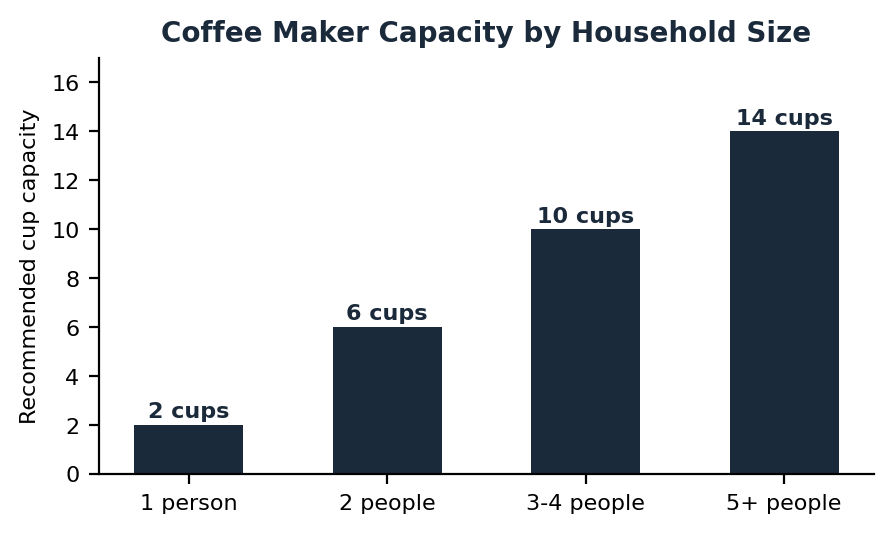
- One person: a single-serve pod machine or a 1-2 cup drip maker. No reason to own an 8-cup carafe that’s a quarter full most mornings.
- Two people: a mid-size single-serve machine, or a small 4-6 cup drip maker if you both drink at the same time.
- Three to four people: a full 8-10 cup drip machine, or a dual-brew system that handles single cups and a full carafe without needing two separate appliances.
- Five or more: a 12-14 cup drip machine, sized to the number of people who actually drink coffee, not the full headcount of the house.
That last point matters more than it sounds. If two people in a household of four drink coffee and the other two don’t, size the machine to the two coffee drinkers. A 12-cup machine brewed for two people just means reheated, bitter coffee by mid-morning, the same hot-plate problem covered in the types of coffee makers breakdown below.
Weekday-versus-weekend mismatches are common too. A household that drinks two cups on a rushed Tuesday but hosts a full pot on Sunday needs something flexible enough for both, not a machine sized for the average of the two. This is exactly what a dual-brew system solves: it switches between one pod and a full carafe instead of forcing you to own two machines.
Budget Coffee Makers: What You Get at Each Price Point
A budget coffee maker under $50 and a $400 espresso machine aren’t competing for the same buyer, so stop comparing them on the same list. Set your price ceiling before you start browsing, not after three hours of open tabs, since that’s the step most buyers skip in any coffee maker buying guide.
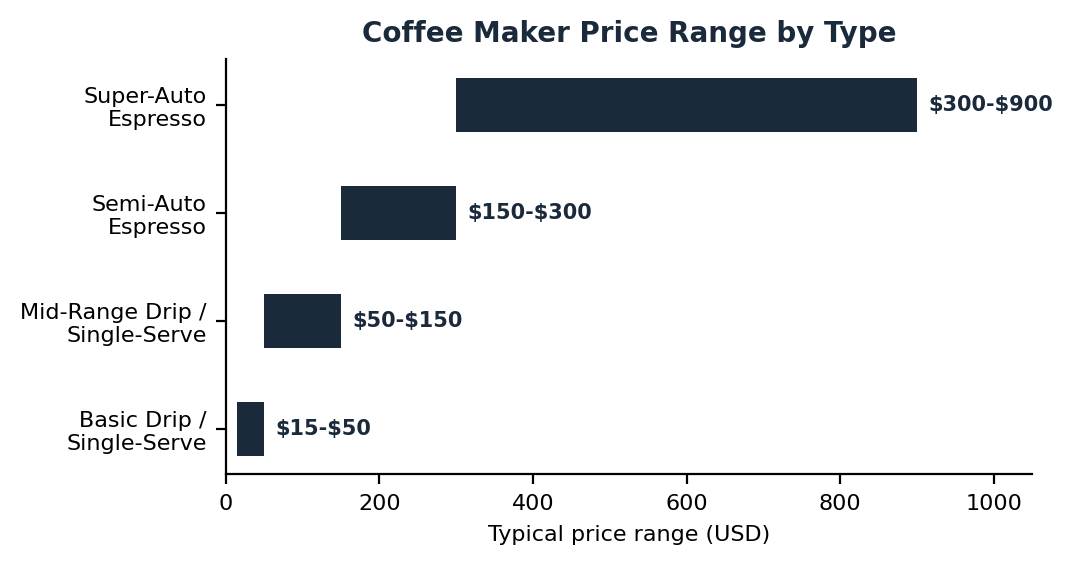
- $15 to $50: basic drip machines and entry single-serve machines. Simpler plastic components, fewer programmable features, and (the thing spec sheets never mention) a hot plate that keeps cooking the coffee after it’s done brewing.
- $50 to $150: where most well-reviewed drip and single-serve machines live, often with a built-in grinder and steadier brew temperature.
- $150 to $300: semi-automatic espresso machines and premium drip machines with real flow control enter here.
- $300 and up: automatic and super-automatic espresso machines, plus commercial-grade drip machines.
Consumer Reports rates more than 150 coffee makers through independent lab evaluations, and its own scoring backs up what that price breakdown implies: price alone rarely predicts where a machine lands on overall performance (Consumer Reports).
Ongoing costs get missed constantly. Pod-based single-serve machines cost more per cup over years than drip or pour-over, since every pod carries a premium over bulk ground coffee.
Espresso machines add descaling solution, replacement water filters, and, for semi-automatic models, a separate grinder if one isn’t built in. Budget a rough annual maintenance line item rather than judging purely on the sticker price.
If real espresso at home is the actual goal and $150-$200 is the ceiling, our budget espresso machine roundup covers four models we’ve verified against exactly that price point.
What to Look for in a Coffee Maker: Features Worth Paying For
Not every feature earns its price tag. Some of the priciest add-ons barely change what ends up in the cup, and this is where most buyers overspend without noticing.
This is also the section of any coffee maker buying guide where a budget coffee maker and a premium one start to look more alike than different. The table below separates the features that change your daily routine from the ones that just look impressive on a box.
| Feature | Worth it when… |
| Programmable timer | You want coffee brewing before you’re out of bed. Common even on mid-range machines now. |
| Built-in grinder | Fresh-ground flavor matters daily. Skip it if you already own a grinder you like, see our coffee grinder picks for standalone options. |
| Water filtration | Your tap water has any noticeable taste. Affects flavor more than most buyers expect. |
| Auto shut-off | You tend to forget the pot. Stops a hot plate from stewing coffee after 20-30 minutes. |
| Thermal carafe | You drink your coffee slowly. Keeps it hot for one to two hours with vacuum insulation instead of an active heating element, so it can’t scorch the way a glass carafe on a hot plate does. |
| Brew strength control | The household disagrees on strength. Adjusts extraction without changing the actual coffee-to-water ratio. |
Water temperature is the feature almost nobody checks, and it’s the one with the biggest effect on taste. The Specialty Coffee Association’s Golden Cup Standard calls for water at 195-205°F at the point of contact with the grounds, most budget drip machines run closer to 175-185°F, which under-extracts the coffee and produces a flat, slightly sour cup no matter how fresh the beans are (Specialty Coffee Association).
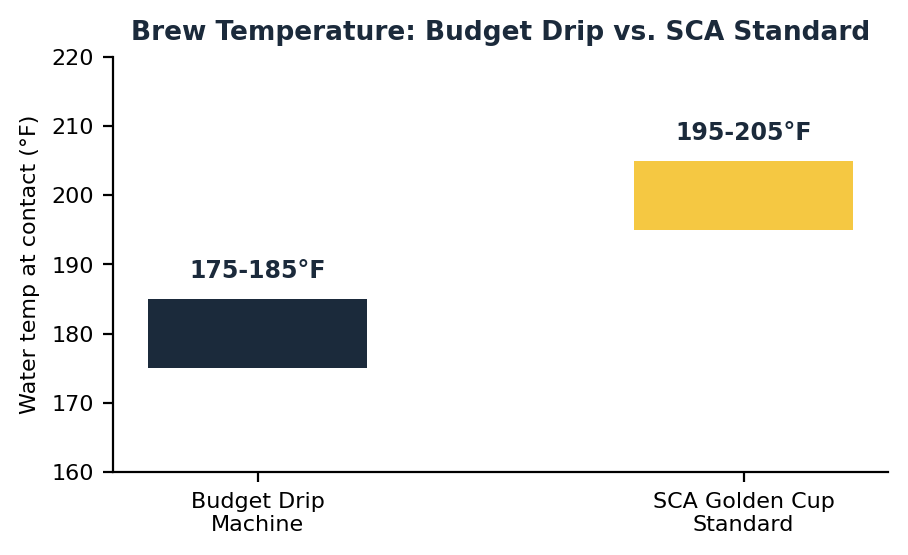
If a listing doesn’t mention brew temperature or SCA certification at all, assume it’s on the low end of that range. It’s a genuinely useful filter for narrowing a shortlist of drip machines that otherwise look identical on paper.
It’s tempting to want every feature on this list at once, but stacking all of them onto one machine usually pushes it into the next price tier. Pick the two or three that solve an actual daily annoyance and treat the rest as optional.
Brew Style: Drip, Single-Serve, Espresso, Pour-Over, or Cold Brew
Once volume, budget, and features are settled, brew style is the next filter in any coffee maker buying guide. Each style produces a genuinely different cup, not just a differently shaped machine. Our full types of coffee makers breakdown covers every method in depth; here’s the short version plus our four verified manual-brewing picks.
Drip suits volume and simplicity. Single-serve suits convenience and variety, and it’s worth reading our Keurig vs. Nespresso comparison before picking a pod system, since the two brands solve different problems.
Espresso suits anyone chasing café-quality drinks without leaving the kitchen. Our espresso machine vs. drip coffee maker guide goes deeper on that trade-off.
If you’re just getting into home coffee at all, start with our best coffee makers for beginners picks instead of jumping straight to a semi-automatic espresso machine.
The Hario V60 Dripper 02 is the one to buy if you want pour-over specifically: 4.7 stars across 12,076 ratings, no Amazon’s Choice badge but 1,000+ purchases a month, which is a lot for a category most people think of as niche. Buyers love the ceramic build and the taste, and Amazon’s own review summary calls out mixed durability, a verified 3-star review says they “won’t even set the thing down in my sink for fear it will shatter,” which tracks with the ceramic being genuinely thin. Handle it the way you’d handle a wine glass, not a mug.
For French press, the Bodum Chambord French Press is Amazon’s Overall Pick in the category at 4.6 stars across 28,811 ratings and 1,000+ purchases a month. The most specific complaint in its reviews, direct from a verified buyer: “the filter mechanism tends to unscrew itself too easily” mid-pour, which Amazon’s own “Customers say” summary echoes as mixed durability on some units. It’s a real quirk, not a dealbreaker, tighten the plunger assembly before every pour and it stops being an issue.
Cold brew makers solve a different problem entirely: smooth, low-acid iced coffee that hot-brewed methods can’t replicate even when poured over ice afterward. Our full cold brew coffee maker guide covers the category; for a single pick, the OXO Good Grips Cold Brew Coffee Maker is Amazon’s Overall Pick here too, at 4.5 stars and 600+ purchases a month. Reviewers say the taste rivals café cold brew, though a verified 3-star reviewer notes “sometimes the water runs right through” instead of brewing at the expected pace, usually fixed with a slightly finer grind on the next batch.
Percolators are the one brew style everyone’s grandparents used and nobody talks about anymore, which is a shame: the Farberware Electric Percolator is the #1 Best Seller in its category at 4.1 stars across 12,787 ratings and 2,000+ purchases a month. It makes a stronger, more aromatic cup than most drip machines in about ten minutes.
A verified 3-star review flags that “the interior has shown signs of rust and did so very early on.” Dry the basket fully after every use rather than letting it air-dry wet, and that mostly goes away. Our full percolator guide covers care in more depth.
None of these five styles are objectively better than the others. A household that values ritual over speed often prefers pour-over even when a drip machine would save five minutes every morning. That’s a reasonable trade, not a mistake.
Coffee Maker for Small Space Kitchens
Machine footprint gets overlooked until the box arrives and doesn’t fit under the cabinet. Measure your counter space before buying, including the clearance needed to lift the lid or refill the water reservoir, not just the closed-box dimensions on the listing.
A coffee maker for small space kitchens has to work around real constraints: narrow counter runs, low upper cabinets, and outlets that aren’t always where you’d want them. This is one part of the coffee maker buying guide worth measuring twice, since a return shipment on an oversized machine erases whatever you saved on price.
Renters searching for a coffee maker for small space setups should also check cord length and whether the machine needs a dedicated outlet, since older apartment kitchens are often short on both.
If you’re shopping specifically for a coffee maker for a small space, single-serve machines and compact drip makers under 6 cups have the smallest footprint in the category, generally under a foot wide. Larger drip machines and semi-automatic espresso machines are the most common source of surprise sizing issues, since their footprint often looks compact in product photos but grows once you account for the water reservoir door swinging open.
Cord length and cabinet clearance matter too, especially for espresso machines with steam wands that need extra headroom to angle a milk pitcher underneath (worth checking against our milk frother reviews if steamed milk drinks are part of your routine). Check the height with the lid open, not just the closed dimensions listed on the box, and confirm the outlet you’re planning to use can reach without an extension cord running across the counter.
Common Coffee Maker Buying Mistakes to Avoid
A handful of mistakes show up again and again in coffee maker reviews and return statistics, and most are avoidable by checking one extra detail before checkout. A budget coffee maker is not immune to any of these; if anything, the cheaper the machine, the more these details tend to matter.
- Buying for guests: sizing a machine for occasional visitors who show up twice a year instead of the people who use it every single day.
- Ignoring the refill process: some machines require removing the entire reservoir to refill it, which is awkward under a low cabinet.
- Skipping the descaling requirement: hard water areas need more frequent descaling, and skipping it shortens the life of any machine regardless of price. If you already own a grinder, our grinder cleaning guide covers the same buildup problem on that side of the routine.
- Assuming price cuts upkeep: every coffee maker still needs regular cleaning, and premium machines aren’t exempt from basic maintenance.
- Overlooking noise level: semi-automatic espresso machines with steam wands can run loud enough to wake a sleeping household, which matters more in an open-plan apartment than a detached house.
- Forgetting warranty terms: budget machines often carry a one-year warranty while premium models stretch to two or three, which changes the real cost if something fails early.
None of these are dramatic alone, but they add up to buyer’s remorse faster than a mediocre cup of coffee ever would. Most trace back to skipping the earlier sections of this coffee maker buying guide and jumping straight to a listing, slowing down for five minutes on volume, budget, and features first heads off nearly all of them.
How to Pick a Coffee Maker for Your Kitchen and Lifestyle
With volume, household size, budget, features, brew style, and counter space all accounted for, here’s how a coffee maker buying guide should end: one table, not twenty open tabs. Match your situation to the closest row below, then use that category as your starting filter once you start browsing listings.
| Match Your Situation to a Coffee Maker Type | ||
| Solo drinker, tight budget | Single-serve pod machine | Lowest cost per cup, minimal counter space |
| Family of 3-4, mixed preferences | Dual-brew machine or full drip | Covers both individual servings and full pots |
| Home barista chasing café quality | Semi-automatic espresso machine | Full control over shot and steam |
| Slow-morning ritual | Pour-over or French press | No electricity needed, full manual control |
| Iced-coffee household | Cold brew maker | Purpose-built for cold extraction flavor |
If more than one row describes your household, prioritize whichever situation happens most often during the week. A once-a-month latte craving shouldn’t drive a decision that a daily drip habit is better positioned to make.
Which Coffee Maker Is Right for You? A Quick Decision Guide
Deciding between pod machines specifically? Our Keurig vs. Nespresso comparison breaks down cost per cup and convenience differences in more detail than this coffee maker buying guide has room for.
Furnishing a kitchen from scratch and coffee is just one line item on a longer list? Our kitchen appliances every new home needs guide covers where a coffee maker fits against everything else on the counter.
For anyone still torn between drip and single-serve, the honest answer is simple: buy based on how many cups you actually drink most days, not how many you think you should drink. Revisit the household size section above if you’re still unsure: that single answer resolves more close calls than any spec comparison will.
Best Coffee Maker Under $100: What You Actually Get
Under $100 buys a genuinely solid drip machine or single-serve pod system. This isn’t a compromise tier; it’s where most well-reviewed everyday machines actually live, and where this coffee maker buying guide sends most solo and two-person households by default. What it usually doesn’t buy: a built-in burr grinder, SCA-range brew temperature as standard, or a thermal carafe, though a handful of models in the $70-$100 band include one of those three.
The best coffee maker under $100 for most households is a mid-range drip or single-serve machine with a programmable timer and auto shut-off: the two features that matter daily, rather than the ones that sound impressive on a box. If a built-in grinder matters more to you than price, expect to spend closer to $120-$150 for a grind-and-brew model that doesn’t feel like a downgrade in either function.
Frequently Asked Questions
What’s the most important factor in a coffee maker buying guide?
Daily coffee volume matters more than any single feature or price point, since it determines the size and style of machine you actually need. Every other factor, including budget, features, and brew style, narrows the field within whichever size category fits that volume.
What’s the best coffee maker for one person?
A single-serve pod machine or a compact 1-2 cup drip maker is the best coffee maker for one person, since it avoids a half-full reservoir sitting stale for days. Anything larger than 4 cups typically means reheating or dumping unused coffee by the second day.
What’s the best coffee maker under $100?
A mid-range drip or single-serve machine with a programmable timer and auto shut-off is the best coffee maker under $100 for most households, since those two features affect daily use more than any spec that sounds impressive on the box. A built-in grinder at this price is rare and usually means a trade-off elsewhere.
Final Verdict
A coffee maker buying guide only earns its keep if you answer the volume question honestly before anything else. Budget, features, brew style, and counter space are all secondary to that one number.
Start with how much you drink, match capacity and budget to that number, then let brew style and features narrow the last few options. If you land on manual brewing, the Bodum Chambord French Press and Hario V60 Dripper above are the two most people end up with, and both are verified in stock as of this guide’s last update.
That’s the whole case for using a coffee maker buying guide instead of a bestseller list: fit beats popularity every time it actually gets used, and for a coffee maker, that’s every single morning.
This post contains affiliate links. As an Amazon Associate, homeapplianceowl.com earns from qualifying purchases at no extra cost to you.