
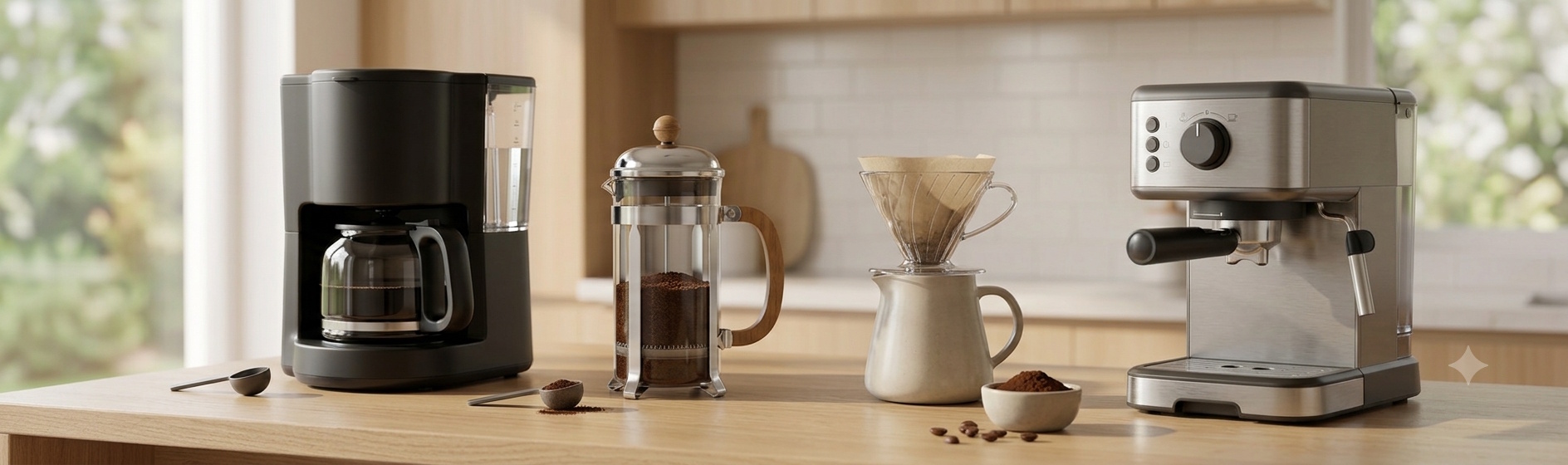
Types of coffee makers fall into seven core categories, and the mistake that costs people the most has nothing to do with picking the wrong brand. It’s matching the wrong machine to a household that doesn’t need it. A 12-cup drip pot sits mostly empty in a one-person apartment, and a single-serve pod machine turns into a bottleneck the moment three people need coffee before 8 a.m.
If you just want a dependable starting point while you read the rest of this guide, the Mr. Coffee 12-Cup Coffee Maker is the safest default: rated 4.4 stars across more than 44,700 verified buyers, priced under $34, and sized for the two most common household situations, a solo drinker and a family of four. The rest of this guide explains exactly when that default is the wrong call, and which of the other six types should replace it instead.
Types of coffee makers break down into seven core categories, and for most households the drip machine remains the strongest default. It brews 8 to 12 cups for under $34, needs zero technique, and beats every other style on three-year cost per cup, at roughly $198 total including grounds.
This guide sticks to the seven types that cover nearly every kitchen counter in the U.S.: drip, single-serve, espresso, French press, pour-over, cold brew, and percolator. Two hybrid styles are worth knowing about even though they don’t get their own section here.
Combination machines pair an espresso maker with a drip pot in one body. Grind-and-brew machines add a built-in grinder ahead of the brew basket. Both blend two categories into one appliance and deserve a dedicated comparison of their own rather than a rushed afterthought.
Table of Contents
- Top Picks at a Glance
- What to Look For
- Drip Coffee Makers
- Single Serve Coffee Maker
- Espresso Machines
- French Press
- Pour Over Coffee Maker
- Cold Brew Coffee Maker
- Percolator Coffee Maker
- Side-by-Side Comparison
- The Real 3-Year Cost of Each Type
- Which Type Fits Your Life
- Which One Should You Choose
- FAQ
- Final Verdict
Top Picks at a Glance: 7 Coffee Maker Varieties Compared
The best picks among these coffee maker varieties depend entirely on how many people are drinking and how much control they want over the final cup. Every price, rating, and badge below was checked live on Amazon on September 15, 2026, with delivery set to a U.S. ZIP code, not pulled from a cached snippet.
| Type | Pick | Price | Rating | Bought/Mo | Check Price |
|---|---|---|---|---|---|
| Drip | Mr. Coffee 12-Cup | $33.99 | 4.4★ (44,708) | 6K+ | Check Price |
| Single Serve | Keurig K-Mini Mate Plus | $109.00 | 4.5★ (414) | 800+ | Check Price |
| Espresso | Casabrews CM5418 | $139.99 | 4.3★ (8,013) | 4K+ | Check Price |
| French Press | Bodum Chambord 34oz | $39.69 | 4.6★ (28,815) | 1K+ | Check Price |
| Pour-Over | HARIO V60 Dripper 02 | $28.25 | 4.7★ (12,078) | 1K+ | Check Price |
| Cold Brew | OXO Good Grips 32oz | $49.99 | 4.5★ (3,435) | 600+ | Check Price |
| Percolator | Farberware Electric 8-Cup | $69.99 | 4.1★ (12,791) | 2K+ | Check Price |
Two things changed since these picks were last checked. The Keurig K-Mini Mate Plus climbed to $109 from roughly $90, and the Farberware percolator now carries an Amazon’s Choice badge it didn’t have before.
Neither change affects which type fits which household. It just means the figures above are current as of this week, not left over from an earlier price check.
What to Look For When Choosing Between Types of Coffee Machines
Before comparing types of coffee machines side by side, or shopping by brand name alone, run through these six questions. They narrow the field faster than any spec sheet, and they’re the actual reasons buyers end up returning the wrong machine within a month.
How Many Cups Do You Actually Drink?
Among the different types of coffee makers here, one or two cups a day points toward a single serve coffee maker or a small pour-over dripper, anything with a reservoir under 20 ounces. Three or more coffee drinkers do better with a drip machine or a larger percolator that brews 8 to 12 cups in one run. Refilling a single-serve reservoir four times before 9 a.m. defeats the entire reason to buy one.
Effort vs. Convenience
Among these coffee maker varieties, pour-over and French press both ask for a few extra minutes of hands-on attention, heating water to a specific temperature, pouring in slow circles, or timing a four-minute steep. Drip and single serve coffee makers are built for pressing one button and walking away, which is a large part of why they outsell manual methods in most American kitchens. If you’re weighing a manual upgrade against your current machine, our best coffee makers for beginners guide covers the gentlest entry points.
Budget and Ongoing Cost
Across every one of these types of coffee makers, the machine’s price tag is only half the story. Pod machines add a real per-cup cost near $0.55 for K-Cups, espresso machines need fresh beans plus roughly $10 a year in descaling solution, and manual brewers like the French press or pour-over dripper cost close to nothing beyond paper filters or a reusable mesh screen. The 3-year cost breakdown further down this page puts exact dollar figures on that gap, and it changes the ranking more than most buyers expect.
Counter Space and Cleanup
Among these types of coffee makers, espresso machines and 12-cup drip makers both claim close to a foot of counter depth once you add the plug and the cord clearance behind them. Manual brewers like the pour-over dripper or French press store flat in a cabinet drawer and rinse clean under running water in under a minute, no dishwasher cycle required.
Taste Control and Customization
Among these types of coffee machines, manual methods hand you the most control. Water temperature, grind size, steep time, and pour speed all shift the final flavor with a pour-over dripper or French press. Drip and single serve coffee makers automate those variables for consistency, which is convenient every morning but leaves little room to fine-tune a specific bean.
Espresso sits in the middle. You control the grind and the tamp. The machine takes over pressure and temperature once the shot starts.
Acidity and How It Feels on Your Stomach
Brew method changes acidity more than most people expect. Hot extraction methods like drip and percolator pull more acidic compounds out of the grounds, which is part of why some coffee drinkers report stomach discomfort with them.
Cold brew’s room-temperature steep extracts fewer of those compounds, which is the main reason it’s often described as smoother and easier on the stomach at a similar caffeine strength. A 2018 peer-reviewed study in Scientific Reports found no major pH difference between hot and cold extraction, but measured meaningfully higher titratable acid in hot brew, the property more closely tied to that sharp, acidic bite drinkers actually notice.
This is a general pattern reported by drinkers and partially supported by that research, not a medical claim. Anyone with a diagnosed digestive condition should raise it with a doctor rather than a coffee blog. For broader context on how Americans drink coffee day to day, the National Coffee Association’s National Coffee Data Trends report remains the longest-running survey on the subject.
Does Grind Size Really Matter for Coffee Makers?
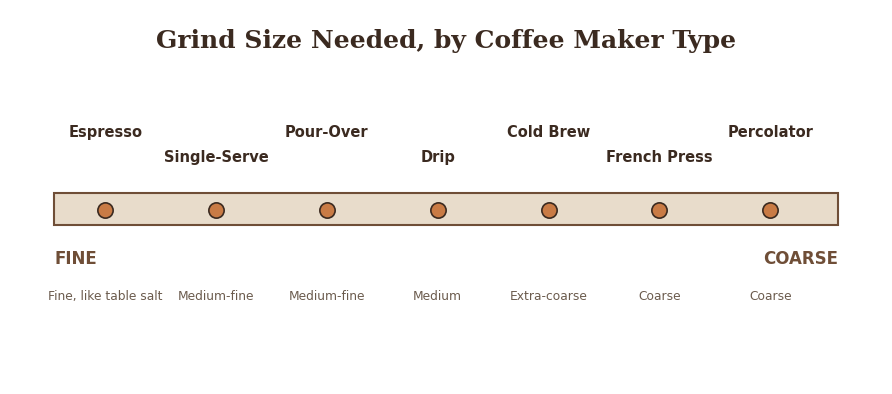
Yes. Grind size is the single biggest variable separating good and bad results across every one of these types of coffee makers. Using the wrong one is the single most common reason a new coffee maker tastes worse than the one it replaced.
A grind too fine for a French press over-extracts into a bitter, muddy cup with grounds stuck in your teeth. A grind too coarse for an espresso machine under-extracts into a thin, sour shot with no crema, because the water pushes through in under 15 seconds instead of the 25 to 30 seconds it needs at 9 bars of pressure.
Espresso needs a grind close to table salt. Single-serve pods and pour-over both want medium-fine. Drip sits at a true medium.
French press, percolator, and cold brew all need coarse to extra-coarse grounds so the extra steep or boil time doesn’t over-extract them. Buying a bag labeled only “drip grind” and using it in a French press or percolator is exactly how a lot of buyers end up with bitter, gritty coffee and blame the machine instead of the bag. If your grinder itself is the weak link, our best coffee grinder picks cover every one of these grind ranges in one machine.
How Long Does It Take to Brew a Full Pot of Coffee?
A 12-cup drip pot takes 8 to 10 minutes start to finish, and a single serve coffee maker takes 1 to 2 minutes per cup. Everything else falls in between depending on how much of that time is hands-on versus unattended, which matters more than the raw total once you factor in a real morning.
An espresso shot itself takes 25 to 30 seconds once the machine is warmed up, but steaming milk for a latte adds another 3 to 5 minutes of active work. French press needs a 4-minute steep before you press the plunger. Pour-over runs 3 to 4 minutes of active pouring.
Percolators need 7 to 10 minutes for a full 8-cup batch. Cold brew is the outlier at 12 to 24 hours of steep time, but only about 5 minutes of actual hands-on effort, since the rest happens unattended in the fridge or on the counter. If steeping overnight isn’t practical, our handheld milk frother guide pairs well with a faster hot-brew method for iced drinks made on demand.
Drip Coffee Makers
Drip machines remain the default among all types of coffee makers for a reason. Add water and medium-ground coffee, press one button, and 8 to 12 cups are ready in under 10 minutes with almost no learning curve. Our best drip coffee maker roundup covers picks across every price tier if you want a deeper comparison than the single pick below.
The Mr. Coffee 12-Cup is a fair example of what this category does well: a glass carafe, a pause-and-serve feature, and a sub-$34 price tag that undercuts almost every other style on this list. The trade-off is control.
You can’t adjust water temperature or steep time the way you can with a pour-over dripper, and the coffee tastes noticeably flatter if the grind is too fine or too coarse for its basket. A verified 3-star buyer reports grounds occasionally ending up in the finished coffee when brewing a full 12-cup batch, worth knowing if you always brew at full capacity rather than 4 to 6 cups.
Maintenance is minimal: a monthly vinegar-and-water descale cycle is typically all a drip machine needs to avoid mineral buildup in hard-water areas. Skip that step for six months or more and expect a slower brew cycle and a metallic aftertaste, the most common complaint in drip machine reviews once a unit passes the one-year mark. Consumer Reports’ 2026 coffee maker testing groups basic drip machines among the easiest small appliances to keep running reliably, which lines up with why they remain the category’s best-selling type year after year.
Single Serve Coffee Maker: Best for One-Person Households
A single serve coffee maker exists for exactly one job: one fresh, hot cup in under two minutes with zero cleanup beyond tossing a pod. That convenience carries a real per-cup cost, closer to $0.55 a pod at typical K-Cup pricing versus roughly $0.15 a cup for bulk-ground drip coffee. If you’re comparing a pod machine against a Nespresso-style capsule system instead, our Keurig vs Nespresso comparison breaks down that cost gap over five years.
The Keurig K-Mini Mate Plus is under 5 inches wide, brews over ice or hot, and holds enough water in its 50 oz reservoir for several cups before refilling, a genuine upgrade over the base K-Mini for dorms, small kitchens, or a second brewer in the office. A verified 3-star reviewer notes the smallest available brew size, 8 ounces, is too large for a single K-Cup pod, which leaves the coffee tasting watery unless you brew into a smaller mug and top it off with less water than the default setting suggests.
Reusable pod adapters are widely available too, which cuts the per-cup cost significantly if you’re willing to add your own medium-fine grounds instead of buying pre-filled K-Cups every time. Among the different types of coffee makers on this list, single-serve is the only one built entirely around individual portions rather than a shared pot. That kind of flexibility is rare across types of coffee machines built around proprietary pod systems.
Espresso Machines
Espresso machines sit among the more premium types of coffee makers on this list. They pull concentrated shots under 9 or more bars of real pressure, and most home models double as a milk-frothing station for lattes and cappuccinos. For a direct look at how this style stacks up against a standard drip pot, see our espresso machine vs drip coffee maker breakdown.
The CASABREWS CM5418 runs a 20-bar Italian pump and a steam wand in a compact stainless-steel body, which is a big part of why it currently sells roughly 4,000 units a month and holds the #1 Best Seller spot in its Amazon category. A verified 3-star reviewer reports the machine overheats after a batch and needs close to 30 minutes to cool down before it can brew again, a real limitation if two people in the house both want espresso back to back rather than one person brewing once.
Pre-ground espresso works fine to start, but a dedicated grinder set to a fine, table-salt-like grind makes a noticeably bigger difference here than with almost any other type on this list. The Specialty Coffee Association’s own brewing standards treat grind consistency as the single biggest lever on extraction quality, ahead of the machine itself. If the steam wand and steep learning curve feel like more than you want, our budget espresso machine picks include simpler alternatives under $100.
French Press
Among coffee maker varieties built for zero-frills brewing, a French press steeps coarse grounds directly in hot water for about four minutes before you press the plunger down. No paper filter means the coffee’s natural oils stay in the cup, which is why French press coffee tastes noticeably fuller-bodied than drip.
Using a fine, drip-style grind here instead of coarse is the single fastest way to end up with a muddy, over-extracted cup. For a wider lineup of options in this style, our best French press roundup covers picks at every price point.
The Bodum Chambord 34oz is the design most people picture when they hear “French press”: a polished stainless steel frame, a borosilicate glass carafe, and a stainless mesh filter with no electricity required. It’s also genuinely portable for camping or travel since there’s nothing to plug in, and at under $40 it’s one of the cheapest types on this whole list to buy outright.
We covered this exact model in more depth in our full Bodum Chambord review. A verified 3-star reviewer who replaced a 35-year-old unit of the same line reports the current metal cage is thinner stamped metal compared with the sturdier chromed frame on older models, worth a gentle hand when you set it down on a hard counter.
Cleanup takes about a minute: rinse the beaker and filter under running water right after pressing, since letting used grounds sit makes the mesh harder to clean later. The glass carafe is the one part to handle carefully. It’s the most common failure point owners mention over years of daily use, so treat it the way you’d treat any glass mug rather than a stainless one.
Pour Over Coffee Maker: Best for Coffee Purists
Of all the types of coffee pots on this list, a pour over coffee maker gives you the most direct control of any brewing method: water temperature, pour speed, and exactly how long the water sits with the grounds. That control is also the catch. Technique matters more here than with any machine on this list, and a rushed, uneven pour is the most common reason a first attempt tastes sour or weak.
The HARIO V60 Dripper 02 is the most widely used pour-over dripper for a reason: a large single hole and spiral ribbing let water flow through evenly instead of channeling around the edges. A verified 3-star reviewer describes the ceramic as feeling a bit low-grade and brittle for the price, and notes Hario’s own instructions call for letting freshly boiled water cool briefly before pouring, a small extra step compared with most other manual brewers that brew straight off the boil.
Once you settle on a medium-fine grind and a slow, circular pour, results get noticeably more consistent within the first few tries. If a manual pour-over cone still feels like too much fuss, the Technivorm Moccamaster automates the same pouring principle in an electric machine.
Cold Brew Coffee Maker: Best for Make-Ahead Iced Coffee
Among all types of coffee makers, a cold brew coffee maker is the one built around a weekly rhythm rather than a daily one. It steeps extra-coarse grounds in room-temperature or cold water for 12 to 24 hours instead of using heat to extract flavor. The result is a smoother, noticeably less acidic concentrate that you dilute with water, milk, or ice whenever you want a glass.
Is Cold Brew Coffee Healthier Than Hot Brewed Coffee?
Not healthier in any measurable nutritional sense, but it is genuinely gentler on the stomach for people sensitive to acidity. The cold, slow extraction pulls out fewer acidic compounds than hot water does, which is why some drinkers who get heartburn from drip coffee don’t react the same way to cold brew. That’s a reported pattern, not a clinical claim, so anyone with a real digestive diagnosis should check with a doctor rather than a blog.
The OXO Good Grips 32oz uses a rainmaker top to distribute water evenly over the grounds and a release switch to stop filtration the moment you pull the carafe out, which keeps the concentrate from over-extracting while you sleep. A verified 3-star buyer reports the plastic reservoir builds up static electricity, which scatters loose coffee grounds around the counter while loading the filter, worth doing over a sink or a towel rather than directly above the counter. One batch makes roughly 12 to 14 drinks, so this is the type built for stocking the fridge once a week rather than brewing daily.
Percolator Coffee Maker: Best for Old-School, Strong Coffee
Of all the types of coffee makers in this guide, the percolator is the closest modern equivalent to stovetop coffee. It cycles boiling water up through a tube and back down over coarse grounds repeatedly until the coffee reaches full strength, the same basic design your grandparents likely used. It produces a bolder, hotter cup than drip, though the repeated boiling can tip into bitterness if you let it run past about 10 minutes.
The Farberware Electric 8-Cup automates the process: load the basket, fill the reservoir to the marked line, and it percolates roughly a cup a minute before switching to a keep-warm setting on its own. This is also the one type of coffee maker in this guide with a real, well-documented reliability gap.
The listing’s own rating breakdown shows exactly 12% of reviews at 1 star, noticeably higher than any other pick here, with buyers most often reporting the unit stops heating properly or fails outright somewhere between month two and month twelve. A verified 3-star reviewer separately reports early interior rust spots despite otherwise easy daily use, a second data point pointing at the same build-quality gap. Registering the warranty the day it arrives is worth the five minutes it takes.
That reliability gap is exactly why the percolator is the one type of coffee maker worth buying from a retailer with an easy return policy rather than a marketplace reseller.
Side-by-Side Comparison: Types of Coffee Pots at a Glance
Whichever of these types of coffee pots you’re weighing, every one of them trades speed, control, or cost against the others. None wins on all three at once. This table lines up all seven types of coffee makers side by side so you can see exactly where each one gives something up.
| Type | Active Time | Control Over Brew | Running Cost | Best For |
|---|---|---|---|---|
| Drip | ~3 min | Low | Low | Households, everyday use |
| Single Serve | ~1 min | Low | High (pods) | One or two people |
| Espresso | ~5 min | High | Medium (beans) | Latte and cappuccino fans |
| French Press | ~5 min | Medium | Very low | Full-bodied, no-frills brewing |
| Pour-Over | ~4 min | Highest | Very low | Purists who enjoy the process |
| Cold Brew | ~3 min (+ unattended steep) | Medium | Low | Make-ahead iced coffee |
| Percolator | ~8 min | Low | Low | Strong, old-school coffee |
Notice that pour-over and French press sit at “very low” running cost while carrying the lowest machine prices on the entire list. That combination is the main reason coffee enthusiasts often end up owning one of these two styles as a backup, even after buying an espresso machine or a single-serve pod system for daily convenience. It’s one of the clearest patterns across these types of coffee pots once running cost gets counted instead of just the price tag.
The Real 3-Year Cost of Each Type
Machine price is the number on the box, but across these types of coffee pots it’s rarely the number that matters most over time. Assuming one cup a day for three years, 1,095 cups total, the chart below adds each type’s realistic filter or pod cost on top of its purchase price, and the ranking flips almost completely.
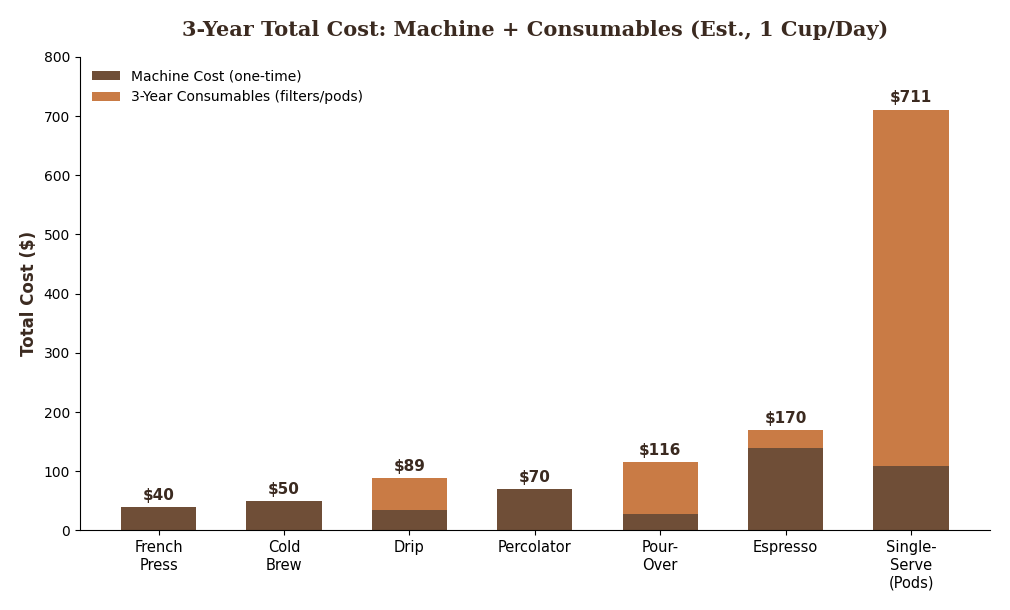
A $109 single serve coffee maker looks like the cheap, low-commitment option next to a $140 espresso machine, until you count pods. At roughly $0.55 a K-Cup, three years of daily single-serve coffee runs about $602 in pods on top of the machine, for a total near $711.
A French press or pour-over dripper costs under $40 once and effectively nothing after that beyond filters. That’s a difference of roughly $520 to $671 over three years, or about what a household would spend on 170 to 220 café lattes.
This doesn’t mean single serve coffee makers are a bad buy. For someone who values two minutes over everything else, that’s a fair trade. It does mean the sticker-price comparison most coffee maker varieties roundups stop at is telling you less than half the story.
Which Type Fits Your Life?
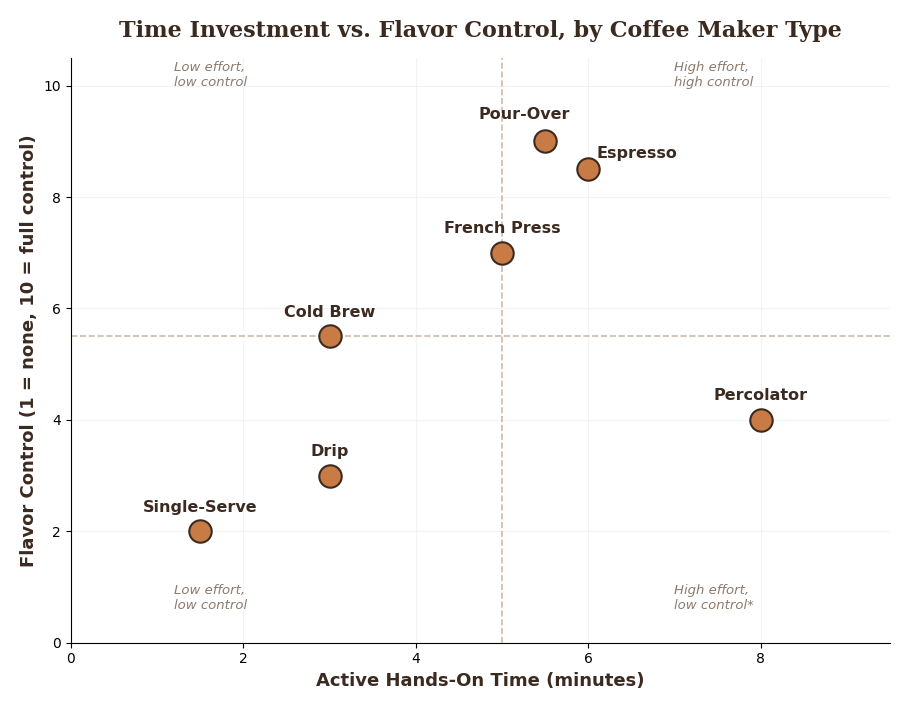
Comparing types of coffee makers on paper only goes so far. This chart plots active hands-on time against how much control you get over the final flavor, so you can see at a glance which quadrant matches how you actually want to spend your morning. It’s also a fast way to compare coffee maker varieties you’d never otherwise put side by side, like a percolator against a pour-over dripper.
- Live alone with zero interest in cleanup? A single serve coffee maker gets you a fresh cup in under two minutes with nothing to wash but a mug.
- Feeding a family every morning? A drip coffee maker brews 8-12 cups at once for less upfront cost than almost anything else here.
- Want café-style lattes at home? An espresso machine with a steam wand is the only type built for milk-based drinks.
- Care about flavor more than speed? A pour over coffee maker or French press both give you more control than any automatic machine.
- Drink iced coffee daily in summer? A cold brew coffee maker lets you batch a week’s worth of concentrate in one sitting.
- Want zero electricity involved? The French press and pour-over dripper both work anywhere, including camping trips.
- Miss stovetop coffee from childhood? A percolator coffee maker is the closest modern equivalent, with the caveat that it also carries the highest 1-star rate of these seven picks.
Which One Should You Choose Among These Types of Coffee Makers?
Choosing among these types of coffee makers gets easier once you stop looking for a single best type of coffee maker and sort yourself into one of these three groups instead.
Choose Drip If…
- Simplicity matters more than customization.
- Multiple people in your household drink coffee each morning.
- Budget is the deciding factor over features.
Choose French Press or Pour-Over If…
- Flavor control matters more than speed.
- Counter space is limited and storage matters.
- Running cost needs to stay close to zero. See the 3-year cost chart above for exactly how much that saves.
Choose Single-Serve or Espresso If…
- Speed and convenience outweigh per-cup cost.
- Milk drinks like lattes are part of your routine (espresso), or you want both in one body. Our best Ninja coffee maker roundup covers the combination espresso-and-drip machines that split the difference.
- Only one or two people drink coffee in your home, and you’ve narrowed it down to a specific model like the Keurig K-Mini rather than the category as a whole.
Common Mistakes When Switching Types
Buyers who upgrade from drip to a manual method are often surprised the first week doesn’t taste better right away. A pour-over dripper or French press only outperforms drip once the grind size and steep time are dialed in, so expect a short adjustment period rather than an instant upgrade. The grind size breakdown above is the fastest fix for this specific complaint.
Across every one of these types of coffee makers, the second common mistake is sizing the machine to the household instead of to actual daily habits. A family of four who all drink one weekend cup doesn’t need a 12-cup drip machine any more than a solo drinker needs a compact single-serve unit if they’re regularly hosting guests. If you’re furnishing a kitchen from scratch, our kitchen appliances every new home needs guide walks through the rest of that sizing logic beyond just coffee.
Finally, buyers moving into espresso for the first time often underestimate the learning curve on the steam wand specifically. Pulling a decent shot comes fairly quickly, but texturing milk into smooth microfoam typically takes several attempts before it clicks. Budget a few practice sessions before judging the machine on its cappuccino, and keep a small kitchen scale nearby since dose consistency matters more than any single setting on the machine itself.
FAQ
A few questions come up more than any others once buyers start comparing these seven types of coffee makers directly. Here they are, answered without the hedging.
What type of coffee maker is best for beginners?
Among these types of coffee makers, a drip coffee maker or single-serve pod machine is best for beginners because both require no technique to get a consistent result. You add water and grounds, or a pod, press one button, and the machine handles temperature and timing, unlike a pour-over or French press, which reward practice and punish the wrong grind size.
Which type of coffee maker makes the strongest coffee?
Espresso and percolator coffee makers both produce the strongest cups, though for different reasons. Espresso concentrates flavor through 9-plus bars of pressure into a small, intense shot, while a percolator repeatedly cycles boiling water through the grounds until the brew reaches full strength over 7 to 10 minutes. These two sit at opposite ends of the types of coffee machines covered in this guide, one built on pressure and the other on repetition.
What size coffee maker do I need for my household?
One or two daily drinkers are well served by a single serve coffee maker or a small pour-over dripper, under 20 ounces of reservoir capacity. Three or more coffee drinkers usually need an 8 to 12-cup drip machine or percolator to avoid brewing multiple rounds every morning before everyone leaves the house.
Final Verdict
Out of every one of these types of coffee makers, and every one of these coffee maker varieties that falls under those seven umbrellas, the critical mistake to avoid isn’t picking drip instead of pour-over, or espresso instead of a percolator. It’s buying based on the sticker price alone, without checking either the true 3-year cost or whether the machine actually matches how many people in the house drink coffee.
A drip machine is still the safest default for most households: affordable, brews enough for a family, and asks nothing of you beyond adding water and grounds in the right amount. But a single serve coffee maker that looks like the “cheap” option can cost roughly $711 over three years once pods are counted, well above a $40 French press over the same stretch, and a percolator that looks like the charming, old-school pick carries a real 12% one-star rate that the other six types don’t.
Whichever style fits, verify current pricing before you buy. Coffee maker prices shift often, and the links below reflect what’s currently in stock as of this week.
Free delivery available with Amazon Prime.
As an Amazon Associate, this site earns from qualifying purchases made through links on this page.