

Air fryer vs deep fryer comes down to one clear winner for most home cooks: the COSORI TurboBlaze, thanks to lower running cost, faster cleanup, and nearly the same crispy texture without a vat of hot oil.
We compared both appliance types across 5 factors that actually matter day to day: price, oil use, speed, cleanup, and safety. The results aren’t as close as most kitchen blogs suggest — one appliance wins on 4 out of 5, and it isn’t always the one you’d expect. If you just want the bottom line, you can check today’s price on the COSORI TurboBlaze here before reading further.
This guide breaks down the air fryer vs deep fryer decision factor by factor, then points you to the specific model worth buying for your kitchen. Every price, rating, and sales figure below is pulled from a verified current Amazon listing, not an estimate.
Table of Contents
- Top Picks at a Glance
- Deep Fryer Versus Air Fryer: Which One Actually Wins
- Is Air Fried Better Than Deep Fried on Taste and Texture?
- Is Air Frying Better Than Deep Frying for Health?
- Full Reviews: COSORI TurboBlaze vs. Hamilton Beach 35034
- Deep Fry vs Air Fry: Cook Time, Cost, and Convenience
- Air Fryer vs Deep Fryer: Side-by-Side Comparison
- Which One Should You Choose
- Frequently Asked Questions
- Final Verdict
Top Picks at a Glance
Skip the full comparison if you already know your priority. Here’s the quick-reference version before the full air fryer vs deep fryer breakdown below.
| Top Picks | ||
|---|---|---|
| Best Overall Air Fryer | COSORI TurboBlaze 6-Qt — $109.99 | Check Price |
| Best Overall Deep Fryer | Hamilton Beach 35034 — $84.95 | Check Price |
| Best for Everyday Health | COSORI TurboBlaze (air fryer) | Check Price |
| Best for Restaurant-Style Crunch | Hamilton Beach 35034 (deep fryer) | Check Price |
| Best Lower Upfront Price | Hamilton Beach 35034 — $84.95 | Check Price |
Neither appliance wins every category outright, which is exactly why the full air fryer vs deep fryer breakdown below matters more than a single quick pick. For a broader look at whether either style is worth owning at all, our air fryers worth it breakdown covers the ownership case in more depth.
Deep Fryer Versus Air Fryer: Which One Actually Wins
Deep fryer versus air fryer isn’t a fair fight on every measure — each one wins clearly in its own lane. A deep fryer wins on raw crunch and speed once the oil is hot. An air fryer wins on cleanup, safety, and everyday running cost.
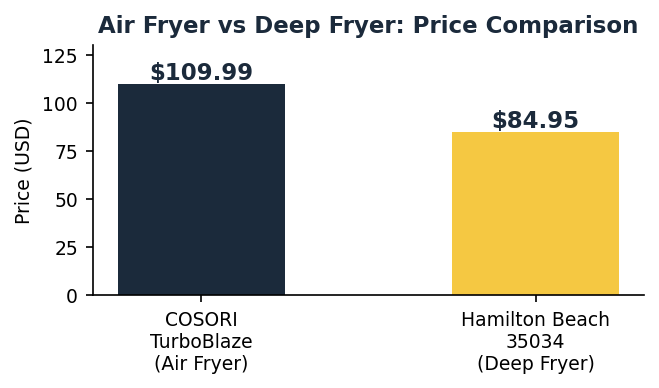
The COSORI TurboBlaze now runs $109.99 (8% off the $119.99 list price), while the Hamilton Beach 35034 sits at $84.95 with no active discount at the time of writing. That means the deep fryer actually costs less to buy today — but the gap narrows fast once you factor in what each one costs to run, which we cover further down.
Here’s how the two prices stack up visually.
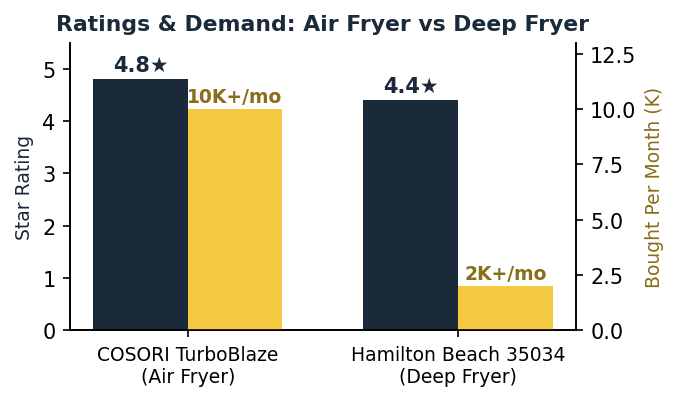
Both listings carry an Amazon’s Choice badge, and both clear the 1,000+ bought-per-month threshold — the COSORI TurboBlaze at 10K+ per month and the Hamilton Beach 35034 at 2K+ per month, so demand isn’t a differentiator here either. The real differences show up once you start cooking, which is what the rest of this guide covers.
Is Air Fried Better Than Deep Fried on Taste and Texture?
Is air fried better than deep fried? On texture, no — a true deep fryer still produces a thicker, more uniform crust. On overall eating experience for most weeknight meals, most home cooks land on air fried anyway, since the difference is smaller than people expect.
Professional side-by-side comparisons from outlets like RTINGS have found that deep-fried fries develop a thicker, more golden crust because the food is fully surrounded by hot oil rather than circulating air. Air-fried versions come out crisp but noticeably lighter, closer to a well-done roast than a classic fry.
Flavor is where the gap narrows the most. Deep frying pulls oil into the food itself, carrying more of the seasoning and fat flavor on the exterior, while air frying keeps more of the food’s own flavor intact. Wet marinades also behave differently — they tend to run off in an air fryer basket rather than sealing into the food the way they do in hot oil.
Chicken is a useful example for anyone deciding between the two. Bone-in pieces cooked in a deep fryer come out juicier inside with a deeper golden color, while air-fried chicken stays lighter and slightly firmer, with a crust that leans crisp rather than shattering. If seasoning penetration matters most to you, the deep fryer keeps a slight edge on strongly marinated foods.
Is Air Frying Better Than Deep Frying for Health?
Is air frying better than deep frying for health? On oil volume alone, yes, decisively. An air fryer typically needs 1 to 2 tablespoons of oil per batch, while the Hamilton Beach 35034 requires close to 19 cups to fill its basket for a full session.
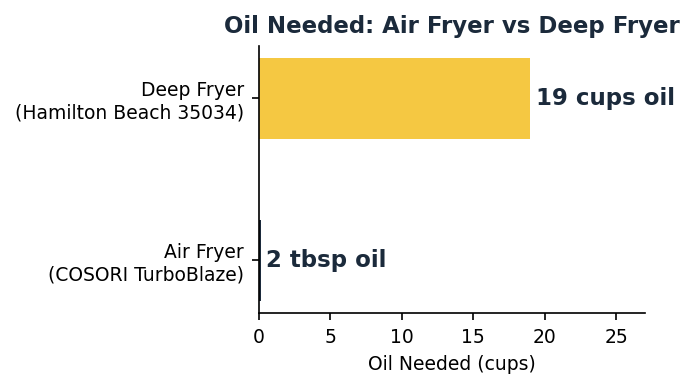
Less oil absorbed into the food generally means fewer calories and less fat on the plate, batch after batch. Chicken wings are a common example: deep-fried wings run noticeably higher in fat than air-fried wings of the same size, and the same pattern holds for French fries.
There’s also a byproduct concern with reused frying oil. Oil that’s heated and cooled repeatedly in a deep fryer can build up compounds linked to health risks over time, which is one reason organizations like Consumer Reports and our own air fryer buying guide lean toward air frying for everyday family cooking.
None of this means deep-fried food is off the table entirely. It means the health gap is real and consistent, and it’s worth weighing against how often you actually fry at home before deciding which appliance earns the counter space.
Full Reviews: COSORI TurboBlaze vs. Hamilton Beach 35034
Here’s a closer look at the two models anchoring this air fryer vs deep fryer comparison, based on verified current Amazon listings confirmed via live product-page checks.
Both models represent the strongest seller in their category rather than a random pick, which matters if you want an appliance with a real track record instead of a brand-new listing with no review history.
COSORI TurboBlaze 6-Qt Air Fryer
| COSORI TurboBlaze Specs | |
|---|---|
| Capacity | 6 quarts, ceramic, PFAS-free basket |
| Price | $109.99 (8% off $119.99 list) |
| Rating | 4.8★ / 21,281 ratings |
| Popularity | 10K+ bought in past month, Amazon’s Choice |
The TurboBlaze’s biggest advantage is a fast preheat combined with a genuinely large 6-quart ceramic basket. Ceramic-coated baskets like this one also tend to hold up better against scratching than standard nonstick coatings over years of use, based on verified listing data and professional comparisons from outlets like RTINGS.
At 10K+ units bought in the past month, it’s the clear sales leader among the air fryers we track for this site. That volume, combined with a 4.8-star average across more than 21,000 ratings, is a strong signal for long-term reliability rather than a short promotional spike.
Day-to-day use is where the ceramic basket pays off most. Food releases cleanly without the sticking that plagues cheaper nonstick coatings after a few months, and the basket itself goes straight into the dishwasher. It’s a big part of why this model keeps winning the air fryer side of our air fryer vs deep fryer comparison.
Free delivery available with Amazon Prime.
Hamilton Beach 35034 Deep Fryer
| Hamilton Beach 35034 Specs | |
|---|---|
| Capacity | 4.5 liters / 19 cups oil, 3 baskets |
| Price | $84.95 (list price, no active discount) |
| Rating | 4.4★ / 5,315 ratings |
| Popularity | 2K+ bought in past month, Amazon’s Choice |
The 35034 is Hamilton Beach’s triple-basket model, which means it can fry two smaller portions side by side or combine baskets for one large batch. The immersed 1800-watt heating element brings oil up to temperature quickly compared to lower-wattage budget fryers, and the view window lets you track color without lifting the lid.
Cleanup is the tradeoff every deep fryer shares, and this model doesn’t fully escape it. The enamel-coated pot, baskets, and lid are dishwasher safe, but the oil itself still needs to cool and get strained or discarded after each session, which is the step most reviewers flag as the real chore.
The breakaway magnetic cord is a genuinely useful safety detail — if it gets snagged mid-fry, it detaches instantly instead of pulling several cups of hot oil off the counter. One recurring quirk shows up consistently across verified owner reviews on other retailers: the magnetic cord itself runs short, so plan your outlet placement before you commit counter space to this one.
Free delivery available with Amazon Prime.
Deep Fry vs Air Fry: Cook Time, Cost, and Convenience
Deep fry vs air fry looks like a clear speed win for the deep fryer once the oil is hot — food cooks in as little as 3 to 5 minutes fully submerged. But that speed advantage disappears once you count preheat time.

Bringing several cups of oil up to 375°F can take up to 15 minutes on the Hamilton Beach 35034, while the COSORI TurboBlaze preheats in about 4 minutes. Net cook time across a full session, including preheat, tends to land closer than either camp expects — for a single quick batch, the air fryer usually finishes first; for back-to-back batches once the oil is already hot, the deep fryer can pull ahead.
Cost per use tells a similar story in the deep fryer’s favor upfront and the air fryer’s favor over time. An air fryer’s shorter cook cycle and lower wattage draw typically add up to a smaller electricity cost per meal than heating a full pot of oil to frying temperature. The oil itself is the bigger ongoing cost for the deep fryer — a few cups get discarded or degrade after repeated use, while the air fryer’s only real ongoing cost is electricity.
Capacity is the other factor worth weighing. Most air fryer baskets max out around 6 quarts, so cooking for a crowd usually means multiple batches, while the Hamilton Beach’s 19-cup oil bath and 3 baskets can often handle a full family-size batch in one pass — a tradeoff we cover in more depth in our air fryer vs microwave comparison for anyone weighing capacity against other countertop appliances.
Air Fryer vs Deep Fryer: Side-by-Side Comparison
This table lines up both appliance types directly, using the COSORI TurboBlaze and Hamilton Beach 35034 as the reference models for price and specs.
| Air Fryer vs Deep Fryer | |
|---|---|
| Cooking method | Circulated hot air vs. full oil submersion |
| Oil needed | 1–2 tbsp vs. up to 19 cups |
| Preheat time | ~4 minutes vs. up to 15 minutes |
| Cook time (fries) | ~18–20 minutes vs. 3–5 minutes once hot |
| Cleanup | Dishwasher-safe basket vs. oil draining + straining |
| Capacity | 6 quarts vs. 19 cups oil / 3 baskets |
| Price (reference models) | $109.99 vs. $84.95 |
| Rating / Bought per month | 4.8★ / 10K+ vs. 4.4★ / 2K+ |
| Safety risk | Low, enclosed basket vs. higher, open hot oil |
| Best for | Everyday meals vs. wet-battered, restaurant-style fry |
The ratings and demand data tell a consistent story — buyers who choose the air fryer tend to rate it slightly higher and buy it far more often, which usually points to broader everyday satisfaction rather than a niche use case.
Which One Should You Choose
Use the breakdown below to match the appliance to how you actually cook, not just which one wins on paper. Most households end up leaning heavily toward one or the other within the first month of ownership, and that pattern is what settles most air fryer vs deep fryer purchase decisions in real kitchens. If you’re still deciding whether either style makes sense at all, our best air fryers under $100 roundup is a good next stop for budget-focused shoppers.
Choose the COSORI TurboBlaze Air Fryer If…
- You cook fried food most weeknights and want minimal daily cleanup.
- You’re feeding 1 to 4 people per meal rather than a full party batch.
- Kitchen safety around kids or pets is a priority, since there’s no open oil.
- Counter space and storage are limited, since there’s no oil to store between uses.
- Versatility matters, since most air fryers also roast, reheat, and bake in the same basket.
Choose the Hamilton Beach 35034 Deep Fryer If…
- Wet-battered recipes like tempura or beer-battered fish are a regular menu item.
- You fry often for a crowd and want one large batch instead of several small ones.
- Restaurant-style crust matters more to you than the health tradeoff.
- Lower upfront cost is the deciding factor, since this model costs less than the air fryer today.
- You already fry often enough that the oil-handling routine isn’t a dealbreaker.
Frequently Asked Questions
Is air fried better than deep fried?
Air fried food is generally better for everyday health and cleanup, but deep fried food still wins on raw crunch and crust thickness for most fried foods.
The right answer depends on what you’re prioritizing more: the healthier, lower-mess option most days, or the closer-to-restaurant texture on special occasions.
- Texture favors deep frying — a thicker, more uniform crust.
- Health and cleanup favor air frying — far less oil, far less mess.
- Flavor is closer than most people expect between the two.
Is air frying better than deep frying for health?
Yes, air frying is generally healthier because it uses 1 to 2 tablespoons of oil compared to close to 19 cups in a deep fryer, resulting in lower fat and calories per serving.
The gap is most noticeable on foods people eat often, like fries and chicken, where the calorie difference adds up over repeated meals rather than showing up in a single serving.
- Lower oil volume means less absorbed fat in the finished food.
- No reused frying oil means no buildup of oil-breakdown compounds over time.
- Fewer calories per serving on identical recipes like fries or wings.
Deep fry vs air fry: which one costs less to run over time?
An air fryer typically costs less to run over time since it draws less electricity per cook and eliminates the ongoing cost of replacing frying oil after every few uses.
A deep fryer’s running cost is driven almost entirely by oil, since a few cups get discarded or degrade after repeated use. Over a year of regular frying, that gap is often the deciding factor in the deep fry vs air fry cost comparison, even though the deep fryer itself currently costs less upfront.
- Oil cost adds up fastest for frequent deep fryer users.
- Shorter cook cycles in an air fryer can mean lower energy use per meal.
- Upfront price currently favors the deep fryer, narrowing the long-term gap.
Final Verdict: Air Fryer vs Deep Fryer
Across all 5 factors, the air fryer vs deep fryer decision comes down to how often you fry and what you’re frying. The COSORI TurboBlaze wins on cleanup, safety, running cost, and everyday health for the vast majority of home cooks, even though it now costs more upfront than the Hamilton Beach.
The Hamilton Beach 35034 still earns its spot for anyone who regularly makes wet-battered foods, fries in bulk for a family gathering, or wants the lower price today. Most kitchens don’t need to pick just one, but if you’re buying your first fryer, the air fryer is the safer everyday starting point.
If your fry list is fries, tenders, wings, and reheated leftovers, start with the COSORI TurboBlaze and don’t look back. If tempura, funnel cake, or feeding a full table of guests is a regular occurrence, the Hamilton Beach 35034 earns its place on the counter alongside it.
Free delivery available with Amazon Prime on both picks.
As an Amazon Associate, this site earns from qualifying purchases made through links above at no extra cost to you. Prices and stock status were verified at the time of publishing and may change.