

How to choose an air fryer comes down to four checks — size, wattage, coating, and features — and a model like the Cosori TurboBlaze 6-Qt gets all four right with PFAS-free ceramic coating and 1,725W of power. Most buyers get at least one of these wrong. This guide walks through the five critical mistakes that cause regret, so you know exactly what to look for before you click buy.
We’ve drawn from Consumer Reports lab testing, Tom’s Guide hands-on reviews, and real buyer feedback from Reddit and Slickdeals. If you’re still deciding whether you need one at all, our Are Air Fryers Worth It breakdown covers that first. If you just want a fast size recommendation, try our Air Fryer Size Calculator — it takes under a minute.
Table of Contents
- Mistake #1: Getting the Size Wrong
- Mistake #2: Ignoring Wattage
- Mistake #3: Picking the Wrong Type
- Mistake #4: Not Checking the Coating
- Ceramic Coated vs PTFE Free: Which Is Safer?
- Mistake #5: Paying for Features You Won’t Use
- Size by Household: Full Reference Table
- Wattage Guide
- Which Type Is Right for You
- Frequently Asked Questions
- Final Verdict
What to Look for in an Air Fryer: The 2026 Buying Checklist
Before the detail, here’s a fast decision framework. If you want a one-line summary of what to look for in an air fryer: 5–6 qt basket, 1,500W+, ceramic coating, digital controls. Each row below maps to one of the five critical mistakes covered in this guide.
Whether you’re buying your first air fryer or replacing an old one, run through this checklist before you click buy. It works the same way regardless of brand or budget.
| How to Choose an Air Fryer: 2026 Checklist | |
| Household size | 1–2 people → 3–4 qt | 3–4 people → 5–6 qt | 5+ people → 7 qt+ |
| Wattage target | Minimum 1,400W for a 4–5 qt basket. 1,700W+ for 6 qt+ |
| Type | Basket = faster, crispier, easier clean | Oven = more versatile, bigger footprint |
| Coating | Ceramic or stainless steel preferred. Check for PTFE-free label if health-conscious |
| Features | Digital controls + dishwasher-safe basket = enough for most. Skip Wi-Fi unless you’ll use it |
For a concrete example of this checklist in action: the Cosori TurboBlaze 6-Qt hits every row — 6 qt basket, 1,725W, PFAS-free ceramic coating, and digital controls. It currently carries Amazon’s “Overall Pick” badge with a 4.8★ rating across 21,170+ reviews.
Mistake #1: Getting the Size Wrong — What Size Air Fryer Do I Need?
Size is the number one source of buyer regret — and the first thing to get right when you figure out how to choose an air fryer. Go too small and you’re batch-cooking every meal, which defeats the speed advantage entirely. Go too big and you’ve wasted money on a power-hungry countertop anchor that barely fits under your cabinets.
Here’s the trap most buyers fall into: manufacturers overstate capacity. Consumer Reports engineers consistently find that usable basket space is smaller than the claimed quart figure — especially in round, tall baskets. A narrow 4 qt basket might only hold two chicken thighs flat in a single layer.
You need that single layer for even crisping — stacking food blocks airflow and turns your air fryer into a slow, soggy steam chamber.
Tom’s Guide makes a sharp, practical point: cooking surface area (square inches) matters more than total volume. A wide, shallow 5 qt basket outperforms a tall, narrow 6 qt every time for everyday air frying because food sits closer to the heating element and hot air circulates more evenly.
1. Size by Household: The Fast Answer
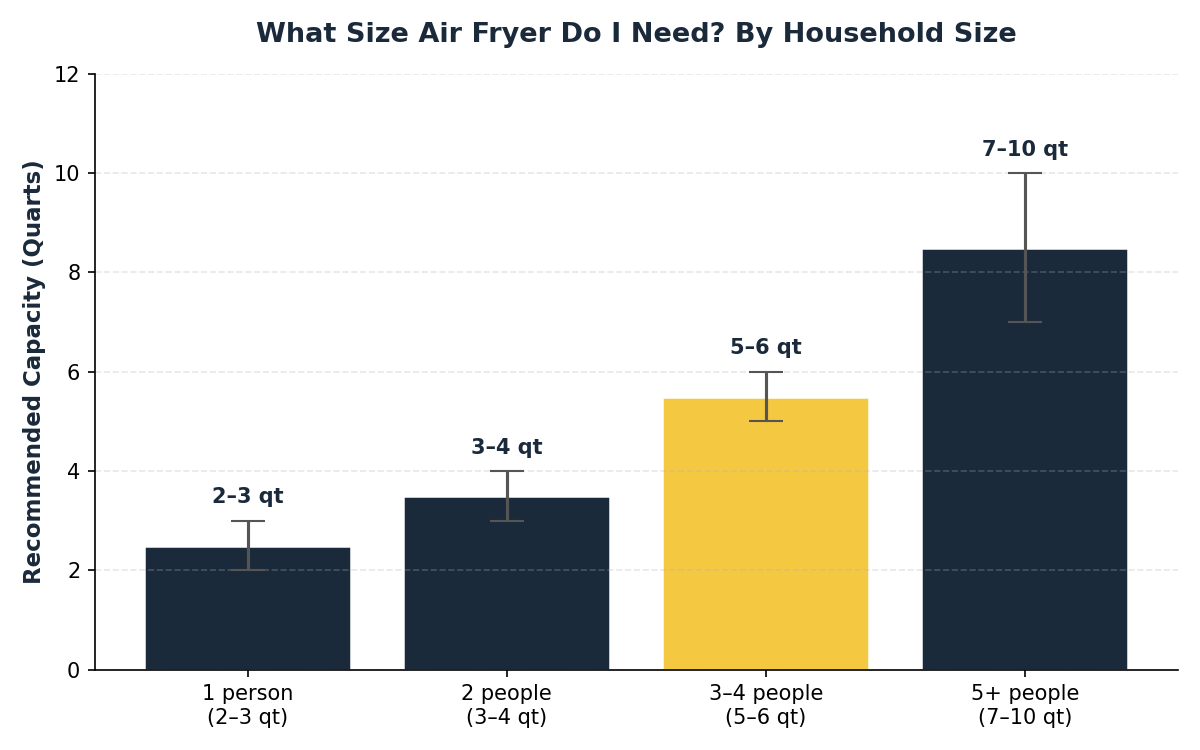
When figuring out what size air fryer do I need, start with your household — not the product listing’s capacity claim:
- 1–2 people: 3–4 qt. Fast preheat, compact footprint, no wasted energy heating empty space. See our Best Air Fryer for One Person picks.
- 3–4 people: 5–6 qt. The sweet spot for most households. Fits four chicken thighs or a pound of fries in one layer.
- 5+ people: 7–10 qt or dual-basket. Anything smaller means constant batching, which kills the time-saving benefit. Our Best Air Fryer for a Family of 4 guide covers this range in detail.
2. The Claimed vs. Actual Capacity Problem
Always check third-party reviews for measured capacity, not just the box claim. A model advertised as 6 qt may deliver 4.5 qt of usable space once you account for basket walls, heating element overhang, and the airflow room your food needs. If you’re still asking yourself how to choose an air fryer size, our Air Fryer Size Calculator gives a personalised recommendation based on your household and cooking habits.
Mistake #2: Ignoring Wattage — Best Air Fryer Wattage Explained
Wattage is the spec most buyers skip — and it’s the one that determines whether your food comes out crispy or underwhelming. Think of it like the engine in a car. A bigger basket with a weak engine means slower, soggier results every single time.
When you choose an air fryer, skipping the wattage check is how you end up with a machine that never quite delivers. Understanding how to choose an air fryer means treating wattage as a first-tier spec, not an afterthought.
The best air fryer wattage for most households sits between 1,400W and 1,700W. Below 1,200W and you’ll struggle with frozen foods, thick cuts of meat, and anything that needs a proper crust. Above 1,800W and you’re paying for power most home cooks never fully use.
3. Match Wattage to Basket Size — Best Air Fryer Wattage Rule
The best air fryer wattage calculation is simple: aim for roughly 300–350W per quart of capacity. It’s the spec that separates a wise decision on how to choose an air fryer from a regretful one. This is where buyers go wrong.
They buy a large-capacity basket but opt for a budget model with underpowered wattage, thinking bigger volume is better. It isn’t. A 5 qt basket needs at least 1,500W to heat the larger air volume efficiently.
Pair a 5 qt basket with 1,200W and you’ll be adding extra cook time on every single meal — and results will still be less crispy than they should be. The wattage-to-capacity ratio is how you tell apart a genuinely capable air fryer from one that looks impressive on paper but underdelivers in use.
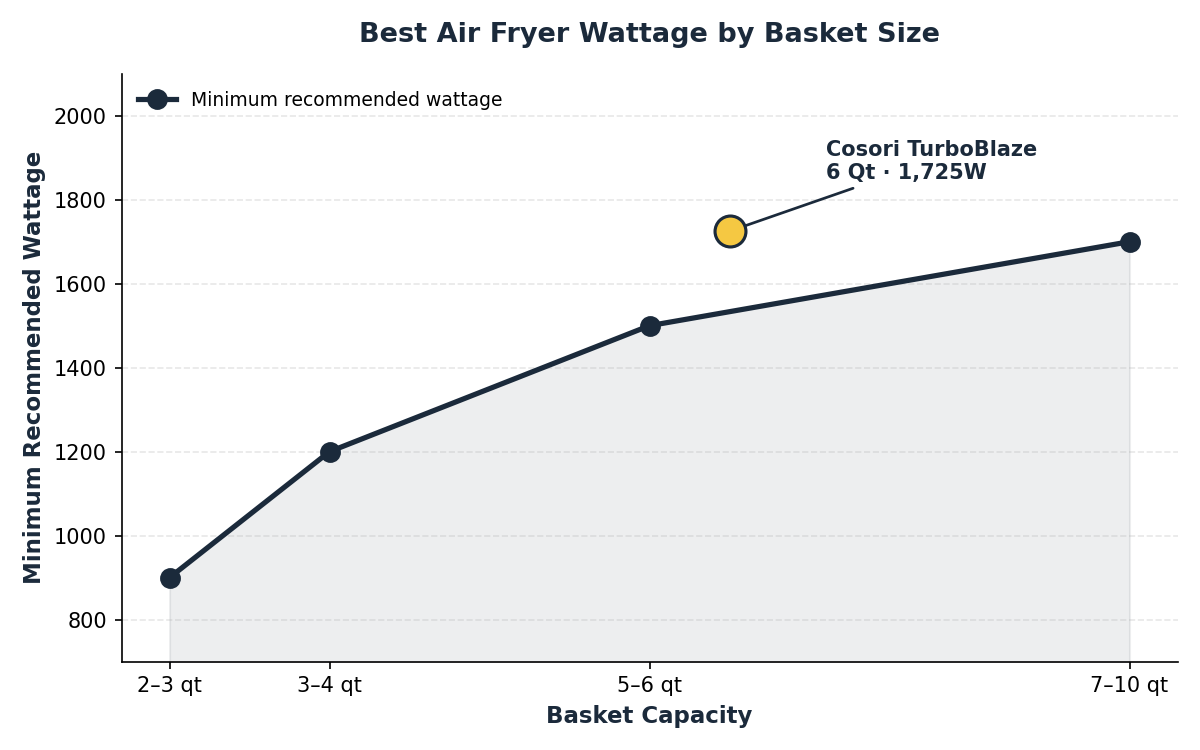
The Cosori TurboBlaze’s 1,725W on a 6 qt basket sits comfortably above the recommended minimum for its size — one reason it holds a 4.8★ rating across 21,170+ verified buyers.
One practical note from Tom’s Guide testing: preheating is often optional. Throw cold food into a cold basket and add 60–90 seconds. For wings, fries, and reheated meals, the results are nearly identical — and you save the preheat wait entirely.
Mistake #3: Picking the Wrong Type — Basket vs Oven Air Fryer
The basket vs oven air fryer decision trips up more buyers than any other spec. Both types use the same hot-air convection principle.
But they behave very differently day-to-day — and buying the wrong one means you’ll use it less, not more. How to choose an air fryer type depends almost entirely on your household size and cooking habits.
4. Basket-Style Air Fryers
Basket air fryers are the dominant style for a reason — and for most buyers asking how to choose an air fryer type, the answer is basket. They heat faster, crisp more effectively, and are far easier to clean. The pull-out drawer lets you shake food mid-cook without touching hot surfaces.
A Reddit poll of 872 air fryer owners leaned overwhelmingly toward basket-style — not because of hype, but because of practical, daily usability.
Best for: everyday frying (wings, fries, reheating), small kitchens, beginner cooks, anyone prioritising speed and clean-up simplicity.
5. Oven-Style Air Fryers
Oven-style models look like compact toaster ovens and take longer to preheat. They have a larger countertop footprint, and wire racks are notoriously harder to clean than dishwasher-safe baskets. But they win clearly on versatility — rotisserie, baking, broiling, dehydrating, and multi-rack cooking for larger meals.
Our Air Fryer vs Oven comparison breaks this trade-off down in more depth.
Best for: families of 5+, home cooks who bake regularly, anyone wanting one appliance to replace multiple countertop units. If replacing your toaster oven is the actual goal, see our Best Air Fryer Toaster Oven Combo picks instead.
Basket vs Oven Air Fryer: Side-by-Side
| Feature | Basket | Oven-Style |
| Preheat speed | Fast (2–3 min) | Slower (4–6 min) |
| Crispiness | Top-tier crisp results | Above average |
| Ease of cleaning | Easy (dishwasher-safe basket) | Harder (wire racks) |
| Cooking functions | Air fry, roast, reheat, dehydrate | All above + rotisserie, bake, broil, toast |
| Countertop footprint | Compact | Large |
| Price range | $30–$200 | $100–$350+ |
| Best for | 1–4 people, everyday frying | Families, multi-function cooking |
Mistake #4: Not Checking the Coating — Air Fryer Nonstick Coating Safety
Air fryer nonstick coating safety has become one of the most-searched topics in this category. Most budget models use standard PTFE-based nonstick — the same chemical family as Teflon. That’s not automatically dangerous, but it does come with caveats that matter when you choose an air fryer for daily use.
How to choose an air fryer coating comes down to one question: how long do you plan to keep it? Ceramic is the answer if longevity matters.
6. PTFE vs Ceramic vs Stainless Steel
PTFE coatings are safe at normal air fryer temperatures. Most models max out at 400°F — well below the 500°F threshold where PTFE starts to degrade. The real air fryer nonstick coating safety risk comes from scratched or chipped coatings, and from running a basket empty at maximum heat.
If the coating is intact and you’re not overheating it, standard PTFE is fine for most households.
That said, board-certified toxicologist Dr. Bruce Jarnot is direct on the matter: “I’d recommend selecting an air fryer that is PFAS-free.” Ceramic-coated baskets are the rising preference — they skip PTFE entirely, offer solid nonstick performance, and resist scratching better than most buyers expect. Stainless steel is the safest long-term material but requires more oil to prevent sticking.
7. What to Look for on the Product Page
Vague language like “healthy coating” or “eco nonstick” tells you nothing useful. This is a critical checkpoint in how to choose an air fryer — don’t skip it. When checking air fryer nonstick coating safety claims, look for specific wording: PTFE-free, PFAS-free, ceramic-coated.
If a brand won’t say what the basket is made from, that’s a red flag — not a marketing gap.
One practical rule regardless of coating type: never use aerosol cooking sprays in an air fryer. The propellants in spray cans degrade nonstick coatings fast — whether PTFE or ceramic. Use a pump-style oil sprayer or brush oil directly onto food instead.
Ceramic Coated Air Fryer vs PTFE Free Air Fryer: Which Is Safer?
A ceramic coated air fryer and a PTFE free air fryer aren’t automatically the same thing. Ceramic is always PTFE-free, but stainless steel and some newer composite baskets are also PTFE-free without being ceramic. PFAS is the broader chemical family that includes PTFE, so a “PFAS-free” claim is actually stronger than a “PTFE-free” one.
The Cosori TurboBlaze is a useful real-world example of clear labeling done right: its product title states “PFAS-Free Ceramic Coating” outright, rather than the vague “healthy coating” language to avoid. It’s currently Amazon’s “Overall Pick” for this search, priced at $109.99, with 20K+ bought in the past month.
Free delivery available with Amazon Prime
Mistake #5: Paying for Features You Won’t Use
Feature bloat is real in this category — and it’s the last trap to avoid when you figure out how to choose an air fryer. Smart Wi-Fi connectivity, app-based presets, voice control, built-in thermometers — these sound compelling in a listing and get ignored after week two. Don’t pay a $50–$100 premium for features that don’t change your actual cooking results.
8. Features Worth Paying For
- Digital controls with presets: More precise than dials. Shake and preheat reminders are genuinely useful day-to-day.
- Dishwasher-safe basket: Non-negotiable for daily use. Hand-washing air fryer baskets becomes a chore fast.
- Viewing window: Useful if you bake or cook delicate items that shouldn’t be opened mid-cook. Less critical for wings and fries.
- Keep-warm function: Underrated. Keeps food crispy while the rest of the meal catches up.
9. Features You Can Skip
- Wi-Fi and app control: You’re standing in your kitchen. You don’t need your phone to check if fries are ready.
- Rotisserie on a basket model: Works in theory, fiddly in practice. Only worthwhile on a full oven-style unit with proper clearance.
- Paddle/auto-stir arm: Works for fries and chopped veg, causes problems with anything else. Largely phased out of mainstream models.
- Budget dual-basket: Wattage splits between two baskets and crisping performance suffers on both sides. Several Slickdeals users flagged this directly on budget dual-basket models.
What Size Air Fryer Do I Need? Full Reference Table
Use this to match household size to the right capacity range. When in doubt, size up — especially if you cook for guests or do weekly meal prep. This is the most common answer to “what size air fryer do I need” based on real-world cooking loads, not manufacturer marketing.
It’s also the fastest shortcut if you’re still working out how to choose an air fryer that won’t feel too small six months from now. The table below is the practical core of how to choose an air fryer by household size.
| Household Size | Recommended Capacity | Recommended Wattage | Notes |
| 1 person | 2–3 qt | 800–1,200W | Fastest preheat, smallest footprint |
| 2 people | 3–4 qt | 1,200–1,500W | Handles most meals without batching |
| 3–4 people | 5–6 qt | 1,500–1,700W | Most popular range; fits 4 chicken thighs flat in one layer |
| 5+ people | 7–10 qt or dual-basket | 1,700–2,000W | Consider oven-style for maximum flexibility |
Best Air Fryer Wattage: Full Breakdown by Cooking Need
The best air fryer wattage for your kitchen depends on basket size and how often you cook from frozen. If you’re still deciding how to choose an air fryer at the right power level, this table gives you the answer by use case:
| Wattage Range | Best For | Limitation |
| 800–1,200W | Singles, reheating, light snacks | Struggles with frozen food and thick cuts |
| 1,200–1,500W | Couples, everyday cooking | Slower on large batches; underwhelms in large baskets |
| 1,500–1,700W | Families of 3–4, most households | None for typical home use — this is the sweet spot |
| 1,700–2,000W | Large families, meal prep, dual-basket models | Higher energy draw; check outlet capacity in older homes |
Air fryers use 50–75% less electricity than a conventional oven, so even a 1,700W model is still a net energy win compared to preheating a full oven for a small meal. The best air fryer wattage is the one that matches your basket size — not just the highest number on the spec sheet. Use this table every time you need to how to choose an air fryer at the right power level.
How to Choose an Air Fryer for a Family: Which Type Is Right for You?
Knowing how to choose an air fryer for a family starts with one honest question: do you need to cook one thing at a time, or do you need an entire meal ready simultaneously? That single answer determines whether a basket or an oven-style model makes sense for your kitchen. How to choose an air fryer for a family of 4 or more is different from choosing for a couple — and the post structure of your kitchen matters too.
Choose a Basket Air Fryer If…
- You cook for 1–4 people and don’t need two dishes running at once.
- Speed and crispiness are your top priorities — basket models heat faster and crisp more effectively.
- Counter space is limited — basket models are significantly more compact than oven-style units.
- You hate cleaning — dishwasher-safe baskets make daily cleanup effortless; oven wire racks do not.
Choose an Oven-Style Air Fryer If…
- 5+ people: Batch cooking defeats the time-saving benefit — or consider a dual-zone basket like the Ninja DZ201 DualZone instead.
- Replacing a toaster oven: Oven-style models bake, broil, toast, and rotisserie.
- Whole chickens or roasts: These simply don’t fit in a standard basket.
- Versatility beats speed for your cooking priorities.
For most 3–4 person households, a 5–6 qt basket at 1,500–1,700W covers 90% of everyday cooking. That’s the short answer on how to choose an air fryer for a family — and on how to choose an air fryer full stop — without overcomplicating it. See our Best Air Fryers Under $100 for specific model picks at every budget tier — all verified in stock with current pricing.
Frequently Asked Questions
What size air fryer do I need?
What size air fryer do I need depends on your household: 2–3 qt for one person, 3–4 qt for two, 5–6 qt for three to four people, and 7–10 qt or dual-basket for five or more. Cooking surface area matters more than total quart volume, since food needs to sit flat in a single layer for even crisping.
- 5–6 qt: Fits 4 chicken thighs or around 1 lb of fries in one layer — the sweet spot for most households.
- 6 qt: Adds flexibility for larger proteins or slightly bigger batch sizes, like the Cosori TurboBlaze above.
- Avoid: Anything below 3 qt for two or more people — constant batching defeats the convenience entirely.
What to Look for in an Air Fryer?
What to look for in an air fryer comes down to four checks: the right capacity for your household, at least 1,400W of power, a ceramic or PTFE-free basket, and only the features you’ll actually use. Skip anything vague about the coating and confirm the wattage before you check out.
- Non-negotiable: Correct capacity, adequate wattage, dishwasher-safe basket.
- Worth paying for: Digital controls, a viewing window, keep-warm function.
- Skip: Wi-Fi/app control, rotisserie on a basket model, budget dual-basket units.
Is a Ceramic Coated Air Fryer Safer Than PTFE?
A ceramic coated air fryer is generally the safer long-term choice over standard PTFE, since ceramic skips PFAS chemicals entirely and holds up better against scratching when the basket is intact. Standard PTFE is still safe at normal air fryer temperatures as long as the coating isn’t chipped or scratched.
- Ceramic: PFAS-free, scratch-resistant, the rising preference for health-conscious buyers.
- PTFE: Safe when intact and used under 400°F, but degrades once scratched or overheated.
- Look for: Explicit “PTFE-free” or “PFAS-free” wording, like the Cosori TurboBlaze’s product listing.
Final Verdict: How to Choose an Air Fryer in 2026
Knowing how to choose an air fryer in 2026 comes down to five decisions — and most buyers get at least one wrong. Run the checklist at the top of this guide every time — it covers how to choose an air fryer regardless of brand or budget, and takes less than two minutes to work through.
Get the size right first. Match wattage to capacity. Pick basket unless you have a specific reason for oven-style.
Check the coating claim, not just the marketing language. Skip smart features unless you know you’ll actually use them.
For most households of 3–4 people, a 5–6 qt basket model at 1,500–1,700W with a ceramic or PTFE-free coating handles everything. When friends ask how to choose an air fryer, that’s the answer in one sentence. The Cosori TurboBlaze checks every box in this guide and currently holds Amazon’s “Overall Pick” badge.
The checklist above works regardless of which brand you land on. That’s how to choose an air fryer that earns its counter space instead of getting shoved to the back of a cupboard by month three.
HomeApplianceOwl.com is a participant in the Amazon Associates programme. As an Amazon Associate we earn from qualifying purchases at no extra cost to you.