
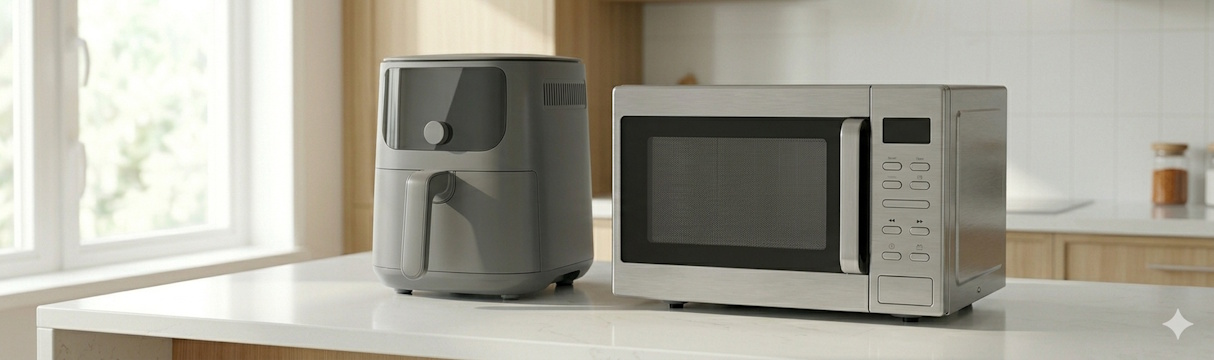
Air fryer vs microwave comes down to one fact most guides skip: the microwave wins for reheating and defrosting, the air fryer wins for cooking and crisping — and neither replaces the other completely.
Most people buy the wrong one for the wrong reason, then blame the appliance when it fails at a job it was never built to do. This guide breaks down 4 secrets nobody explains clearly: which one actually saves money, which one cooks real food, and which mistake costs new owners the most.
Here’s everything you need to know about air fryer vs microwave in 2026 — including the one buying mistake that trips up almost every first-time shopper.
Quick take: the Ninja AF141 (4.7★, 8,379 ratings, Amazon’s Choice) is our pick for cooking and crisping. The Toshiba EM131A5C-SS (4.4★, 21,321 ratings) is our pick for fast reheating and defrosting.
Free delivery available with Amazon Prime
Table of Contents
- The Difference Between Air Fryer and Microwave
- Air Fryer vs Microwave Oven: Quick Comparison
- Reheating: Which One Wins?
- Cooking from Scratch and Frozen
- Energy Cost: The Real Numbers
- Health and Food Quality
- Space, Cost, and Cleaning
- Can an Air Fryer Replace a Microwave?
- Are Air Fryers Better Than Microwaves? 6 Buyer Profiles
- Our Picks for 2026
- People Also Ask
The Difference Between Air Fryer and Microwave: How Each One Works
The difference between air fryer and microwave starts with physics — because understanding how each one heats food explains every trade-off you’ll run into below.
A microwave uses electromagnetic waves to vibrate water molecules inside your food. That vibration generates heat from the inside out. This is why microwaves reheat soups and high-moisture foods so fast — they target the water directly.
It’s also why a microwave turns pizza crust limp and chewy instead of crisp. That inside-out vs outside-in split is the entire reason the air fryer vs microwave debate exists.
An air fryer works like a small convection oven. A heating element superheats the air inside, and a fan circulates it around your food at high speed. Heat comes from the outside in, which is how it creates the Maillard reaction — the browning process behind crispy skin and caramelized edges.
Still deciding whether an air fryer even fits your kitchen? Our guide to choosing an air fryer covers sizing and wattage basics before you compare it to anything else. Those two heating methods — inside-out vs outside-in — explain every difference in the air fryer vs microwave debate below.
Air Fryer vs Microwave Oven: Quick Comparison
Here’s how the air fryer vs microwave oven comparison stacks up across every dimension that matters in a real kitchen — from reheating speed to energy cost. This side-by-side view is the fastest way to see where air fryer vs microwave oven differences actually show up in daily use.
| Category | Air Fryer | Microwave |
|---|---|---|
| Heating Method | Hot circulating air (outside-in) | Electromagnetic waves (inside-out) |
| Reheat Speed | 8–15 minutes | 1–3 minutes ✅ |
| Reheat Quality | Crispy, restaurant quality ✅ | Soft, often soggy |
| Liquids & Soups | Cannot do ❌ | Fast & precise ✅ |
| Defrosting | Limited, slower | Fast, dedicated mode ✅ |
| Cooking Versatility | Fry, roast, bake, dehydrate ✅ | Reheat, steam, defrost |
| Wattage | 1,400–1,800W | 700–1,200W |
| Energy Per Use | ~$0.08–$0.21 per session | ~$0.005–$0.03 per use ✅ |
| Entry Price (2026) | $60–$130 | $60–$150 |
| Cleaning | Basket wash after each use | Wipe interior ✅ |
| Counter Space | Compact (most models) | Larger footprint |
| Best For | Crispy food, cooking, roasting | Speed, liquids, defrosting |
Microwave vs Air Fryer for Reheating: Which One Actually Wins?
This is the battle most people actually care about — and the answer isn’t what you’d expect. Neither wins outright. They win for completely different foods.
The Microwave Wins for Speed and Liquids
Reheating a bowl of soup, a mug of coffee, leftover pasta with sauce, or anything high in moisture? The microwave is done in 90 seconds. The air fryer cannot heat liquids at all — you’d need to transfer soup to a stovetop pot first.
That’s not a workaround, that’s a different appliance. It’s the clearest example of why air fryer vs microwave isn’t really a competition — it’s two different jobs.
The microwave also has a dedicated defrost mode. Thawing a chicken breast, frozen shrimp, or ground beef for tonight’s dinner takes minutes on the defrost setting. An air fryer can cook from frozen, but defrosting specifically — separating thaw from cook — isn’t something it handles cleanly.
The Air Fryer Wins for Texture and Quality
Leftover pizza from the fridge. Day-old fries. Fried chicken from last night.
Spring rolls. Anything with a crust, coating, or skin that you want restored to its original crunch. The microwave turns all of these soggy — the air fryer brings them back to life in 5–8 minutes, genuinely crispy and heated all the way through.
This is consistent, real-world feedback from home cooks across major cooking communities: people who buy an air fryer for one reason often end up keeping it for the reheating. Leftover pizza in an air fryer at 375°F for 4 minutes beats the original delivery — that’s a consistent result microwave reheating simply cannot replicate. That gap alone explains why the difference between air fryer and microwave shows up most clearly at reheating time.
Verdict: for speed and liquids → microwave. For texture and quality → air fryer. Knowing which category your meal falls into before you press any buttons is the whole answer.
Cooking from Scratch and from Frozen
This is where air fryer vs microwave tilts sharply in one direction — and it’s not the microwave. The cooking comparison isn’t close.
Air fryers cook. Microwaves reheat. That’s the bluntest version of the truth, and it holds up under almost any test.
A microwave can technically cook certain foods — baked potatoes, steamed vegetables, simple scrambled eggs — but the results are functional at best, never what you’d get from dry heat. This is the clearest air fryer vs microwave contrast in the entire comparison.
An air fryer at 400°F cooks chicken thighs in 20 minutes with crackling skin. It roasts broccoli until the edges char slightly and turn sweet. It turns frozen fries into something that actually tastes fried.
If you’re weighing this against a full-size oven instead of a microwave, our air fryer vs oven comparison breaks down the same speed and energy trade-offs in more detail.
From frozen specifically, the gap is widest. Frozen nuggets, frozen wings, frozen fish sticks — straight into the basket, no thaw required, 15 minutes, done. The microwave does technically cook from frozen, but the texture outcome with most foods is inferior.
Many frozen meal packages still list both microwave and oven instructions precisely because the microwave version is the compromise option. It’s one more sign of how lopsided air fryer vs microwave performance gets once food starts frozen.
One real-world note this debate rarely covers: the air fryer makes healthy eating less painful. Chicken breast in a microwave turns rubbery. The same chicken breast in an air fryer — seasoned, cooked at 375°F for 18 minutes — comes out juicy inside with a lightly crisped exterior.
When cooking healthy food feels enjoyable, people actually stick to it. That single habit shift is an underrated part of the air fryer vs microwave decision.
Air Fryer vs Microwave Energy Use: The Real Numbers
The air fryer vs microwave energy question is one of the most searched — and most misunderstood — angles in this debate. Here’s what the actual numbers show.
A standard microwave runs at 700–1,200 watts. A standard air fryer runs at 1,400–1,800 watts. On wattage alone, the microwave wins.
But wattage is only half the equation — total energy consumed is wattage multiplied by time, and that’s where the comparison gets more nuanced.
To reheat leftovers, a microwave runs at ~1,000W for 2 minutes: 0.033 kWh, roughly $0.005. The same task in an air fryer takes 8 minutes at ~1,500W: 0.2 kWh, roughly $0.03. For reheating, the microwave uses about 6x less energy per session.
But cooking a chicken breast is a different calculation. An air fryer at 1,500W for 20 minutes uses 0.5 kWh (~$0.08). A conventional oven at 3,500W for 30 minutes uses 1.75 kWh (~$0.28).
The air fryer uses 70% less energy than the oven for the same result — a saving that’s real if you’re currently baking dinner in a full-size oven every night.

The honest summary: the microwave is cheaper per use for quick reheating tasks. The full energy picture depends on what you’re replacing — if you’re swapping out oven usage, the air fryer pays for itself in energy savings within months. If you’re just reheating soup twice a day, stick to the microwave.
Health and Food Quality: What the Science Says
In the air fryer vs microwave health comparison, both appliances beat deep frying — but they win in different ways, and that distinction matters more than most guides admit.
Microwaves are one of the most nutrient-preserving cooking methods available. Because cook time is short and no water is added, water-soluble vitamins like B and C are retained better than boiling or steaming. Ninety seconds to reheat broccoli in a microwave preserves more nutrients than a 20-minute oven roast — a genuine win most comparisons skip.
Air fryers use up to 75% less oil than traditional deep frying while delivering comparable texture and crunch. For a household that used to deep-fry wings twice a week and now air-fries them instead, that fat reduction is significant. For a closer look at exactly how much oil an air fryer saves compared to true deep frying, see our air fryer vs deep fryer breakdown.
One note worth settling here: both appliances are safe. Microwaves do not make food radioactive or alter its molecular structure in harmful ways — they heat water molecules, the same way a stovetop does.
Air fryers don’t produce harmful compounds at normal cooking temperatures. The safety fear around both is largely unfounded. Whichever way you lean in the air fryer vs microwave health debate, neither appliance deserves the reputation it sometimes gets.
Air Fryer vs Microwave: Space, Cost, and Cleaning
Counter Space
Most countertop microwaves occupy a larger footprint than a standard air fryer. The Toshiba EM131A5C-SS, for example, measures 20.6″ wide — wider than most air fryers, including the Ninja AF141 at 11.29″ wide. If counter space is tight, the air fryer wins on size.
Price
Entry-level models of both appliances land in a similar range in 2026. The Ninja AF141 currently sits at $128.49; the Toshiba EM131A5C-SS sits at $148.99 — a gap of just $20.50 between our two picks. If your budget caps out well below either of these, our roundup of best small kitchen appliances under $50 covers cheaper starter options in both categories.
Cleaning
The microwave is easier to clean day-to-day: wipe the interior with a damp cloth. The air fryer basket and crisper plate need washing after every use — most are dishwasher-safe, but you still have to remember to do it. Roughly 5 extra minutes of cleaning per use compared to a microwave.
Neither is a burden, but for someone who hates doing dishes or has limited kitchen time, the microwave’s easier cleanup is worth noting. It’s a small but real difference in the long-term ownership experience — one that guides skipping the cleaning angle always underestimate. It’s one more entry on the air fryer vs microwave difference list worth knowing before you buy.
Can an Air Fryer Replace a Microwave? The Straight Answer
This is the most-asked question in this space — and the most commonly dodged. So here’s the direct answer: can an air fryer replace a microwave? No, not fully.
But a microwave also can’t do what an air fryer does best. That two-way gap is the honest core of the air fryer vs microwave replace-or-not question.
There are 4 specific tasks where the microwave is irreplaceable:
- Heating liquids — soup, coffee, sauces, gravies, baby formula. An air fryer cannot heat liquids. Full stop.
- Dedicated defrosting — thawing meat by weight or time before cooking. Air fryers cook from frozen but don’t defrost-only.
- Reheating soft foods fast — rice, pasta, mashed potato, casseroles. The microwave does this in under 2 minutes; the air fryer takes 8–12 minutes and may dry soft foods out.
- Microwave-specific ready meals — many packaged frozen meals are formulated for microwave cooking only and won’t cook evenly in an air fryer.
Some people do manage to live without a microwave entirely — but they’ve adapted their habits significantly. They heat soup on the stovetop, plan defrosting the night before, and avoid packaged microwave meals. For the right lifestyle, it works.
For most households, eliminating the microwave creates friction at exactly the moments you need convenience most. It’s the clearest sign that air fryer vs microwave ownership works best as a pair, not a swap.
The sharper question isn’t whether an air fryer can replace a microwave — it’s what you’d actually miss if you got rid of your microwave tomorrow. Answer that honestly and you’ll know whether you need both. See our guide on are air fryers worth it for a deeper look at real-world value.
Are Air Fryers Better Than Microwaves? 6 Buyer Profiles
Rather than a generic verdict, here’s the air fryer vs microwave answer mapped to six real household types. In every scenario below, the right pick comes down to cooking style — not brand preference.
| Your Situation | Get This | Why |
|---|---|---|
| Student or solo diner — mostly reheating ready meals and soups | Microwave | Fast, cheap to run, handles liquids, minimal cleanup |
| Health-conscious cook replacing oven use | Air Fryer | Cooks real meals with less oil, saves energy vs oven |
| Family of 4+ who cook daily and reheat daily | Both | Air fryer for cooking and crispy food, microwave for liquids and quick reheats |
| Renter with minimal counter space and tight budget | Air Fryer | Smaller footprint, replaces oven for most tasks, one appliance does more |
| Meal prepper who batch cooks on Sundays | Air Fryer + microwave for reheating | Air fryer for batch cooking; microwave to reheat portions quickly during the week |
| Office worker relying on frozen meals and quick lunches | Microwave | Speed is the priority; most packaged meals are microwave-optimized |
Fit the renter or budget profile above? Our best air fryers under $100 roundup narrows the field to specific models.
Not sure which capacity fits your household? Our Air Fryer Size Calculator gives you a personalized recommendation based on family size and cooking habits. Either way, whether are air fryers better than microwaves for you comes down to which of these six profiles matches your household.
Best Air Fryer 2026 and Best Microwave: Our Picks
If you’ve read this far, you know where you land in the air fryer vs microwave decision. The picks below reflect the strongest available options in each category for 2026, verified live on Amazon.

Best Air Fryer: Ninja AF141 5qt — $128.49
The Ninja AF141 is the best air fryer 2026 pick we’d recommend to most first-time buyers. It’s Amazon’s Choice with 10,000+ units bought in the past month and a 4.7-star rating across 8,379 ratings — a strong, consistent track record rather than a fringe pick. The 5qt basket handles up to 4 lbs of fries or several chicken meals, and Air Crisp Technology at 400°F delivers genuinely crispy results.
At $128.49, it’s priced for that consistency rather than as a budget bargain — you’re paying for the Amazon’s Choice status and near-five-star track record, not a clearance deal. It’s also the right size for most kitchens: at 11.29″ wide, it fits easily on a standard counter. If you’d rather compare it against a close rival first, our Cosori TurboBlaze review covers the other top-selling option in this price range.
Free delivery available with Amazon Prime
Best Microwave: Toshiba EM131A5C-SS 1.2 cu ft — $148.99
The Toshiba EM131A5C-SS is a consistently well-reviewed countertop microwave with a 4.4-star rating across 21,321 ratings and 4,000+ units bought in the past month. Smart Humidity Sensor technology automatically adjusts cooking time based on moisture levels, ten power levels, 12 auto menus, a mute function, and an ECO mode that reduces standby power. At 1,000W output, it handles every standard reheating and defrosting task cleanly.
One honest caveat worth flagging: real buyer reviews on this listing show a reliability split — most owners report years of smooth daily use, but a minority describe failures (a cracked door, a stalled turntable) within the first year. That’s worth knowing going in, even though it hasn’t stopped this model from being a consistent 4,000+/month seller. For a broader look at how the Ninja AF141 compares to Cosori models on the air fryer side, see our Cosori vs Ninja air fryer comparison.
Free delivery available with Amazon Prime
People Also Ask
Can an air fryer replace a microwave?
An air fryer cannot fully replace a microwave — it cannot heat liquids, has no dedicated defrost mode, and takes significantly longer for simple reheating tasks. For cooking from scratch and reheating crispy foods, though, it outperforms a microwave completely.
- Air fryer cannot do: heat soup, coffee, or sauces; defrost by weight; reheat soft foods in under 2 minutes
- Air fryer does better: cook from scratch, crisp frozen foods, reheat pizza and fried foods without sogginess
- Bottom line: most households benefit from having both — the air fryer handles cooking, the microwave handles speed and liquids
What is the difference between an air fryer and a microwave?
The core difference is how each one heats food: a microwave vibrates water molecules to heat from the inside out, while an air fryer circulates superheated air to heat from the outside in. That single difference explains every practical gap between them.
- Microwave method: electromagnetic waves, fast, best for liquids and moisture-heavy food
- Air fryer method: circulating hot air, slower, best for crisping and browning
- Practical result: microwave for speed and soft food, air fryer for texture and real cooking
Are air fryers better than microwaves?
Neither is universally better — an air fryer wins for cooking, crisping, and reheating fried or crusted foods, while a microwave wins for speed, liquids, and defrosting. The better appliance depends entirely on what you’re making.
- Air fryer wins for: chicken, fries, frozen foods, and anything that should come out crispy
- Microwave wins for: soup, sauces, coffee, rice, and anything that needs to defrost first
- The smart move: match the appliance to the food, not the food to whichever appliance you already own
Final Verdict
The air fryer vs microwave debate doesn’t have a loser — it has two appliances built for different jobs that happen to live on the same counter. Understanding that distinction is what lets you stop guessing and start cooking better.
Get an air fryer if you cook regularly, want to replace your oven for everyday meals, care about food texture, or currently deep-fry and want a healthier alternative. The Ninja AF141 at $128.49 is the right starting point for most households.
Keep your microwave if you reheat soups and liquids daily, rely on packaged frozen meals, or need the fastest possible reheating with minimal cleanup. The Toshiba EM131A5C-SS at $148.99 handles every standard microwave task cleanly.
Get both if you cook for a family, meal prep weekly, or want to stop compromising on food quality. Our two picks combined cost under $280 — owning one of each is genuinely affordable and removes every kitchen compromise. If you’re weighing the same question for a different appliance pair, our Instant Pot vs Crock Pot comparison answers it for slow cooking.
For independent testing data on air fryer performance, we recommend RTINGS.com’s air fryer lab results and Reviewed.com’s microwave rankings for unbiased appliance comparisons.
Free delivery available with Amazon Prime
Affiliate disclosure: HomeApplianceOwl.com is a participant in the Amazon Services LLC Associates Program. We earn a small commission on qualifying purchases at no extra cost to you. Prices verified as of August 2026 and subject to change.