
How to choose a blender comes down to matching wattage and blender type to what you actually make — a 500-watt personal blender for solo smoothies, or a 1,000+ watt countertop model if ice and nuts are a daily habit.
Most people buy a blender based on price or brand name, then find out three months later it can’t crush ice or it’s too loud for a small apartment. That’s the #1 mistake buyers make, and it’s avoidable.
This guide walks through blender types, wattage, jar material, and the other buying criteria that actually matter — plus a few real products at each price point so you know exactly what to look for on the listing page.
Knowing how to choose a blender isn’t about memorizing spec sheets — it’s about matching a handful of decisions to your actual routine. Once you’ve read this once, you’ll be able to size up any blender listing in under a minute.
We’ll also flag the exact wattage, jar size, and blade details worth checking on Amazon before you buy, since listings don’t always highlight the numbers that matter most — in short, what to look for in a blender listing that a photo alone won’t tell you.
Table of Contents
- How to Choose a Blender: What Actually Matters
- Types of Blenders: Which One Fits Your Kitchen
- Best Blender Wattage: How Much Power You Actually Need
- What to Look for in a Blender: 4 More Buying Criteria
- Quick Comparison: 4 Blenders Worth Considering
- Which Blender Type Should You Choose
- Blender Buying Guide Checklist: Final Steps Before You Buy
- FAQ
- Final Verdict
How to Choose a Blender: What Actually Matters
Every blender buying guide lists a dozen features. Only two actually decide whether you’ll be happy with the machine: blender type and wattage.
Everything else — jar material, speed settings, noise level — matters, but it’s secondary. Get the type and power right first, and the rest is just picking a price point.
If you’re short on time: a personal blender covers solo smoothies, a standard countertop blender covers most households, and a high-performance model earns its price tag if you blend daily and crush ice often.
Learning how to choose a blender the right way also means being realistic about your kitchen habits, not the habits you’re hoping to start. A blender bought for daily green smoothies that ends up used twice a month is money spent on countertop clutter.
Think back over the last month: how often did you actually reach for a blender, what did you make, and how much cleanup did you tolerate afterward? Those three answers point you toward a type faster than any spec sheet.
People often ask how to choose a blender that “does everything,” but that machine doesn’t really exist at a reasonable price. A blender built for daily ice-crushing and a blender built for occasional smoothies are different tools, even if they look similar in a product photo.
The rest of this guide breaks how to choose a blender for your specific situation into four decisions: type, wattage, jar details, and everyday usability. Work through them in that order and the right pick usually becomes obvious.
Types of Blenders: Which One Fits Your Kitchen
There are three main types of blenders on the market, and each one is built for a different job. Picking the wrong type is the single most common blender-buying mistake.
You’ll also see hybrid devices marketed as “blender-food processor combos.” They’re worth a look if you genuinely need both tools and have the counter space, but a combo unit typically does neither job as well as a dedicated blender at the same price point.
High-Performance Countertop Blenders
These are the workhorses: large pitchers (48–64 oz), motors above 1,000 watts, and the ability to crush ice, grind nuts, and puree fibrous vegetables without stalling.
The Vitamix 5200 is a common benchmark in this category — a 64 oz container, stainless-steel blades, and enough motor to self-heat soup from friction alone. We cover it in more depth in our full Vitamix 5200 review.
Expect to pay $300–$600 for a genuine high-performance model, and expect it to last. Warranties in this tier commonly run 5–10 years, which tells you something about how the manufacturers expect the motor to hold up under daily use.
The tradeoff is size and noise. These jars take up real counter space, and the motors are loud enough that blending at 6am in a shared apartment is a genuine consideration, not a minor annoyance.
Free delivery available with Amazon Prime.
Personal Blenders
Personal blenders trade capacity for convenience — single-serve cups, 300–900 watt motors, and a footprint that fits in a cabinet instead of taking over your counter.
The NutriBullet Pro 900 is a strong example of the category: enough wattage to break down frozen fruit and leafy greens for one, at a fraction of a full-size blender’s price. If you’re torn between this size and a full countertop model, our Nutribullet vs Vitamix comparison breaks down the tradeoffs in detail.
Most personal blenders blend directly into a travel cup, so there’s no separate pitcher to wash — you rinse a blade attachment and you’re done. That single feature is why this category dominates single-person households and dorm kitchens.
The catch is capacity and consistency. A personal blender struggles with large batches, and the shorter blade shaft means it’s less forgiving of chunky, fibrous ingredients than a full-size jar with more blending headroom.
Free delivery available with Amazon Prime.
Immersion Blenders
An immersion blender skips the jar entirely — you bring the blade to the food, right in the pot or bowl. It won’t replace a countertop blender for smoothies, but it’s the fastest tool for pureeing soup or whipping cream.
The MuellerLiving Ultra-Stick is one of the best-reviewed options in this category, with a 500-watt motor and attachments for whisking and frothing built in.
Storage is the real selling point here — an immersion blender fits in a drawer, not a cabinet shelf, which matters if counter space or storage is already tight.
Where it falls short: smoothies with ice or frozen fruit. Without an enclosed jar to trap the ingredients against the blade, an immersion blender pushes chunks around instead of pulling them in, so it’s a poor substitute for a countertop model on that specific job.
Once you’ve matched a type to your routine, the next part of how to choose a blender is making sure the motor behind it can actually keep up.
Free delivery available with Amazon Prime.
Best Blender Wattage: How Much Power You Actually Need
Wattage is the number most buyers fixate on, and it’s a fair place to start — but only if you match it to what you’re actually blending.
- 300–500 watts: fine for soft fruit, yogurt, and protein shakes. Struggles with ice.
- 500–700 watts: the everyday sweet spot — handles smoothies, sauces, and the occasional ice cube without complaint.
- 700–1,000 watts: comfortable with regular ice crushing and frozen fruit, still budget-friendly.
- 1,000+ watts: nut butters, hot soup, dense root vegetables — the territory of high-performance blenders.
The Hamilton Beach Power Elite sits at 700 watts, which explains why it’s one of the best-selling blenders on Amazon — it covers the everyday sweet spot without the high-performance price tag.
Free delivery available with Amazon Prime.
Watts alone don’t tell the whole story. Blade design and jar shape affect how efficiently that power actually gets used, which is why two 700-watt blenders can perform noticeably differently.
A narrow, tapered jar forces ingredients back toward the blade through the natural blending vortex, while a wide, straight-sided jar relies more on raw blade speed to do the same job. That’s part of why best blender wattage numbers alone can be misleading on a spec sheet.
If two models list the same wattage, check for a tamper (a rod used to push ingredients toward the blade mid-blend) and blade count. Both directly affect how the motor’s power actually gets applied to your ingredients.
A quick real-world gut check: if a recipe calls for frozen mango, whole almonds, or crushed ice more than twice a week, that’s a strong signal to size up a wattage tier. It’s a cheaper fix now than replacing a motor that burns out early.
What to Look for in a Blender: 4 More Buying Criteria
Once type and wattage are settled, these four factors decide whether you’ll actually enjoy using the blender day to day.
- Jar material: Tritan plastic is lightweight and BPA-free; glass resists scratches and odors but adds weight.
- Speed settings and pulse: more granular control means better texture — pulse specifically helps with chopping without over-processing.
- Capacity: a 40–48 oz jar covers 2–4 servings; go 64 oz+ only if you regularly blend for a crowd.
- Cleanup: a self-cleaning cycle (fill with water and soap, run on high) saves real time versus hand-washing blades.
Noise is worth a mention too — high-wattage blenders are louder by nature, so if you’re blending early mornings in a shared apartment, that’s a real tradeoff against raw power.
Jar material specifically deserves a closer look, since it affects both durability and what you can safely blend. Tritan plastic resists cracking if dropped and won’t pick up stains from turmeric or berries the way older plastics did, but it will eventually show fine scratches from ice.
Blade material follows a similar logic. Stainless steel holds an edge longer than coated or lower-grade alloys, and it’s the standard across nearly every blender worth buying above the $30 price point — treat a blender without stated stainless-steel blades as a caution flag.
Glass jars solve the scratching and odor-retention problem, and most people find them easier to trust with hot liquids, but they add real weight and are less forgiving if you drop them on a tile floor.
Capacity math is simple once you do it once: a single smoothie serving runs roughly 12–16 oz, so a 48 oz jar comfortably covers 2–3 people, and a 64 oz jar is really built for batch-blending or a full family.
On cleanup, a genuine self-cleaning cycle — not just “dishwasher-safe parts” — saves the most time day to day. Add a few drops of dish soap, fill halfway with warm water, and run the highest speed for 30–60 seconds.
None of these four criteria will make or break a purchase on their own, but together they’re a real part of how to choose a blender you won’t regret six months in.
Quick Comparison: 4 Blenders Worth Considering
Here’s how the four picks from this guide stack up side by side — a fast reference now that you know what to look for in how to choose a blender that fits your habits.
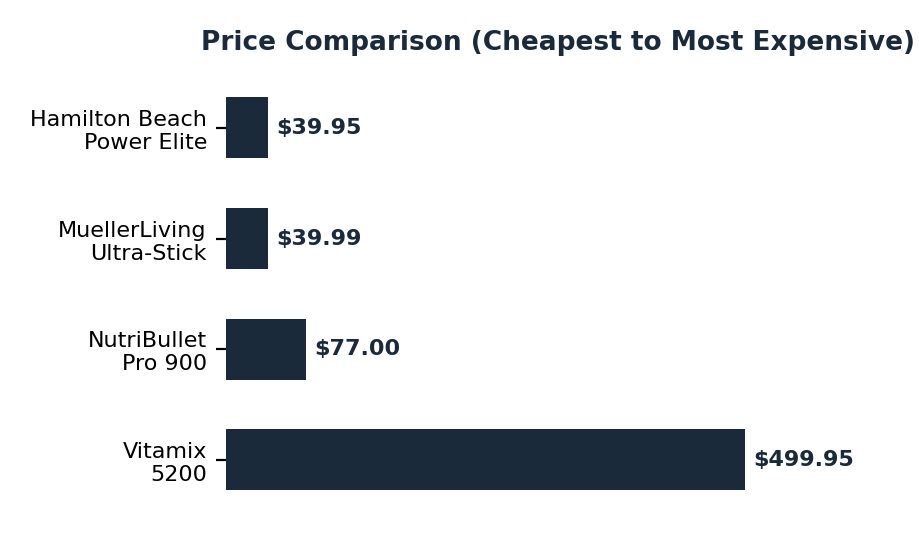
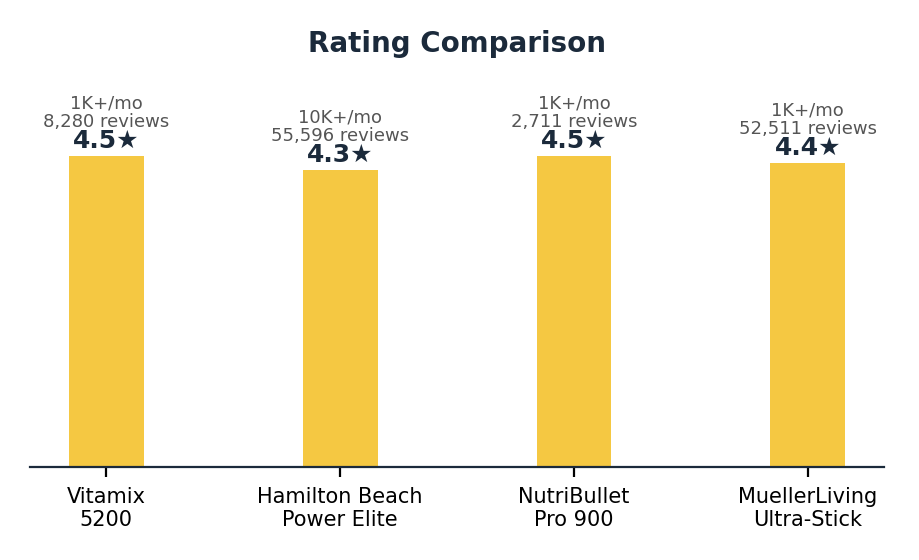
| Model | Type | Price | Rating | Bought/Mo | Check Price |
|---|---|---|---|---|---|
| Vitamix 5200 | High-Performance Countertop | $499.95 | 4.5★ (8,280) | 1K+ | View |
| Hamilton Beach Power Elite | Standard Countertop | $39.95 | 4.3★ (55,596) | 10K+ | View |
| NutriBullet Pro 900 | Personal | $77.00 | 4.5★ (2,711) | 1K+ | View |
| MuellerLiving Ultra-Stick | Immersion | $39.99 | 4.4★ (52,511) | 1K+ | View |
The bought-in-the-past-month figures are worth reading alongside the ratings. Hamilton Beach’s 10K+ figure at a 4.3★ average tells you it’s popular precisely because it’s an accessible, no-drama everyday blender — not because it’s chasing a premium audience.
Which Blender Type Should You Choose
Match your actual habits to a type below rather than buying on price or brand alone — this is the fastest version of how to choose a blender if you just want a direct answer.
| If you mostly make… | Best blender type | Example pick |
|---|---|---|
| Solo smoothies or protein shakes | Personal blender | NutriBullet Pro 900 |
| Family smoothies, soups, frozen drinks | High-performance countertop | Vitamix 5200 |
| Occasional soups, sauces, limited storage | Immersion blender | MuellerLiving Ultra-Stick |
| Everyday blending on a budget | Standard countertop | Hamilton Beach Power Elite |
Still unsure? Default to a standard countertop blender in the 700-watt range. It’s the widest-use option and the easiest to grow into as your needs change.
If You Mostly Drink Solo
- Skip the large jar. A 20–24 oz personal blender cup is the right size, not a downgrade.
- Prioritize cleanup speed. A blend-and-drink cup with no separate pitcher wins here.
If You Cook for a Household
- Go standard countertop at minimum, and consider high-performance if soups and sauces are a weekly habit.
- Check jar capacity against your typical batch size, not the largest number on the box.
If Storage Space Is Tight
- Consider an immersion blender first — it stores flat in a drawer instead of taking cabinet shelf space.
- Accept the smoothie tradeoff. It won’t fully replace a jar blender for ice-heavy drinks.
Blender Buying Guide Checklist: Final Steps Before You Buy
Before you add anything to cart, run through this quick blender buying guide checklist one more time.
- Matched wattage to what you’ll actually blend, not what sounds impressive.
- Picked a type — the types of blenders covered above are personal, standard countertop, high-performance, or immersion.
- Checked jar capacity against your typical serving size.
- Confirmed warranty length — high-performance models often run 5–10 years; budget models are usually 1–3.
- Considered noise level if you’ll be blending early or in a shared space.
- Checked the return window. Amazon’s standard 30-day window is usually enough to test a blender on your actual weekly recipes.
That last point matters more than it sounds. A blender that seems fine in the store or in a review can still turn out too loud, too small, or too underpowered once it meets your actual routine — test it in the first two weeks, not the last week of the return window.
This checklist is really the whole answer to how to choose a blender compressed into six lines. If every box is checked honestly, the blender you buy is very unlikely to end up back in its box.
According to Consumer Reports, entry-level blenders start around $20 while premium machines can run past $600, and higher prices generally do translate to better performance. That range is wide enough that matching the criteria above matters more than chasing a specific price point.
FAQ
How much wattage do I need in a blender?
Most households do fine with 500–700 watts for smoothies, sauces, and occasional ice. Go above 1,000 watts only if you crush ice daily, make nut butters, or blend fibrous vegetables regularly.
- Light use: 300–500 watts
- Everyday use: 500–700 watts
- Heavy/daily ice or nuts: 1,000+ watts
If you’re stuck between two wattage tiers, round up rather than down. A more powerful motor running on a low speed setting for delicate ingredients is a non-issue, but an underpowered motor straining on ice will shorten its own lifespan over time.
What’s the difference between an immersion blender and a countertop blender?
An immersion blender is handheld and works directly in a pot or bowl, while a countertop blender uses an enclosed jar. Immersion models are faster for soups and sauces but can’t replicate a countertop blender’s smoothie or ice-crushing performance.
Per KitchenAid’s own buying guide, an immersion blender goes directly into the food rather than the food going into it, which is exactly why it’s the better tool for pureeing soup or sauce right in the pot it was cooked in.
Do I need a high-powered blender to crush ice?
Not always, but it helps. Blenders under 500 watts can struggle or dull their blades on straight ice, while 700+ watt models handle it as a routine task rather than a strain.
If ice crushing is a daily habit — frozen margaritas, iced coffee, smoothie bowls — budget for at least 700 watts and check that the manufacturer specifically lists ice crushing as a supported function.
A quick way to spot-check this before buying: search the product’s own listing images and Q&A section for the words “ice” or “crush.” If a manufacturer is confident about that capability, they usually say so directly rather than leaving buyers to assume.
Final Verdict
How to choose a blender really comes down to being honest about how you’ll use it. Solo smoothies call for a personal blender. Daily ice, nut butters, and family-size batches call for a high-performance countertop model.
If you’ve read this far still unsure, that’s normal — most people default to whichever type matches how they cooked growing up. It’s worth overriding that instinct once and choosing based on your current kitchen, not a childhood one.
For most households, a 700-watt standard countertop blender like the Hamilton Beach Power Elite covers 90% of what you’ll ever blend, at a fraction of the price of a high-performance machine. If you blend daily and want a machine built to outlast a decade of smoothies, the Vitamix 5200 is the safer long-term buy.
If wattage is still the deciding factor for you, revisit the best blender wattage breakdown above before checking out — it’s the single number most likely to determine whether you’re happy with this purchase a year from now.
Tight on storage or mostly cooking for one? The MuellerLiving Ultra-Stick or NutriBullet Pro 900 respectively will outperform a bulky countertop model you rarely have room to use anyway.
Whatever you land on, the blender buying guide checklist above is worth a second pass right before checkout — it takes two minutes and it’s the difference between a blender you reach for daily and one that quietly moves to a cabinet after the second week.
As an Amazon Associate, this site earns from qualifying purchases made through links on this page, at no extra cost to you.