

Picking the best french press comes down to one thing most buying guides skip entirely: grind size. Get that wrong and even a $150 press turns out gritty, bitter coffee. Get it right, and a $25 model can out-brew presses three times its price.
If you just want the short answer, the Bodum Chambord has led this category for close to a century and currently holds a 4.6-star rating across 28,816 reviews at $39.95, verified live on Amazon.com this month. Grab it there, or keep reading for three more verified picks and the mistake that ruins most people’s first cup.
We checked live pricing, star ratings, and stock status directly on Amazon this month, and pulled real buyer feedback across the rating spread so you’re reading actual owner experience, not just spec sheets. No cords, no pods, no subscriptions required. Just coarse grounds, hot water, and four minutes of patience.
Table of Contents
- Best French Press: Top Picks at a Glance
- What to Look For in the Best French Press Coffee Maker
- Material: Glass, Stainless Steel, or Insulated
- Size and Capacity: How Much Coffee Do You Need
- Filtration and French Press Grind Size
- Coffee Press vs French Press: Same Machine, Different Name
- Full Best French Press Reviews
- Side-by-Side Comparison
- Decision Helper: Finding the Best Budget French Press for You
- Which One Should You Choose
- How Long Should a French Press Steep? Full Brewing Guide
- Frequently Asked Questions
- Final Verdict
Best French Press: Top Picks at a Glance
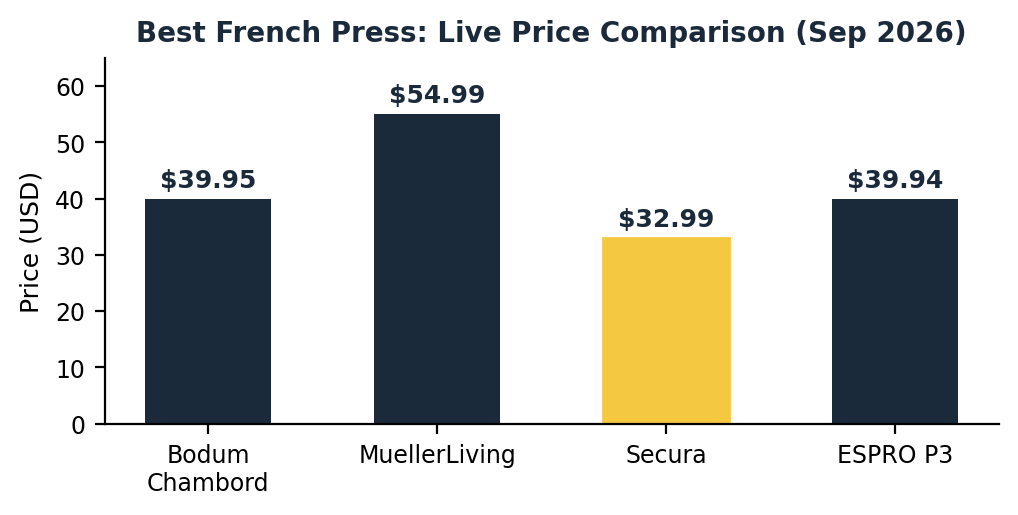
The best french press for most people is the Bodum Chambord 34oz: 4.6 stars across 28,816 reviews at $39.95 and a current Amazon’s Choice pick. It beats pricier stainless models on trust and track record, though the Secura 34oz Insulated is the stronger buy under $35.
Every price, rating, and stock status below came straight from Amazon’s live listings this month, not cached search data. Two of the four now cost more than our last check, and we’ve flagged that directly in each review rather than quietly updating the number.
| Model | Best For | Price | Rating | Bought/Mo | Check Price |
|---|---|---|---|---|---|
| Bodum Chambord 34oz | Best Overall | $39.95 | 4.6★ (28,816) | 600+ | Check Price |
| MuellerLiving 34oz | Best Rated | $54.99 | 4.7★ (35,268) | Not disclosed | Check Price |
| Secura 34oz Insulated | Best Budget French Press | $32.99 | 4.7★ (36,016) | Not disclosed | Check Price |
| ESPRO P3 32oz | Best Sediment-Free | $39.94 | 4.2★ (2,300) | 600+ | Check Price |
What to Look For in the Best French Press Coffee Maker
A french press has three parts: a carafe, a lid, and a plunger. Small differences in material and filtration change the cup far more than most buying guides let on.
Before you spend real money on the best french press for your kitchen, weigh four factors against how you actually drink coffee: material, capacity, filtration, and grind size. A single-cup drinker has almost nothing in common with a household brewing a full pot every morning, and the wrong size wastes both counter space and cash.
Material: Glass, Stainless Steel, or Insulated
Borosilicate glass carafes, like the one inside the Bodum Chambord, survive rapid temperature swings that would shatter ordinary glass. A single hard knock against a granite countertop still ends a glass press’s life instantly, which is the trade-off you’re accepting for being able to watch the brew.
Stainless steel models trade that visibility for durability, and double-walled insulated versions like the Secura and MuellerLiving keep coffee hot for an hour or more without a reheat. Neither will crack if it slides off the counter.
| Type | Trade-off |
|---|---|
| Glass carafe | Lets you watch the brew, costs less, cracks against hard surfaces |
| Single-wall steel | More durable than glass, but loses heat almost as fast |
| Double-wall insulated | Heaviest option, holds heat far longer for slow drinkers |
Size and Capacity: How Much Coffee Do You Need
Most standard presses hold around 34oz, which brews roughly four 8-ounce cups. That covers one or two people drinking daily without a second round.
Households brewing for a crowd should look at 50oz-plus capacity instead. Smaller 12 to 17-ounce presses exist too, aimed at solo drinkers who want one strong cup without leftover coffee going cold on the counter.
| Capacity | Who It Fits |
|---|---|
| 12 to 17oz | One strong cup, ideal for a single daily drinker |
| 34oz | The standard size, brews about four cups at once |
| 50oz and up | Built for households or guests who need a full pot |
Capacity also decides how long your press takes to clean. Larger carafes hold more spent grounds, meaning more rinsing before the mesh filter runs clear again.
Filtration and French Press Grind Size: Why Sediment Ruins Your Cup
A standard french press uses a single mesh filter, and grind size decides whether that filter actually does its job. Grind too fine and particles slip straight through the mesh. Grind too coarse and the coffee comes out weak and under-extracted.
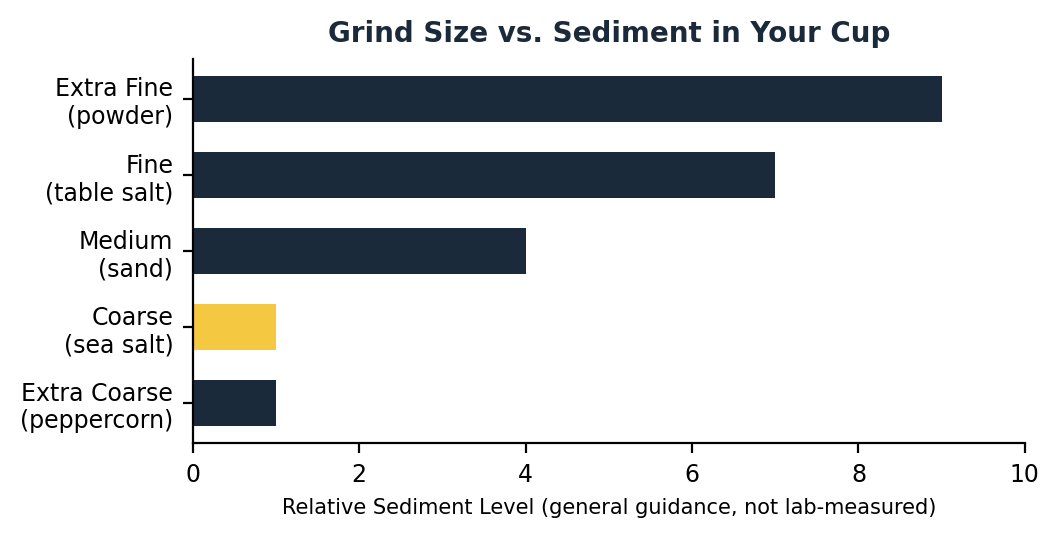
Aim for grounds that look like coarse sea salt, roughly 700 to 1,300 microns if your grinder has a digital readout. Pre-ground supermarket coffee is almost always cut for drip machines, closer to table salt, which is the single most common reason home brewers end up with a gritty cup.
Multi-layer filters, like the MuellerLiving’s 4-level system or the ESPRO P3’s double micro-filter, catch far more of that fine sediment than a single mesh screen, which is exactly why they command a price premium. Consumer Reports’ own coffee maker evaluations found double-layer mesh screens caught meaningfully more grounds than a single mesh in their most recent comparison, which lines up with what we found in ESPRO and MuellerLiving owner reviews.
If filtration matters more to you than price, a reliable burr grinder will do more for your cup than any press upgrade. A blade grinder produces an uneven mix of fine and coarse particles no matter how careful you are, and that inconsistency is what actually causes most sediment complaints, not the press itself.
Coffee Press vs French Press: Same Machine, Different Name
If you’re reading french press reviews and one product page calls itself a “coffee press” instead, it’s the exact same brewing method. Coffee press, cafetiere, and press pot are all names for the same plunger-over-mesh mechanism.
Retailers sometimes swap in “coffee press” to sidestep trademark language tied to specific brands, and the name shifts by region too. British listings often say “cafetiere,” while some older American catalog copy still says “press pot.”
Cost per cup is where a french press quietly beats pod-based machines and even a drip coffee maker over time. A bag of ground coffee lasts weeks and costs a fraction of what single-serve pods run, and the press itself has no consumable parts beyond an occasional filter screen.
Full Best French Press Reviews
We verified every price, rating, and review count below directly on Amazon’s live listings this month, not cached search snippets or older price-tracking data. Delivery location was confirmed at a US address (New York, 10001) before capturing any numbers, since Amazon can show different offers and prices depending on where a shopper browses from.
Bodum Chambord 34oz French Press — Best Overall
| Bodum Chambord Specs | |
|---|---|
| Material | Borosilicate glass carafe, stainless steel frame |
| Capacity | 34oz (about 4 cups) |
| Filtration | Standard mesh plunger filter |
| Price | $39.95 |
| Rating | 4.6★ (28,816 reviews), Amazon’s Choice, sold and shipped by Amazon.com |
The Bodum Chambord hasn’t changed its core design since the 1930s, and that’s precisely the point. Reviewers point to the snug filter seal and thick borosilicate glass as reasons it survives years of daily use where cheaper presses crack.
At $39.95, it sits in the middle of this lineup on price but leads on trust, with nearly 29,000 reviews behind that 4.6-star average. Amazon reviewers do flag one recurring issue worth knowing before you buy: the glass carafe can crack or break if it takes a hard knock, so this is not the pick for a busy shared kitchen counter.
Free delivery available with Amazon Prime
MuellerLiving 34oz French Press — Best Rated
| MuellerLiving Specs | |
|---|---|
| Material | Double-insulated stainless steel |
| Capacity | 34oz (about 4 cups) |
| Filtration | 4-level filtration system |
| Price | $54.99 |
| Rating | 4.7★ (35,268 reviews), Amazon’s Choice, ships from Amazon, sold by third-party seller KNDirect |
If you’re hunting for the best rated french press by the numbers alone, the MuellerLiving carries the highest review count of any model in this roundup, and its 4-level filtration system is the reason reviewers keep coming back. Amazon reviewers specifically note the build quality, with one buyer pointing out there are no visible seams or folds from manufacturing, an unusually specific detail for a budget-adjacent press.
Its price has climbed since we last checked, from $46.74 to $54.99, so weigh that against the Secura below before deciding. One more thing worth naming plainly: this listing ships from Amazon but is sold by a third-party seller (KNDirect), not Amazon.com directly, which doesn’t affect returns but is worth knowing upfront.
Free delivery available with Amazon Prime
Secura 34oz Insulated French Press — Best Budget French Press
| Secura Specs | |
|---|---|
| Material | 304-grade double-wall stainless steel |
| Capacity | 34oz (about 4 cups) |
| Filtration | Ships with 2 extra screens |
| Price | $32.99 |
| Rating | 4.7★ (36,016 reviews), ships from Amazon, sold by third-party seller Lafraise |
The Secura matches the MuellerLiving’s 4.7-star rating and edges it on review count, all while staying the cheapest model in this lineup. Its double-wall 304 stainless steel construction holds heat well and comes with two spare filter screens in the box.
Its price also moved since our last check, from $25.69 to $32.99. A verified US buyer’s four-star review sums up the one real trade-off well: solid build quality, but noticeably harder to clean than a glass press because you can’t see inside while rinsing. Like the MuellerLiving above, this listing ships from Amazon but is sold by a third-party seller (Lafraise).
Free delivery available with Amazon Prime
ESPRO P3 32oz French Press — Best Sediment-Free
| ESPRO P3 Specs | |
|---|---|
| Material | Borosilicate glass, stainless steel frame |
| Capacity | 32oz (about 4 cups) |
| Filtration | Patented double micro-filter |
| Price | $39.94 |
| Rating | 4.2★ (2,300 reviews), sold directly by ESPRO Inc., shipped by Amazon |
The ESPRO P3 exists to solve one specific complaint: grit at the bottom of the cup. Amazon reviewers confirm its patented double micro-filter genuinely keeps grounds out of the coffee, calling it “exceedingly easy to use” for the amount of filtration it provides.
Its 4.2-star rating trails the other three models here, worth knowing upfront. The real trade-off Amazon reviewers point to isn’t taste, it’s cleanup: several buyers say the double-filter mechanism is genuinely harder to take apart and rinse than a standard mesh press, which is the price of that grit-free cup.
Free delivery available with Amazon Prime
Side-by-Side Comparison
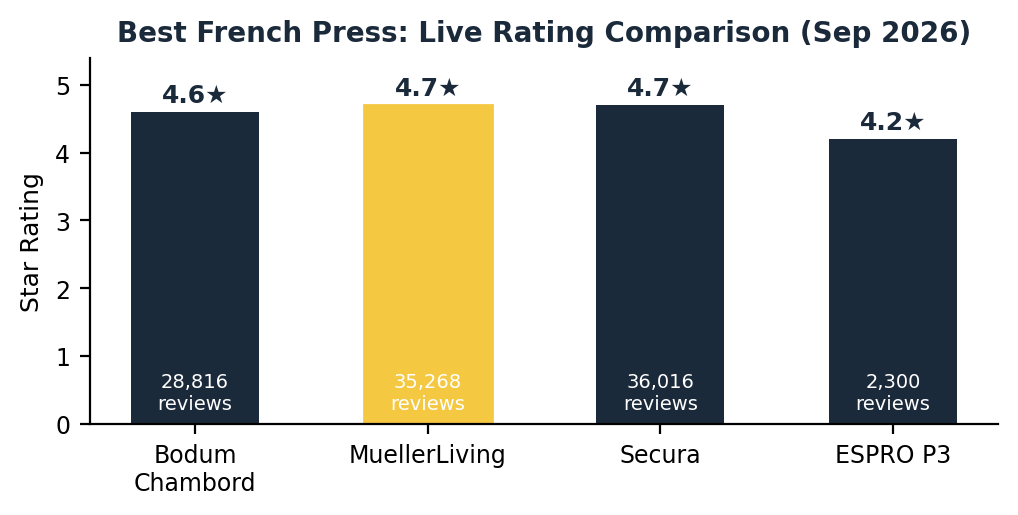
Here’s how all four best french press contenders stack up once the numbers are lined up side by side.
| Model | Material | Price | Rating | Reviews |
|---|---|---|---|---|
| Bodum Chambord | Glass + steel | $39.95 | 4.6★ | 28,816 |
| MuellerLiving | Insulated steel | $54.99 | 4.7★ | 35,268 |
| Secura | Insulated steel | $32.99 | 4.7★ | 36,016 |
| ESPRO P3 | Glass + steel | $39.94 | 4.2★ | 2,300 |
None of these four cross the 1,000-units-a-month threshold we require before showing a “bought” badge, even though all four sell steadily with tens of thousands of reviews between them. French press buying tends to be a slower, more considered purchase than an air fryer or blender.
Decision Helper: Finding the Best Budget French Press for You
Price alone won’t tell you which press fits your life. Run through these four real trade-offs before you check out.
Budget threshold: if you’re spending under $35, the Secura is the best budget french press in this roundup and still beats the Bodum on review count. Batch size: anyone brewing for more than two people daily should skip the 12 to 17oz travel presses entirely and go straight to a 34oz model.
Cleaning tolerance matters more than most buyers expect going in. If you hate scrubbing a mesh filter by hand, the Secura’s extra screens help, but the ESPRO P3’s double micro-filter takes noticeably longer to disassemble, per its own reviewers. Counter space and seller preference matter too: the Bodum and ESPRO P3 both ship and sell directly through Amazon.com or the brand itself, while the MuellerLiving and Secura currently ship through third-party marketplace sellers.
If a french press turns out to be the wrong fit entirely, a dedicated cold brew maker solves the sediment problem completely by skipping hot immersion altogether, and a stovetop coffee percolator is worth a look if you want a fully manual method with no plastic parts at all.
Which One Should You Choose
Choose the Bodum Chambord if…
- You want the classic design most coffee drinkers already recognize, sold and shipped directly by Amazon.com.
- You prefer watching the brew through a glass carafe and don’t mind handling it carefully.
- You value a nearly century-old design backed by the largest review history in this roundup.
Choose the MuellerLiving if…
- You want the highest-rated, most-reviewed option in this entire roundup.
- You drink slowly and need real insulation to keep coffee hot for an hour or more.
- You’re comfortable buying from a third-party marketplace seller shipped through Amazon.
Choose the Secura if…
- You’re buying your first french press and don’t want to overspend.
- You want the best insulated french press at the lowest price in this lineup.
- You don’t mind a bit more scrubbing at cleanup time in exchange for the lower price.
Choose the ESPRO P3 if…
- Sediment has bothered you in every french press you’ve owned before.
- You’re willing to trade a slightly lower star rating and slower cleanup for grit-free coffee.
- You want a listing sold directly by the brand itself, not a third-party reseller.
Still torn between a glass and a steel model generally? The best glass french press options (Bodum, ESPRO) let you watch extraction happen, while the best stainless steel french press picks (Secura, MuellerLiving) trade that visibility for real heat retention.
How Long Should a French Press Steep? Full Brewing Guide
Four minutes is the standard steep time for a french press, timed from the moment hot water hits the grounds. The best press in the world still makes a mediocre cup with the wrong technique, and grind size matters more here than in almost any other brewing method.
- Grind your coffee to a texture close to coarse sea salt. Finer grounds slip past the mesh filter and end up at the bottom of your cup.
- Heat water to just off boiling, around 200°F, then pour it evenly over the grounds.
- Let the coffee bloom for 30 seconds, stirring gently to release trapped carbon dioxide.
- Steep for a full 4 minutes, then press the plunger down slowly and evenly. Forcing it stirs up sediment you’d otherwise avoid.
- Decant right away into a mug or separate carafe. Leaving coffee sitting on the grounds turns it bitter within minutes.
America’s Test Kitchen’s most recent french press evaluation (updated July 2025) points to plunger resistance as a real quality signal. A smooth, even push with only slight resistance usually means a well-sealed filter, while a plunger that slides down with no resistance at all often means grounds are slipping past the mesh entirely.
Clean it after every use. Dried coffee oils build up quickly on a mesh filter and turn future cups bitter, and most carafes and plungers are dishwasher-safe even if hand-washing the lid extends its life.
Frequently Asked Questions
These are the three questions we see most often around the best french press, pulled from real reader searches and community threads rather than guessed at. CNN Underscored’s 2026 french press coverage lands on similar answers, especially on the french press vs drip coffee question below.
What’s the biggest mistake people make with a french press?
The single biggest french press mistake is using a grind that’s too fine, which lets fine particles slip past the mesh filter and turn your cup gritty and bitter. Coarse, sea-salt-sized grounds and a full 4-minute steep fix nearly every gritty-cup complaint.
| Do | Don’t |
|---|---|
| Grind coarse, like sea salt | Use pre-ground drip coffee |
| Steep for exactly 4 minutes | Leave coffee sitting on the grounds |
| Press slowly and evenly | Force the plunger down hard |
How long should a french press steep?
Four minutes is the standard steep time for a french press, timed from the moment you pour in hot water around 200°F. Steeping longer than that on a coarse grind starts pulling bitter compounds out of the grounds.
| Step | Target |
|---|---|
| Water temperature | Just off boiling, around 200°F |
| Grind size | Coarse, similar to sea salt |
| Bloom time | 30 seconds before the full steep |
Is a french press better than a drip coffee maker?
A french press produces a fuller-bodied, heavier cup than drip brewing because the metal filter lets natural coffee oils through that a paper filter would trap. A drip coffee maker wins on hands-off convenience and a cleaner, sediment-free cup.
| Method | What You Get |
|---|---|
| French press | Richer body, more control, needs active brewing time |
| Drip coffee maker | Hands-off convenience, cleaner cup, less intensity |
If you brew both styles depending on the morning, our drip coffee vs Americano breakdown and our look at how an espresso machine compares to drip brewing both cover the caffeine and flavor differences in more depth than we can fit here.
Final Verdict: Our Pick for Best French Press
For most people, the Bodum Chambord is the best french press to buy. It’s the design the category is built around, backed by nearly 29,000 reviews and a 4.6-star average sold directly through Amazon.com.
Want the single highest-rated option and don’t mind a third-party seller? Take the MuellerLiving instead, though its price has climbed since our last check. The Secura and ESPRO P3 each solve a different problem: a tight budget or a genuine grit complaint.
Whichever model you land on, get the grind right first. Pair any of these four with a proper burr grinder, kept clean using our guide on how to clean a coffee grinder, and even the budget pick outperforms an expensive press paired with pre-ground supermarket coffee.
Still exploring other brewing styles first? Our types of coffee makers guide and full coffee maker buying guide cover everything from a Chemex pour-over setup to the Technivorm Moccamaster to single-serve pod machines like Keurig vs Nespresso, so you can compare french press against every other method before you buy.
Free delivery available with Amazon Prime
As an Amazon Associate, homeapplianceowl.com earns from qualifying purchases made through links on this page.