

Bodum chambord french press buyers consistently praise its build quality, but the one flaw that decides whether it lasts is how you wash it. This review breaks down the real specs, the honest tradeoffs against the cheaper Bodum Brazil, and the buying mistake that causes most of the bad reviews. If you want the verdict first, the checkout link is right below.
Quick take: $39.69, 4.6★ (28,728 reviews), Amazon’s Choice, 1K+ bought last month. In stock now.
Free delivery available with Amazon Prime.
Table of Contents
- Bodum Chambord French Press at a Glance
- What to Look for in a Bodum Chambord Coffee Press
- Bodum Chambord French Press Coffee Maker: Frame and Glass Explained
- How to Brew Coffee With a Bodum Chambord French Press
- Choosing the Right Bodum Chambord Coffee Maker for Your Kitchen
- Full Review: Bodum Chambord French Press
- Bodum Chambord vs Brazil: Which Should You Buy
- The Real Buying Mistake Most Owners Make
- Who Should Buy the Bodum Chambord French Press
- Frequently Asked Questions
- Final Verdict
Bodum Chambord French Press at a Glance
Most bodum chambord review roundups agree on one thing: the build quality and brewing performance haven’t changed much since the 1950s design, and that’s largely a compliment. Here’s the snapshot before we get into the details.
This particular bodum chambord french press is the 34oz polished stainless steel version, sold directly by Amazon rather than a third-party marketplace seller. That matters for returns: Amazon-fulfilled listings carry the standard 30-day return window, while some marketplace sellers set shorter or stricter terms.
| Bodum Chambord French Press — Quick Specs | |
| Price | $39.69 |
| Rating | 4.6★ (28,728 reviews) |
| Amazon Badge | Amazon’s Choice |
| Bought Last Month | 1K+ |
| Capacity | 34oz / 8-Cup |
| Material | Borosilicate glass, polished stainless steel |
| Made In | Portugal |
What to Look for in a Bodum Chambord Coffee Press
The Chambord line comes in four sizes: 12oz (3-cup), 17oz (4-cup), 34oz (8-cup), and 51oz (12-cup). The 34oz is the one most people land on, and it’s the size this review covers.
Frame finish is the other real choice. Polished chrome is the standard and cheapest option, and both copper and matte finishes exist at a premium. If you want the copper version specifically, our broader french press roundup covers that variant alongside three other brands.
Locking lid or standard lid matters more than it sounds. The locking version turns to seal the spout closed during brewing, which cuts down on spills if you tend to walk away from the counter mid-brew.
A bodum chambord french press coffee maker with a locking lid also traps heat slightly longer during the four-minute brew, since the spout isn’t left open to the air. It’s a small difference, but noticeable if your kitchen runs cold in winter.
Price differences between finishes are mostly cosmetic rather than functional. A polished chrome bodum chambord coffee press and a matte chrome version brew identically; the only real difference is how fingerprints and water spots show up on the frame.
Bodum Chambord French Press Coffee Maker: Frame and Glass Explained
The carafe is borosilicate glass, chosen specifically for resistance to thermal shock rather than everyday impact resistance. That’s a deliberate engineering tradeoff, not a defect, but it does mean the glass is thinner than a typical drinking glass or mixing bowl.
The frame itself is stainless steel that’s gone through multiple chrome-plating passes, and it’s genuinely the sturdiest part of the whole unit. The plunger uses a three-part stainless mesh filter that’s designed to catch grounds without needing a paper filter.
Bodum has kept the core bodum chambord french press design essentially unchanged since it was acquired from Melior-Martin in 1991, and the current lineup is still manufactured in Portugal rather than outsourced. That continuity is part of why replacement parts remain compatible across model years.
Weight is worth noting too: the empty 34oz unit comes in at roughly 2.2 pounds, most of it concentrated in the steel frame and base rather than the glass. That balance actually helps stability — a full carafe sits lower and steadier on the counter than the glass weight alone would suggest.
One detail worth knowing: the same carafe and brewing method work for cold brew, not just hot coffee. If that’s part of your routine, our cold brew coffee maker guide covers dedicated options too, in case you’d rather keep hot and cold brewing separate.
Every bodum chambord french press ships with the same core parts: the glass carafe, the stainless steel frame, a plunger rod, and the three-piece filter plate. The glass, plunger, and filter are dishwasher safe on their own; it’s the frame’s plastic handle grip that Bodum recommends hand washing to preserve the finish.
Nothing else is included in the box — no scoop, no cleaning brush, and no instruction card beyond a basic diagram. That’s consistent across most manual french presses at this price point, so it isn’t a mark against this specific listing.
That distinction matters more than it looks on paper. A bodum chambord coffee maker that goes through the dishwasher whole, carafe included, is exactly the scenario owners describe when a carafe chips against a rack or another dish mid-cycle.
How to Brew Coffee With a Bodum Chambord French Press
Brewing with a bodum chambord french press takes about four minutes start to finish, and the process hasn’t changed since Bodum first put it on the market. Getting the ratio and timing right is what separates a full-bodied cup from a weak or over-extracted one.
- Measure grounds: use 2 rounded tablespoons of coarse-ground coffee per 8oz of water.
- Boil water: bring water to a boil, then let it sit 10-15 seconds before pouring.
- Pour and stir: pour over the grounds, leaving 1 inch of space at the top, then stir gently.
- Place the plunger: rest the plunger on top without pressing, and close the spout if using a locking lid.
- Wait four minutes: let the coffee steep undisturbed for a full four minutes.
- Press down slowly: push the plunger down with steady, even pressure, then pour immediately.
Coarse grounds matter here specifically because a bodum chambord coffee press uses a mesh filter rather than paper. Fine grounds slip through the mesh and end up as sediment in the cup, which is the most common complaint that has nothing to do with the hardware itself.
If your bodum chambord french press consistently produces a muddy or overly bitter cup, the fix is almost always grind size or steep time rather than the machine. Coffee shops that sell bags labeled for drip or espresso are ground too fine for this brewing method and will slip past the filter.
Ask for a “french press grind” specifically, or grind your own beans on the coarsest setting your grinder offers. That single change resolves most of the sediment and bitterness complaints attributed to the hardware.
Water temperature matters almost as much as grind size. Water straight off a rolling boil is slightly too hot and can scorch the grounds, which is why waiting those 10-15 seconds after boiling brings it closer to the 195-205°F range most coffee professionals recommend for immersion brewing.
If you don’t own a thermometer, timing the wait is a reliable substitute. Skipping that step is a small, easy-to-miss mistake that changes the flavor of a bodum chambord french press cup more than most people expect.
Choosing the Right Bodum Chambord Coffee Maker for Your Kitchen
For one or two coffee drinkers, the 17oz (4-cup) is usually enough without reheating a half-full carafe. For a household of three or more, or for anyone who refills a mug more than once, the 34oz bodum chambord french press reviewed here is the more practical pick.
The 51oz (12-cup) exists mainly for offices or larger gatherings. Coffee sitting in any french press longer than 20-30 minutes starts to over-extract and taste bitter, so bigger isn’t automatically better for daily solo use.
Still deciding between brewing methods entirely, not just sizes? Our coffee maker buying guide walks through drip, pour-over, and french press side by side before you commit to this style.
Full Review: Bodum Chambord French Press
Bodum Chambord 34oz French Press, Polished Chrome
| Specs | |
| Capacity | 34oz (8-Cup) |
| Frame | Polished stainless steel |
| Carafe | Borosilicate glass |
| Filter | 3-part stainless mesh |
| Dishwasher Safe | Yes (glass, plunger, filter) |
| Price | $39.69 |
This is the classic version of the Chambord — the one most people picture when they hear the name. At 4.6★ across 28,728 reviews with an Amazon’s Choice badge and 1K+ bought last month, it’s also the best-documented french press on the platform by review volume.
Editorial coverage from outlets like RTINGS and Consumer Reports consistently ranks the Chambord among the top beginner-friendly manual brewers, citing the simple four-minute process and minimal parts to clean. The tradeoff, covered in detail further down, is the glass carafe’s fragility under rough handling.
A long-time owner on a coffee-focused forum described owning multiple Chambord units over the years, replacing the carafe when it eventually cracked, and buying another Bodum rather than switching brands. That pattern shows up across owner communities more than any single bad batch complaint.
For day-to-day use, a bodum chambord french press earns back its price through simplicity rather than any single standout feature. There’s no cord, no filter to buy, and no descaling schedule to track — just grounds, hot water, and four minutes.
Free delivery available with Amazon Prime.
Bodum Chambord vs Brazil: Which Should You Buy
The chambord french press and the Bodum Brazil use the identical borosilicate glass beaker and the same three-part filter system. The coffee that comes out of either one is, for practical purposes, the same cup.
The real difference is the frame. Chambord uses chrome-plated stainless steel; Brazil uses a BPA-free plastic frame. That construction difference is also most of the price gap you’ll see below.
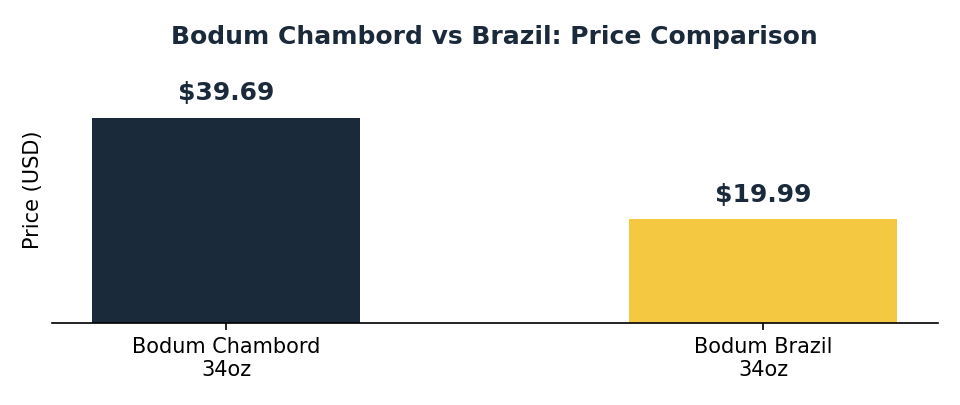

| Model | Price | Rating | Frame | Buy |
| Bodum Chambord 34oz | $39.69 | 4.6★ (28,728) | Stainless steel | Check Price |
| Bodum Brazil 34oz | $19.99 | 4.5★ (19,919) | BPA-free plastic | Check Price |
Choose Chambord if the stainless steel look matters to you, or if you want a frame that will outlast the glass carafe itself. Choose Brazil if you just want the same coffee for roughly half the price and don’t mind a plastic frame.
Cleaning is identical between the two since the glass carafe, plunger, and filter are the same part on both models. The only maintenance difference shows up years down the line: a stainless frame won’t crack or discolor the way a plastic frame eventually can under repeated heat exposure and years of daily dishwashing.
Neither a bodum chambord french press nor the Brazil comes with a spare carafe in the box, so budgeting for a replacement glass at some point is realistic regardless of which one you choose. Factor that into the total cost of ownership rather than judging purely on the sticker price of either model.
The Real Buying Mistake Most Owners Make
The most consistent complaint across owner communities isn’t the coffee quality — it’s the glass carafe breaking. A recurring Slickdeals thread on the Chambord’s smaller sibling drew over two dozen comments from long-term owners describing exactly this.
One commenter on that thread said the glass will “shatter if you even sneeze near it”, and a separate owner on a coffee enthusiast forum described breaking multiple carafes over the years despite careful use. But the thread also included pushback: other long-term owners reported years of daily use with zero breakage, pointing to the product’s 4.6★ aggregate as the more representative outcome.
The pattern that emerges isn’t manufacturing defects — it’s specific handling triggers. Metal utensils striking the glass while stirring, drying racks that let the carafe tip and knock against a hard edge, and dishwasher racking that lets it bump other items are the recurring causes owners describe.
Worth knowing for context: the U.S. Consumer Product Safety Commission issued a 2014 recall covering Bodum’s rose-gold, locking-lid Chambord press sold through Starbucks, after reports the carafe could fall out of its frame. That recall applied specifically to the rose-gold Starbucks-exclusive model, not the polished chrome version reviewed here, but it’s a fair data point on the product line’s known failure mode.
The actual mistake most buyers make isn’t picking the Chambord — it’s treating the carafe like ordinary glassware. Use a wooden or plastic stirring spoon, hand wash when possible, and give the carafe its own space on the drying rack instead of leaning it against other dishes.
It’s also worth confirming the listing before checkout. Buying a bodum chambord french press sold and shipped by Amazon directly, rather than a third-party marketplace seller, generally means faster replacement processing if a carafe does arrive damaged in transit.
Who Should Buy the Bodum Chambord French Press
- Coffee drinkers who want a full-bodied cup without buying paper filters or pods.
- Kitchen aesthetics matter to you, and the stainless steel frame fits your counter setup better than plastic.
- One-to-three-person households who’ll actually finish a full 34oz carafe before it goes cold.
- Buyers comfortable hand washing a glass carafe rather than tossing everything in the dishwasher daily.
On the other hand, a bodum chambord french press probably isn’t the right fit for everyone. A few situations where it makes sense to look elsewhere:
- Frequent movers or campers who need something less breakable than glass.
- Dishwasher-only households who won’t realistically hand wash a carafe regularly.
- Sediment-sensitive drinkers who prefer a completely clean cup over french-press body.
If low-sediment coffee matters more to you than the classic french press body, it’s worth comparing against a pour-over setup instead — our pour-over coffee maker guide covers that alternative in detail.
Frequently Asked Questions
Is the Bodum Chambord French Press Worth It in 2026?
Yes, for most buyers who want a manual brewer with a stainless steel frame and don’t mind hand-washing the glass carafe. The main risk is carafe breakage from rough handling, not the coffee quality itself. A bodum chambord french press bought today uses the same design that’s held up since the 1950s, which says something about how little there is to actually go wrong.
- Best for: daily manual brewing without paper filters or pods.
- Watch for: metal utensils and dishwasher edge-knocks against the glass.
- Skip if: you want zero-maintenance dishwasher-only cleanup.
What’s the Difference Between Bodum Chambord and Bodum Brazil?
The glass carafe and filter system are identical between both models. The only real difference is the frame material: stainless steel on the Chambord, BPA-free plastic on the Brazil. Comparing bodum chambord vs brazil side by side, the coffee itself comes out the same either way.
- Chambord: $39.69, stainless steel frame, 4.6★.
- Brazil: $19.99, plastic frame, 4.5★.
Are Bodum Chambord Replacement Parts Easy to Find?
Yes. Replacement glass carafes, filter screens, and plunger assemblies are sold directly on Amazon and through Bodum’s own site, typically for less than a third of the full unit’s price. Since a bodum chambord french press and the Brazil share compatible carafe sizes, spare parts are easy to cross-shop between listings too.
- Spare carafes: sized to match 12oz, 17oz, 34oz, and 51oz models.
- Filter screens: sold individually or in multi-packs.
Final Verdict
The bodum chambord french press earns its reputation honestly. The coffee is genuinely full-bodied, the stainless frame is durable, and at 4.6★ across nearly 29,000 reviews, most owners are satisfied long after the return window closes.
Buy it if you want the classic stainless steel look and are willing to hand wash the carafe. Buy the Brazil instead if you want the identical cup of coffee for roughly half the price and don’t mind a plastic frame. Either way, treat the glass gently and it will likely outlast the return window by years, not weeks.
Free delivery available with Amazon Prime.
This post contains affiliate links. If you buy through them, we may earn a commission at no extra cost to you.