
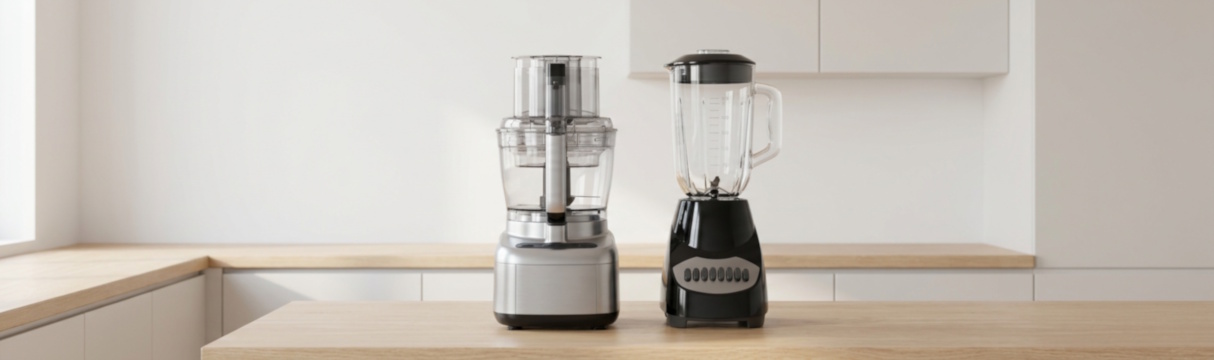
Food processor vs blender comes down to moisture and blade design: a food processor wins for dry, dense, or chunky prep like dough, shredding, and chopping, while a blender wins for anything liquid-based like smoothies, soups, and purees. Most home cooks eventually need both, but if you’re choosing one first, base it on whether you cook more solid food or more liquid food.
If you’re stuck picking just one appliance right now, the Hamilton Beach 70730 Food Processor is the safer first purchase for most kitchens, it handles more of the tasks a blender can’t touch (shredding, kneading, slicing) than a blender can cover in reverse. If smoothies and soups are your main use case, though, the Ninja BL610 Professional Blender is the better first buy. We’ll walk through exactly why below, task by task, rather than just telling you to get both.
This isn’t a trivial distinction. Buy the wrong one first and you’ll spend six months trying to make salsa in a blender (watery mess) or a smoothie in a food processor (leaks everywhere, chunky texture). The rest of this food processor vs blender guide breaks down precisely where each appliance wins, using two verified current models as reference points.
Table of Contents
- Top Picks at a Glance
- What to Look For Before You Buy
- Is a Food Processor and Blender the Same?
- Difference Between Food Processor and Blender
- Full Reviews: Our Top Picks
- Side-by-Side Comparison
- Can I Use a Blender Instead of a Food Processor?
- Food Processor vs Immersion Blender
- Which One Should You Buy?
- Frequently Asked Questions
- Quick Recap
- Final Verdict
Top Picks at a Glance
Before the full food processor vs blender breakdown below, here’s the short version: these are the two products we’d actually put in a cart.
| Product | Best For | Rating | Bought/Mo | Buy |
|---|---|---|---|---|
| Hamilton Beach 70730 Food Processor | Chopping, shredding, dough, dense prep | 4.5★ (41,391) | 3K+ | Check Price |
| Ninja BL610 Professional Blender | Smoothies, soups, purees, ice crushing | 4.6★ (57,042) | 7K+ | Check Price |
What to Look For Before You Buy
Every food processor vs blender buying decision comes down to the same three things: bowl and jar shape (wide and shallow vs tall and narrow), blade design (S-blade with interchangeable discs vs a single fixed blade), and liquid tolerance (food processors leak with thin liquids, blenders need a minimum liquid volume to blend at all). Motor wattage matters less than most buying guides suggest.
Bowl and jar shape. A food processor bowl is wide and shallow, which is exactly why it chops evenly instead of pureeing, food stays close to the blade in a thin layer rather than getting pulled into a vortex. A blender jar is tall and narrow specifically to create that vortex, pulling everything down toward the blade repeatedly until it’s smooth.
Blade and attachment design. Food processors ship with a sharp S-blade for chopping plus separate discs for slicing and shredding, that’s the whole reason they can make coleslaw or hash browns and a blender can’t. Blenders have one fixed, less aggressive blade built for continuous liquid motion, not for grating cheese or slicing potatoes.
Liquid tolerance. This is the detail most buying guides skip. Food processor lids aren’t sealed the way blender lids are, so thin liquids (broth, milk, watery smoothies) will leak out around the feed tube opening. Blenders, by contrast, need a minimum amount of liquid in the jar just to create the vortex that pulls food down to the blade, try blending something too thick or dry and you’ll get a stuck, unmixed clump instead.
Noise and cleanup. This rarely makes it into a food processor vs blender comparison, but it should. Food processors run at lower RPM and sound more like a kitchen mixer; high-wattage blenders like the Ninja BL610 are noticeably louder at full speed, closer to a garbage disposal for a few seconds. On cleanup, food processor bowls, blades, and discs all go in the dishwasher but take up more rack space; a blender jar is one piece and easier to hand-rinse between uses.
If you’re setting up a kitchen from scratch and trying to figure out which appliances actually earn counter space, our full new-kitchen appliance checklist covers where a food processor and blender both rank against the rest of your must-haves.
Is a Food Processor and Blender the Same?
No, a food processor and blender are not the same appliance, despite both using spinning blades and a motor. A food processor uses a wide, shallow bowl with interchangeable blades and discs built for chopping and shredding solid food; a blender uses a tall, narrow jar with one fixed blade built for liquefying and pureeing. The confusion comes from overlapping tasks like hummus and pesto, which both can technically make. It’s a fair question to ask, since so many food processor vs blender comparisons gloss over exactly why they’re different.
The overlap is real but narrow. Both appliances can make hummus, pesto, and salad dressing reasonably well, and that’s usually where the confusion starts. Push past those three overlap tasks, though, and the two machines diverge hard: try shredding a block of cheddar in a blender and you’ll get an unusable paste; try making a silky tomato bisque in a food processor and you’ll get a chunky, leaking mess. That gap alone answers whether a food processor and blender are the same tool wearing two names, they aren’t.
Difference Between Food Processor and Blender: Blade Design and Bowl Shape
The core difference between food processor and blender designs is bowl geometry paired with blade type. A food processor’s wide, shallow bowl plus swappable S-blade and slicing/shredding discs create even chopping with minimal liquid. A blender’s tall, narrow jar plus a single fixed blade create a vortex that liquefies food, which is why it needs liquid to function at all.
Motor wattage gets thrown around in a lot of buying guides as the deciding factor, but it isn’t. The Hamilton Beach 70730 runs at 450W and the Ninja BL610 runs at 1000W, more than double, yet the food processor is still the better tool for kneading dough, because wattage doesn’t change what the bowl shape and blade geometry are built to do. A higher-wattage blender still can’t shred a carrot; a food processor still can’t make a silky-smooth soup.
According to a comparison published by America’s Test Kitchen, food processors tend to produce a coarser texture on purees than a blender does, since food travels through a larger bowl and contacts the blade less frequently, a texture difference they treat as a preference for certain applications like pesto rather than as a flaw, a distinction covered in more depth in our food processor roundup.
Full Reviews: Our Top Food Processor and Blender Picks
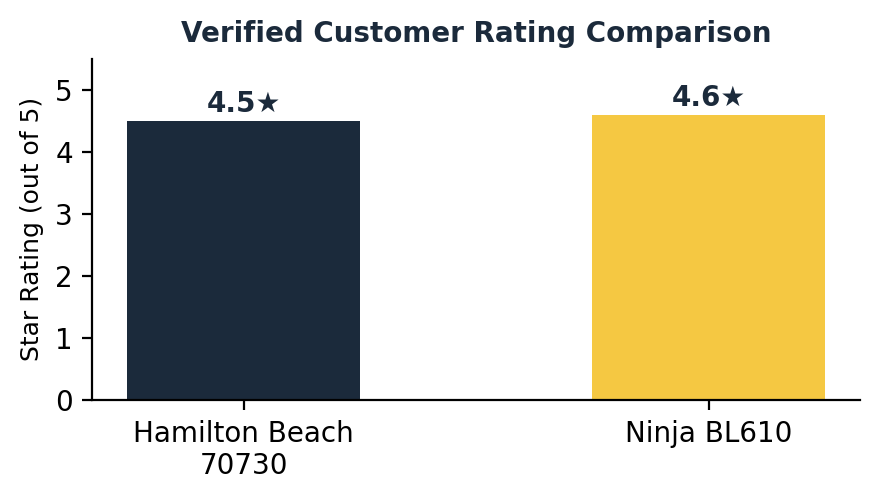
The Hamilton Beach 70730 (10-cup, $59.99, 4.5★) is the strongest all-around food processor pick for most home kitchens, and the Ninja BL610 (72oz, $99.00, 4.6★) is the strongest all-around blender pick, both verified in-stock and sold directly by Amazon.com as of this review. Together, they’re the two products we’d point to first in any food processor vs blender comparison.
Hamilton Beach 70730 Food Processor
| Hamilton Beach 70730 Specs | |
|---|---|
| Capacity | 10-cup bowl |
| Motor | 450W |
| Speeds | 2 speeds + pulse |
| Attachments | S-blade, slicing/shredding disc, bowl scraper |
| Price | $59.99 |
| Rating | 4.5★ (41,391 ratings) |
The 450W motor sounds modest next to the Ninja’s 1000W, but that’s the wrong comparison to make, this appliance was never meant to liquefy anything. What it does well is chop a whole onion into an even dice in under ten seconds and shred a block of cheddar without turning your hands orange. The built-in bowl scraper is a small but genuinely useful touch: it folds ingredients back toward the blade mid-process so you’re not stopping every 20 seconds to scrape down the sides by hand.
Real buyers consistently point to the same two things: the motor handles tough ingredients (whole vegetables, raw chicken for grinding, thick dough) without bogging down, and it’s saved them from hand-chopping fatigue on recipes they used to avoid making. The recurring complaint is the rotary speed dial, which several long-term owners describe as sticky or fussy after a year or two of regular use, worth knowing going in, since it’s the one part of the unit that isn’t a simple button press. Nothing here changes the broader food processor vs blender calculation, though, it’s still the strongest all-around food processor pick at this price.
Free delivery available with Amazon Prime
Ninja BL610 Professional Blender
| Ninja BL610 Specs | |
|---|---|
| Capacity | 72oz pitcher (64oz max liquid) |
| Motor | 1000W |
| Technology | Total Crushing blades |
| Material | BPA-free, dishwasher-safe pitcher |
| Price | $99.00 |
| Rating | 4.6★ (57,042 ratings) |
1000W paired with the Total Crushing blade design means this handles frozen fruit and ice straight from the freezer without pre-thawing, the single biggest complaint about weaker blenders. The 72oz pitcher is genuinely family-sized: two full servings of smoothie at once without running a second batch, which matters more than most spec sheets let on if you’re making breakfast for more than one person.
Buyers who’ve owned this for years report it’s still running strong on daily smoothie use, which is a meaningful signal given how many blenders burn out motors within 12 to 18 months of heavy use. The trade-offs buyers flag most: it’s loud (expected at this wattage) and the pitcher’s height means it won’t slide under some upper cabinets without removing the lid first, worth a quick cabinet-clearance check before you buy if counter space is tight. On the blender side of the food processor vs blender comparison, this is the model we’d recommend without hesitation.
For a closer look at where this fits against other Ninja models, our full Ninja blender lineup comparison breaks down the wider family.
Free delivery available with Amazon Prime
Food Processor vs Blender: Side-by-Side Comparison
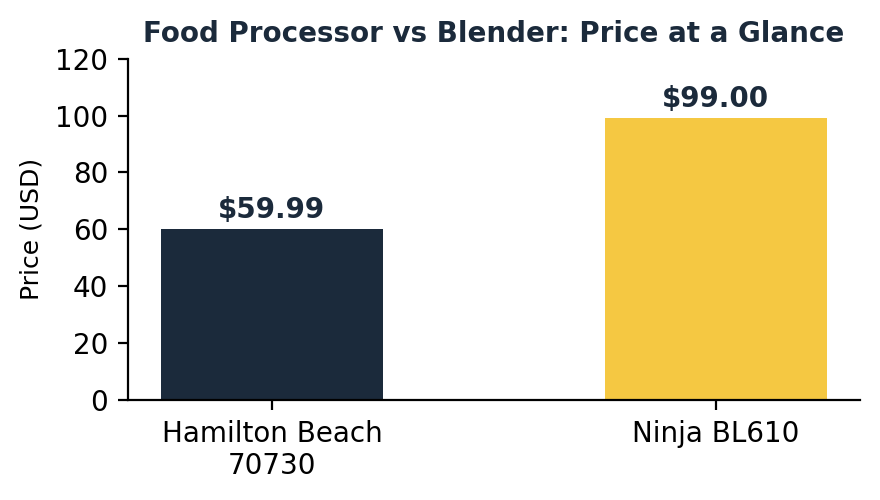
Comparing directly, the Hamilton Beach 70730 wins on price ($59.99 vs $99.00), versatility of attachments, and dry/dense food handling. The Ninja BL610 wins on liquid handling, ice crushing, and single-serve smoothie speed. Neither wins outright, the right pick depends entirely on which task category you cook more often. This is the heart of the food processor vs blender debate: two appliances built for opposite ends of the same kitchen.
| Category | Hamilton Beach 70730 | Ninja BL610 |
|---|---|---|
| Price | $59.99 | $99.00 |
| Rating | 4.5★ (41,391) | 4.6★ (57,042) |
| Bought/Mo | 3K+ | 7K+ |
| Best For | Chopping, shredding, dough | Smoothies, soups, ice |
| Where to Buy | Check Price | Check Price |
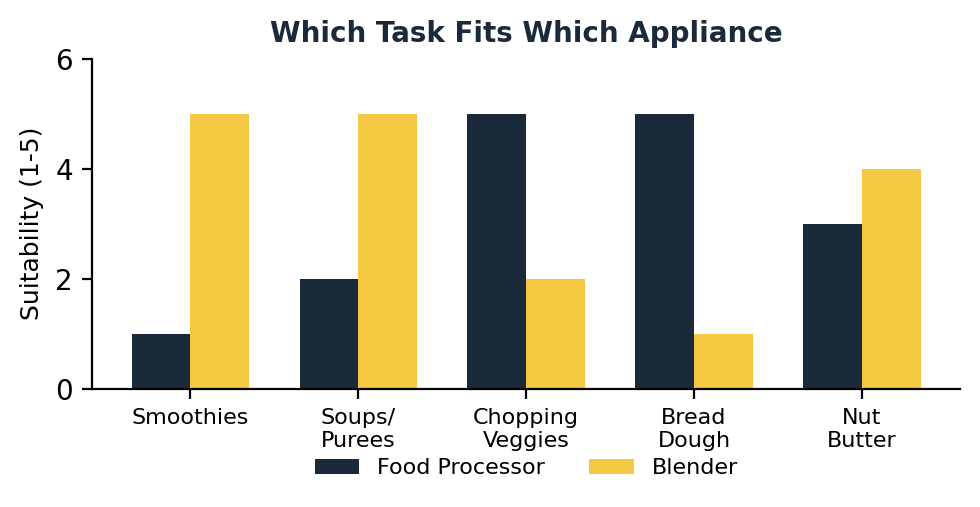
Notice the pattern in that chart: there’s almost no overlap in the tasks each appliance actually excels at. That’s the real answer to the question of whether these are the same appliance, they’re built for opposite ends of the moisture spectrum, and the tasks in the middle (hummus, pesto) are the only real gray zone.
Can I Use a Blender Instead of a Food Processor?
You can use a blender instead of a food processor for wet or semi-liquid tasks like hummus, pesto, and thin batters, but not for dry chopping, shredding, or kneading dough, a blender’s fixed blade and sealed jar aren’t built for those textures and will either jam or turn the food into a paste.
Where the swap works: smoothies, soups, salad dressings, and thin sauces all blend fine either way, since these all lean liquid-heavy already. A high-powered blender like the Vitamix 5200 can even pulse dry ingredients briefly without much trouble, which is usually the strongest case for whether you can use a blender instead of a food processor on a given day.
Where it fails: try shredding cabbage for coleslaw in a blender and you’ll get a wet, over-processed mush instead of crisp shreds, because the blender jar pulls everything down into the vortex repeatedly rather than letting it pass the blade once. Bread dough is worse, the motor simply isn’t built to handle that resistance, and you risk burning it out. If you’re asking whether you can use a blender instead of a food processor for anything beyond that liquid-heavy list, the answer is almost always no.
According to comparison coverage from TechRadar, the deciding factor for whether a swap works comes down to whether the recipe needs liquid to move, which is a genuinely useful gut check to run before reaching for whichever appliance is already out on the counter. It’s the same logic that governs food processor vs blender decisions in general.
Food Processor vs Immersion Blender
A food processor and an immersion blender solve different problems than a food processor and a full-size blender do. An immersion blender purees directly in the pot (great for soups without transferring hot liquid), while a food processor still requires transferring food into its bowl, but the food processor still wins on chopping, shredding, and dough that an immersion blender can’t do at all. Think of food processor vs immersion blender as a narrower, liquid-only offshoot of the main food processor vs blender question.
If your main use case is pureeing soup directly in the pot without dirtying a second container, our full immersion blender buying guide is worth reading before you assume a food processor covers that job, it doesn’t, not without a lot of careful ladling and a real burn risk from transferring hot liquid. It’s a close cousin to the “is a food processor and blender the same” question, just narrowed to one specific blender type.
Which One Should You Buy?
Buy the Hamilton Beach 70730 food processor first if you cook more solid food than liquid food, chopping vegetables, shredding cheese, making dough. Buy the Ninja BL610 blender first if smoothies, soups, or frozen drinks are your primary use case. If your cooking is genuinely split evenly, the food processor edges out as the more versatile first purchase in this food processor vs blender matchup.
Choose the Hamilton Beach 70730 if:
- You cook meals that start with chopped onions, garlic, or peppers most nights
- You make your own bread, pizza dough, or pie crust regularly
- You want to shred cheese or slice vegetables without a hand grater
Choose the Ninja BL610 if:
- Smoothies or protein shakes are a near-daily habit
- You make soups you want silky-smooth, not chunky
- Crushed ice or frozen drinks come up often in your kitchen
Read back over both lists side by side, they’re basically a plain-language version of the food processor vs blender split we’ve been building toward this whole guide.
Still torn between the two appliance categories entirely, rather than these two specific models? Our rice cooker vs Instant Pot comparison uses the same task-first decision framework if you’re outfitting a kitchen and weighing multiple appliance categories at once, the same logic that makes the food processor vs blender choice easier once you name the task first.
Frequently Asked Questions
Do You Need Both a Food Processor and a Blender?
Most home cooks who cook regularly end up needing both within a year or two, because the overlap tasks (hummus, pesto) are narrower than they first appear. If you’re only buying one right now, base the choice on which task category comes up more in your actual weekly cooking.
- Cook mostly stir-fries, salads, baked goods: start with the food processor
- Cook mostly smoothies, soups, sauces: start with the blender
- Genuinely 50/50: the food processor edges ahead on raw versatility
The honest reason most kitchens eventually own both comes down to how narrow the true overlap actually is. Once you’ve made hummus and pesto in either appliance a few times, the differences in daily cooking (chopping an onion, shredding cheese, blending a smoothie) push you toward owning one of each within a year or two, not because marketing convinces you to, but because the task list genuinely splits that way.
Can a Food Processor Replace a Blender?
A food processor can replace a blender for thicker tasks like hummus, nut butter, and pesto, but it can’t replace a blender for smoothies or silky soups, the wide, shallow bowl doesn’t create the vortex a blender jar does, so thin liquids stay separated instead of emulsifying. The reverse question, whether you can use a blender instead of a food processor, has a similar answer: it works for liquid-heavy jobs and fails for dry, dense ones.
- Works: dips, spreads, thick sauces
- Doesn’t work: smoothies, ice crushing, silky purees
- Risk: thin liquids leak from the feed tube opening
The clearest way to tell if a food processor can cover the job is to check how much liquid the recipe calls for relative to solids. A thick hummus or nut butter has more solid content than liquid, so the food processor’s wide bowl and S-blade handle it fine. A gazpacho or a fruit smoothie is mostly liquid, and that’s exactly the kind of recipe a food processor vs blender comparison always comes back to a blender for.
Is a Food Processor and a Blender the Same Thing?
No. They share a motor-and-blade design in the broadest sense, but the bowl shape, blade geometry, and liquid requirements are built for opposite jobs, one for chopping dry or dense food, the other for liquefying wet food into a smooth consistency. If you’ve read this far wondering whether a food processor and blender are the same, the short version is: close cousins, not twins.
- Food processor: wide bowl, S-blade and discs, minimal liquid needed
- Blender: narrow jar, single fixed blade, liquid required to function
- Shared ground: hummus, pesto, salad dressing
Quick Recap: Food Processor vs Blender
Run through the whole food processor vs blender decision one more time, in plain terms. A food processor handles dry, dense, and chunky prep: chopping vegetables, shredding cheese, kneading dough, and grinding nuts into butter. A blender handles anything liquid-heavy: smoothies, soups, sauces, and crushed ice. The difference between food processor and blender designs isn’t a marketing distinction, it’s a structural one, built into the shape of the bowl and the blade sitting inside it.
If you’ve been asking whether a food processor and blender are the same appliance under two different names, the honest answer is no. They overlap on a handful of tasks (hummus, pesto, dressing) and diverge everywhere else. And if you’re weighing whether you can use a blender instead of a food processor for an upcoming recipe, the safest rule of thumb is this: if the recipe needs liquid to move, the blender wins; if it needs to stay dry and chunky, the food processor wins.
For a narrower comparison than this one, remember that food processor vs immersion blender is really a question of where you want the puree to happen, in the bowl or directly in the pot, not a question of raw power.
Final Verdict
If you’re buying one appliance today and your cooking leans toward solid, dense, or dry ingredients, get the Hamilton Beach 70730 Food Processor. If smoothies, soups, or frozen drinks are the bigger part of your routine, get the Ninja BL610 Professional Blender. Neither purchase locks you out of the other appliance later, most kitchens that cook seriously end up owning both within a year. That’s the real takeaway from this food processor vs blender comparison: it’s not about picking a permanent winner, it’s about matching the appliance to what you’re actually cooking this week.
This post contains affiliate links. As an Amazon Associate, we earn from qualifying purchases at no extra cost to you.