

The Zojirushi neuro fuzzy rice cooker family has one clear winner for most home cooks: the NS-ZCC10, because its onboard logic chip adjusts for cooking mistakes that would ruin rice in a basic cooker. It sits in the middle of Zojirushi’s lineup on price, but it’s the brand’s most reviewed model with a real track record behind it.
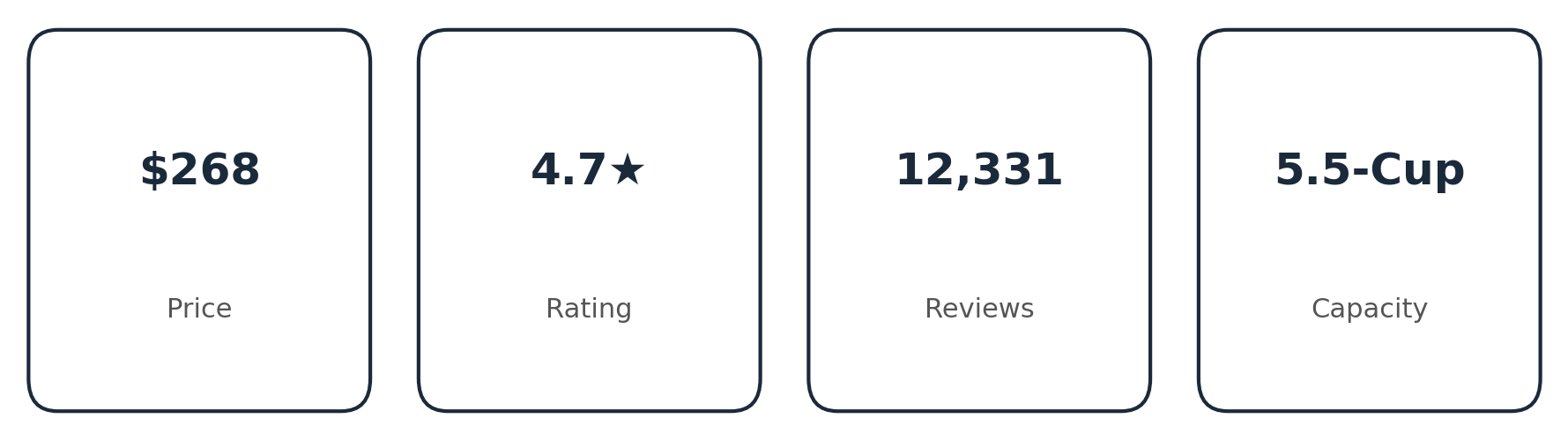
At $268, this isn’t an impulse buy. It carries an Amazon’s Choice badge and holds a 4.7-star average across 12,331 ratings. If you already know it’s the one you want, you can check the current price on Amazon before reading the rest of this breakdown.
Zojirushi has been making rice cookers and vacuum-insulated products out of Osaka since 1918, and the company’s own listing content leans on that history rather than flashy marketing language. That’s part of why this specific model still shows up in “best rice cooker” discussions well over a decade after it first launched.
This review covers what the Zojirushi NS ZCC10 actually does differently, how it holds up according to real owners, and where it sits against the rest of the Zojirushi range. Jump to any section below.
Table of Contents
- Quick Verdict: Who Should Buy the Zojirushi NS-ZCC10?
- Zojirushi NS ZCC10: Full Specs at a Glance
- Zojirushi Neuro Fuzzy: How the Technology Actually Works
- What’s Actually Inside the Box?
- How Does the Rice Actually Turn Out?
- Zojirushi Rice Cooker Review: What Owners Say After Months of Use
- How Does It Compare to the Rest of the Zojirushi Lineup?
- Is Zojirushi Rice Cooker Worth It in 2026?
- Care and Cleaning Tips
- Frequently Asked Questions
- Final Verdict
Quick Verdict: Who Should Buy the Zojirushi NS-ZCC10?
If you eat rice a few times a week and don’t want to babysit a pot or guess at water ratios, this Zojirushi neuro fuzzy rice cooker is worth the price. It handles white, brown, sushi, porridge, and mixed rice without you needing to adjust anything by hand.
If you cook rice rarely, or you’re feeding one or two people once in a while, a cheaper Micom model from the same brand gets you most of the way there for less money. We cover that tradeoff further down.
Zojirushi NS ZCC10: Full Specs at a Glance
Here’s every verified spec for this Zojirushi neuro fuzzy rice cooker, pulled directly from the live Amazon listing rather than the manufacturer’s marketing copy.
| Zojirushi NS-ZCC10 Neuro Fuzzy Rice Cooker | |
| Capacity | 5.5 cups uncooked (up to 10 cups cooked) |
| Technology | Neuro Fuzzy logic with thermal sensor |
| Wattage | 680 watts, 120V |
| Menu Settings | White/sushi, mixed, porridge, sweet, semi-brown, brown, rinse-free, quick cook |
| Dimensions | 10.13″W x 13″D x 8.13″H |
| Price | $268.00 |
| Rating | 4.7 out of 5 (12,331 ratings) |
| Bought in Past Month | Not disclosed by Amazon |
| Badge | Amazon’s Choice |
| Warranty | 1-year limited |
| Sold By | Third-party seller, ships from Amazon |
One detail worth flagging before you buy: this listing ships from Amazon but is sold through a third-party seller rather than directly by Amazon.com. That doesn’t affect the 30-day return window, but it’s worth knowing going in.
Zojirushi Neuro Fuzzy: How the Technology Actually Works
A thermal sensor sits at the bottom of the inner pot. As the pan’s weight settles onto it, the sensor tracks temperature and timing throughout the whole cook, not just at the start. Zojirushi neuro fuzzy logic uses that data to adjust heat and cook time on the fly, based on the rice type you’ve selected and how much water is actually in the pot.
Regular rice cookers work off a simple on/off switch tied to a single temperature threshold. Neuro Fuzzy keeps recalculating throughout the cycle, which is why the same setting produces consistent results even if your rice-to-water ratio isn’t exact.
Zojirushi also sells a step-down tier called Micom, found in models like the NS-TSC10. Micom still uses a microcomputer to manage the cook, but without the same continuous fine-tuning. The Kitchn’s review of the Micom model found it makes rice comparable to how a careful home cook would on a stovetop, just without the burnt bottoms. If your budget tops out around $200, that’s a reasonable place to land.
The naming can get confusing since Zojirushi doesn’t put “Neuro Fuzzy” or “Micom” on the box in large text the way you’d expect from a spec sheet. The model number is really the only reliable way to tell them apart before buying, which is exactly why we’ve listed the ASIN and exact model name throughout this review instead of just calling it “the Zojirushi rice cooker” the way a lot of forum posts do.
In practice, the gap between the two technologies is most noticeable on rice types that are forgiving to get wrong, like plain white rice, and least noticeable on ones that punish small errors, like brown rice or a large sushi rice batch. If brown rice is a regular part of your rotation, the jump from Micom to Neuro Fuzzy matters more than it would for a household that only ever makes quick white rice on weeknights.
What’s Actually Inside the Box?
Beyond the cooker itself, this Zojirushi NS ZCC10 box includes two measuring cups (a rinse-free cup and a standard rice cup), a nonstick rice spatula, a spatula holder that clips onto the unit, and a recipe booklet thick enough to double as an actual cookbook. The manual covers substitutions for water lines in more detail than most people will ever need.
The body has a retractable power cord built into the base, an LCD panel with a clock and two delay-timer settings, and a detachable inner lid that comes off for washing. None of this is unique to Zojirushi, but the fit and finish are noticeably tighter than what you get on sub-$100 cookers.
One reviewer compared unboxing it to unboxing a small appliance from a specialty Japanese import shop rather than a generic big-box kitchen gadget, right down to how the manual is organized. The recipe booklet doesn’t stop at rice either. It includes instructions for steaming vegetables in the included basket accessory, plus base recipes for sponge cake and cheesecake cooked entirely inside the rice pan, which is a genuinely unexpected use of the appliance.
How Does the Rice Actually Turn Out?
The clearest evidence for what this Zojirushi neuro fuzzy rice cooker adds over a simpler cooker comes from a deliberate mistake, not a normal cook. Tools and Toys, citing Wirecutter’s lab comparison, reported that when reviewers intentionally used the wrong rice-to-water ratio across a lineup of cookers, the NS-ZCC10 was the only one that adjusted enough to produce rice described as “not just edible, but delicious.” A basic cooker just runs its fixed cycle regardless of what’s actually sitting in the pot.
Under normal conditions with correctly measured rice, the menu settings do what they promise. Sushi rice comes out firmer and slightly less wet, which matters if you’re rolling it later. Porridge cooks low and slow instead of just simmering in more water, and the quick-cook cycle shaves real time off the standard white rice setting when you’re in a hurry.
Brown rice is where the difference from a basic cooker shows up most. The extended preheat time on that setting gives the bran layer more time to absorb water before cooking starts, which is the same principle a patient stovetop cook would use, just handled automatically instead of requiring you to babysit a soaking pot.
Zojirushi Rice Cooker Review: What Owners Say After Months of Use
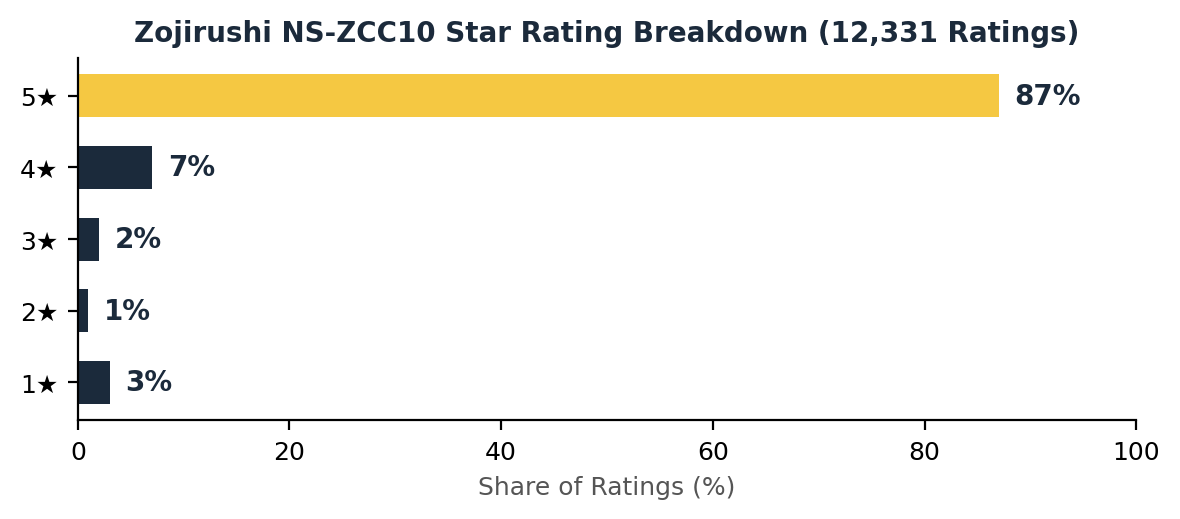
Eighty-seven percent of ratings on this Zojirushi rice cooker review page are five stars, and Amazon’s own review summary highlights consistent brown and Basmati rice as the most repeated praise, alongside how quickly the nonstick pan wipes clean. One buyer switched from using it purely for rice to running steel-cut oats overnight, waking up to a finished breakfast instead of a pot to babysit.
One detailed long-term review described using the delay timer to prep frozen chicken, vegetables, and canned soup the night before, layered by how long each ingredient needs to heat through, so the whole thing finishes cooked and warm right when the alarm goes off. That’s a genuinely clever use of a feature most buyers probably associate only with plain rice, and it comes up often enough in this Zojirushi rice cooker review’s source material to count as a real pattern rather than a one-off.
Another reviewer, self-described as someone who researched rice cookers used by Japanese, Korean, and Chinese households specifically because rice is a daily staple in those cuisines, singled out the retractable cord as an unexpectedly satisfying detail. A smaller but recurring theme in the reviews: buyers appreciate that the elephant logo and Japan-origin manufacturing feel like a genuine point of pride rather than a marketing gimmick, especially among people buying it as a gift.
The most specific complaint worth repeating: one verified buyer reported that the inner pan’s coating can lift if anything metal touches it, and that a replacement pan isn’t cheap or easy to find on its own. If you’re the type to reach for a metal spoon out of habit, budget for a silicone one and this stops being an issue.
Amazon’s review summary also notes a small minority of buyers reporting failure within roughly four months of purchase. That’s a real signal worth weighing, though it sits against 87% five-star ratings and reviews describing seven-plus years of regular use, so it reads more like normal manufacturing variance than a widespread defect.
How Does It Compare to the Rest of the Zojirushi Lineup?
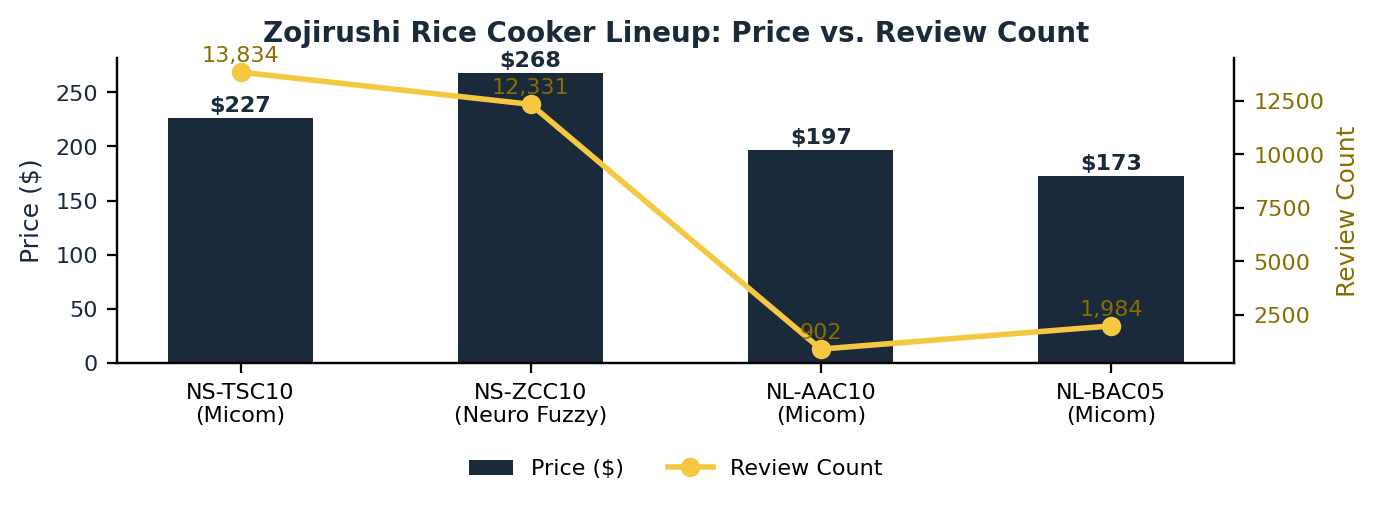
Amazon’s own “compare with similar” data on this Zojirushi NS ZCC10 listing puts it in the middle of the pack on price but near the top on review depth. The NS-TSC10 Micom model is cheaper and has more total reviews, but it’s a step down in technology, not just price.
| Zojirushi Lineup Comparison (Amazon-Verified) | |||
| Model | Technology | Price | Reviews |
| NS-TSC10 | Micom | $226.59 | 13,834 |
| NS-ZCC10 (this review) | Neuro Fuzzy | $268.00 | 12,331 |
| NL-AAC10 | Micom | $196.59 | 902 |
| NL-BAC05 | Micom | $172.59 | 1,984 |
If you’re set on staying inside the Zojirushi brand, this table covers the tradeoff clearly. If you’re open to other brands entirely, we’ve also compared this exact model head-to-head in our Cuckoo vs Zojirushi breakdown, and reviewed Cuckoo’s own flagship rice cooker separately if you want a second opinion on the Korean alternative.
As a rule of thumb: pick the NL-BAC05 if you’re cooking for one or two people occasionally, the NS-TSC10 if you want Zojirushi’s reputation without paying for Neuro Fuzzy specifically, and this Zojirushi neuro fuzzy rice cooker if brown rice, sushi rice, or feeding a full household are regular parts of your week rather than occasional events.
Is Zojirushi Rice Cooker Worth It in 2026?
This exact question, is Zojirushi rice cooker worth it, shows up constantly on deal forums, and the honest answer depends entirely on how often you cook rice. A recurring Slickdeals thread on this model makes the skeptic’s case well: for occasional rice, a $30 basic cooker gets you 80% of the result for a fraction of the cost.
But the counterargument in that same thread came from a 15-year Zojirushi owner, who pointed out their unit keeps rice tasting fresh for two to three days on keep-warm, while a cheaper cooker they’d tried dried out in half a day. That’s the actual value proposition: not that the rice tastes dramatically better on day one, but that it holds up over hours and days without turning into a crusty mess.
On the “Made in Japan” question specifically, this exact SKU (ASIN B00007J5U7) is manufactured in Japan, which matters to some buyers and is a non-issue for others. It’s a fair thing to factor in given the price gap versus cookers made elsewhere.
One more practical note: this specific model has dipped as low as $170 to $180 during past Amazon sales, according to historical Slickdeals postings. At full price it’s a stretch for casual use; if you can catch it during a sale, the value case gets a lot easier to make.
Think about it in terms of cost per use rather than sticker price. A household cooking rice four or five nights a week will put hundreds of cycles on this machine in the first year alone, which brings the effective cost down close to what a mid-range coffee maker or blender runs, appliances most people don’t think twice about buying. That’s usually the deciding factor whenever someone asks is Zojirushi rice cooker worth it in the first place.
If you’re weighing a rice cooker against a multi-cooker you already own or are considering, our rice cooker vs. Instant Pot comparison covers that exact fork in the road, and our broader guide to appliances every new home needs can help you prioritize where a rice cooker actually ranks against everything else on your list.
Our take on whether this Zojirushi rice cooker is worth it: if rice is a weekly habit in your house, not an occasional side dish, this Zojirushi neuro fuzzy rice cooker earns its place on the counter.
Care and Cleaning Tips
The inner pan on this Zojirushi neuro fuzzy rice cooker is the one part worth babying. It cleans up with a quick wipe or a soft sponge under warm water, but a scouring pad or anything metal will wear down the nonstick coating faster than normal use would, and that’s the single most repeated complaint across owner feedback for this model.
The detachable inner lid pops out for washing separately, and the steam vent cap benefits from a wipe-down after every cook rather than letting starch build up over several uses. The base unit itself should never be submerged. A damp cloth is enough for the exterior and the control panel.
- Hand wash the inner pan, never in the dishwasher
- Use the included nonstick spatula, not metal utensils
- Wipe the steam vent and thermal sensor after each use
- Keep the base unit dry at all times
Frequently Asked Questions
A few questions come up repeatedly in every Zojirushi rice cooker review and Slickdeals thread we found while researching this Zojirushi NS ZCC10.
Is the Zojirushi NS-ZCC10 Made in Japan?
Yes, the Zojirushi NS ZCC10 (ASIN B00007J5U7) is manufactured in Japan, based on the listing details for this exact SKU. Its 10-cup sibling, the NS-ZCC18, shares the same Neuro Fuzzy technology in a larger body.
- NS-ZCC10: 5.5-cup uncooked capacity, $268.00
- NS-ZCC18: 10-cup uncooked capacity, larger household or batch cooking
How Long Does a Zojirushi Rice Cooker Last?
Multiple verified owners of this Zojirushi neuro fuzzy rice cooker report seven or more years of regular use without issues, and Amazon’s own review summary confirms this as the dominant pattern. A small minority report failure within about four months, which is worth knowing but isn’t the typical experience.
- Avoid metal utensils on the nonstick inner pan to prevent coating damage
- Wipe the thermal sensor at the base after spills to keep readings accurate
- Never submerge the base unit, only the removable inner pan and lid
What’s the Difference Between Zojirushi Neuro Fuzzy and Micom?
Zojirushi neuro fuzzy technology continuously recalculates heat and timing throughout the cook using a thermal sensor, while Micom uses a simpler microcomputer with less real-time adjustment. This Zojirushi neuro fuzzy rice cooker costs more than a Micom model but corrects for measurement mistakes better.
| Neuro Fuzzy | Micom |
| Continuous thermal-sensor adjustment | Microcomputer-timed cycle, less real-time correction |
| Better recovery from water-ratio mistakes | Needs accurate measuring for best results |
| Higher price tier ($250+) | Lower price tier ($170-$230) |
Final Verdict
The Zojirushi neuro fuzzy rice cooker NS-ZCC10 earns its 4.7-star average honestly, and that’s the throughline of this entire Zojirushi rice cooker review. It isn’t flashy, the coating needs a bit of care, and it costs more than most people expect to pay for a rice cooker, but the Neuro Fuzzy logic genuinely delivers on consistency in a way a $30 cooker can’t match.
Based on verified specs, 12,331 buyer ratings, and independent lab findings from Wirecutter, our editorial rating lands at 4.6 out of 5. It loses a fraction of a point purely for the pan-coating durability caveat, not for anything related to how it actually cooks rice.
Free delivery available with Amazon Prime.
As an Amazon Associate, HomeApplianceOwl earns from qualifying purchases. Prices and availability are accurate as of the publish date and are subject to change.