
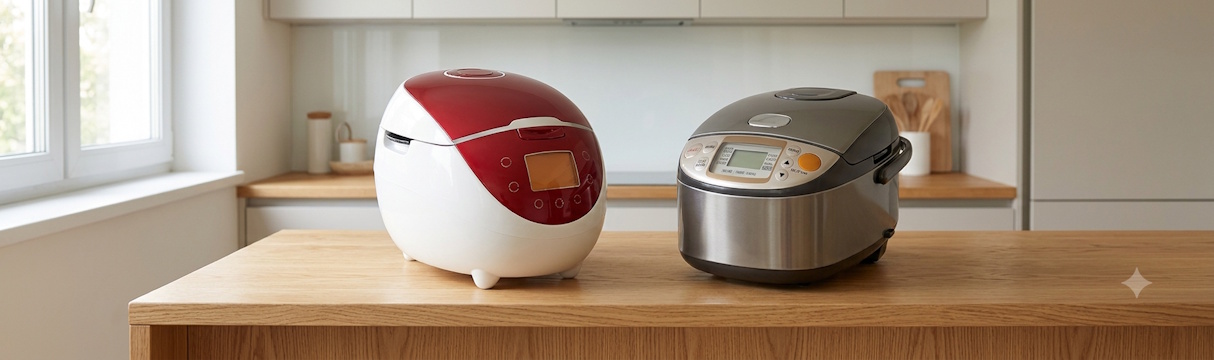
Cuckoo vs Zojirushi rice cooker comes down to one clear edge: the Zojirushi NS-ZCC10 is the proven winner for most kitchens, thanks to its Amazon’s Choice status and the highest rating between the two. Cuckoo’s CR-0675FW still wins on speed and price, cooking rice in under 40 minutes for less than half the cost. Which one actually fits your kitchen depends on what you value more: consistency or convenience.
Both brands dominate the premium rice cooker conversation for a reason. Zojirushi built its name on Neuro Fuzzy logic and Japanese-style precision, while Cuckoo pushes pressure and speed harder than almost anyone else in the category. We compared verified Amazon listings, professional lab data, and real owner feedback to see which one actually earns its price tag.
Every price, rating, and review count in this comparison was pulled directly from live Amazon listings rather than estimated or carried over from an old snapshot. Where we reference texture or cook-time findings, those come from independent testing sites that ran the two machines side by side, not from our own kitchens. We’ll note explicitly anywhere a figure comes from a verified buyer thread instead of a manufacturer spec sheet.
Table of Contents
- Top Picks at a Glance
- What to Look For When You Compare Zojirushi Rice Cookers
- Best Rice Cooker Zojirushi Makes vs Cuckoo’s Fastest Model
- Best Rice Cooker for Sushi Rice: Where Each Brand Stands
- Japanese vs Korean Rice Cooker: Why the Style Matters
- Full Reviews
- Side-by-Side Comparison
- Cuckoo vs Zojirushi Rice Cooker: The 60-Second Decision Guide
- Which One Should You Choose
- FAQ
- Final Verdict
Top Picks at a Glance
Here’s the short version before we get into specs and testing notes. Both models are currently in stock and verified live on Amazon.
This cuckoo vs zojirushi rice cooker breakdown pulls straight from those live listings, so the numbers below reflect real-time pricing rather than a stale snapshot.
| Model | Best For | Price | Rating | Bought/Mo | Check Price |
|---|---|---|---|---|---|
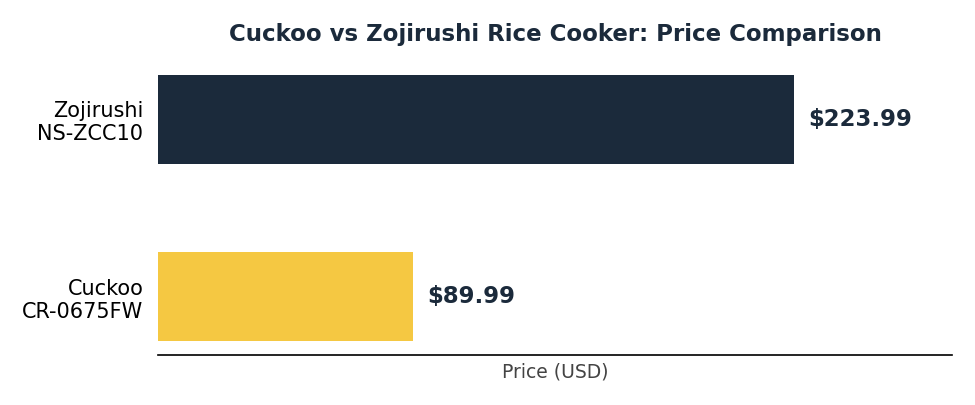
| Zojirushi NS-ZCC10 | Overall Winner | $223.99 | 4.7★ (12,308) | 1K+ | Check Price |
| Cuckoo CR-0675FW | Speed & Budget | $89.99 | 4.4★ (5,246) | 2K+ | Check Price |
What to Look For When You Compare Zojirushi Rice Cookers to Cuckoo
When you compare Zojirushi rice cookers against Cuckoo models, four factors matter more than the marketing copy. Cooking technology, capacity, keep-warm quality, and total cost of ownership decide whether you’ll actually use the appliance daily. Everything else is secondary.
- Cooking technology: Zojirushi’s Neuro Fuzzy logic makes small real-time adjustments to heat and moisture, while Cuckoo leans on pressure and turbo settings to cook faster.
- Capacity match: the NS-ZCC10 holds 5.5 cups uncooked, and the CR-0675FW holds 6 cups uncooked — close enough that household size shouldn’t be the deciding factor.
- Keep-warm quality: rice that sits for hours without drying out or developing an off smell separates a reliable cooker from a mediocre one.
- Total cost: factor in the $134 price gap against how often you’ll actually use the extra features Zojirushi charges for.
Replacement parts are worth checking before you buy, too. Both brands sell official inner pots and packing rings on Amazon, which matters once a nonstick coating starts to wear after several years of daily use. A $30 replacement pot is a far better outcome than replacing the whole cooker.
Delay timers and voice guides sound like minor extras until you actually own one. Being able to set rice to finish right when you walk in the door changes how often you cook it from scratch instead of reaching for takeout. Both the CR-0675FW and the NS-ZCC10 include a delay timer, so neither loses points here.
If you’re weighing a rice cooker against a different countertop appliance entirely, our rice cooker vs Instant Pot comparison breaks down when a multicooker makes more sense than a dedicated rice cooker. Keep these four factors in mind as you read through the rest of this cuckoo vs zojirushi rice cooker comparison.
Best Rice Cooker Zojirushi Makes vs Cuckoo’s Fastest Model
Ask which is the best rice cooker Zojirushi makes for everyday use, and the NS-ZCC10 is usually the answer. It carries the only Amazon’s Choice badge between these two listings, and its 12,308 reviews are more than double Cuckoo’s count. That review volume and badge status reflect sustained demand, not a launch-week spike.
Cuckoo doesn’t lose on quality here, though. The CR-0675FW’s 6-cup capacity edges out the NS-ZCC10’s 5.5-cup uncooked rating, and it cooks white rice in 28 to 36 minutes against Zojirushi’s slower, gentler cycle. Real owners on Slickdeals describe the CR-0675FW as “built like a tank,” pointing to its stainless-steel construction as the reason it holds up over years of daily use.
Material choice explains part of that owner sentiment. Several Slickdeals threads on Zojirushi models mention the inner pot’s nonstick coating eventually starting to peel after years of use, a concern Cuckoo’s heavier steel construction sidesteps entirely. That tradeoff cuts both ways: Zojirushi’s coating helps rice release cleanly for easier cleanup, while Cuckoo’s steel favors long-term durability over convenience.
So which is genuinely the best rice cooker Zojirushi sells if the NS-ZCC10 feels too small? The brand’s 10-cup Umami Micom line steps up capacity while keeping the same Neuro Fuzzy core, at a further price premium over even the NS-ZCC10. For most two-to-four-person households weighing this cuckoo vs zojirushi rice cooker decision, though, the 5.5-cup NS-ZCC10 remains the volume sweet spot.
Best Rice Cooker for Sushi Rice: Where Each Brand Stands
If sushi night is the whole reason you’re shopping, this is the section to read closely. Independent side-by-side testing from Prudent Reviews found the Zojirushi consistently produced tighter, slightly chewy grains typical of restaurant-quality sushi rice, while the Cuckoo’s texture varied more between batches. Gadget Kitchen Reviews reached a similar conclusion after running short-grain Japanese rice through both machines across five consecutive batches.
Neither brand fails at sushi rice outright. Cuckoo’s turbo settings can still produce sticky, cohesive grains that work fine for home rolls on a busy night. But when the goal is specifically the best rice cooker for sushi rice, the professional consensus leans Zojirushi for texture consistency batch after batch.
Part of that consistency comes down to how each machine handles rinsed rice with slightly variable moisture content. Zojirushi’s Neuro Fuzzy sensors read the load and adjust the cook cycle in real time, which matters more for sushi rice than for everyday steamed rice since sushi rice needs a narrower moisture band to hold its shape. This is one of the clearest places this cuckoo vs zojirushi rice cooker matchup actually separates the two machines.
Japanese vs Korean Rice Cooker: Why the Style Matters
The Japanese vs Korean rice cooker debate isn’t just brand loyalty — it reflects two genuinely different cooking philosophies. Japanese-style cookers like the Zojirushi prioritize gradual, even heat that produces soft, distinct grains suited to sushi and everyday steamed rice. Korean-style cookers like the Cuckoo use pressure to cook faster and create the stickier, chewier texture common in Korean and Southeast Asian dishes.
Neither approach is objectively better; they’re built for different plates. If your household cooks a lot of jasmine or glutinous rice for stir-fries and bibimbap, Cuckoo’s pressure system fits naturally. If steamed short-grain and delicate textures are the daily norm, Zojirushi’s gentler cycle is the more natural match.
This is also why the two brands rarely compete head-to-head in their home markets. Cuckoo dominates Korean households where fast, pressurized rice is standard, and Zojirushi holds a similar position in Japan for slow, precise cooking. Buying based on the cuisine you cook most often will usually serve this cuckoo vs zojirushi rice cooker decision better than buying based on brand reputation alone.
Full Reviews
Cuckoo CR-0675FW Review
| Cuckoo CR-0675FW Specs | |
|---|---|
| Capacity | 6 cups uncooked / 12 cups cooked |
| Technology | Micom Fuzzy Logic, 10 cooking modes |
| Cook Time | 28-36 minutes for white rice |
| Price | $89.99 |
| Rating | 4.4★ (5,246 reviews) |
The CR-0675FW is Cuckoo’s answer to buyers who want fuzzy-logic precision without the Japanese-brand price tag. Its nonstick inner pot and 10 cooking modes cover white rice, GABA rice, and mixed grains, and Auto Clean cuts down on the scrubbing that turns people off pressure cookers. At $89.99, it undercuts the Zojirushi by more than half.
The tradeoff shows up in consistency rather than features. Owners on Slickdeals report strong results for everyday jasmine and white rice, but professional side-by-side testing found more batch-to-batch variation than Zojirushi delivers on delicate grains. For fast, reliable everyday rice on a budget, it’s hard to beat.
The current $89.99 price also reflects a 36% markdown from its $139.99 list price at the time of this review, so it’s worth checking the live listing before you buy in case pricing shifts. At 2,000-plus units bought in the past month, it’s also the higher-velocity seller of the two models covered here, even without an Amazon’s Choice badge attached.
Free delivery available with Amazon Prime.
Zojirushi NS-ZCC10 Review
| Zojirushi NS-ZCC10 Specs | |
|---|---|
| Capacity | 5.5 cups uncooked (10-cup version also available) |
| Technology | Neuro Fuzzy logic, automatic keep-warm, delay timer |
| Badge | Amazon’s Choice: Overall Pick |
| Price | $223.99 |
| Rating | 4.7★ (12,308 reviews) |
The NS-ZCC10 earns its premium price through consistency rather than any single flashy feature. Neuro Fuzzy logic reads moisture and temperature throughout the cook cycle, adjusting in real time instead of following a fixed timer. That’s the difference professional testers point to when the Zojirushi keeps producing the same texture on batch five as it did on batch one.
One Slickdeals owner who has run theirs for over a decade called it “one of few buy it for life items,” and the keep-warm cycle holds cooked rice for three to four days without drying it out. The main downside is the slower cook cycle, which can run over an hour for larger batches. If you want reliable, restaurant-style rice and don’t mind planning ahead, this is the pick worth the extra cost.
At 12,308 reviews and an Amazon’s Choice: Overall Pick badge, the NS-ZCC10 has the strongest trust signals of any product covered in this comparison. Its 1,000-plus monthly purchase volume is lower than Cuckoo’s, but that’s consistent with a premium product at nearly two and a half times the price rather than a sign of weaker demand.
Free delivery available with Amazon Prime.
Cuckoo vs Zojirushi Rice Cooker: Side-by-Side Comparison
With both full reviews behind us, here’s every number lined up in one place. Use this table as the tie-breaker once you’ve decided which factors matter most to your kitchen.
| Feature | Cuckoo CR-0675FW | Zojirushi NS-ZCC10 |
|---|---|---|
| Price | $89.99 | $223.99 |
| Capacity | 6 cups uncooked | 5.5 cups uncooked |
| Cook Time (White Rice) | 28-36 minutes | Over 1 hour for larger batches |
| Rating | 4.4★ (5,246) | 4.7★ (12,308) |
| Bought/Mo | 2K+ | 1K+ |
| Amazon Badge | None | Amazon’s Choice: Overall Pick |
| Best Suited Style | Korean/Southeast Asian, sticky textures | Japanese-style, sushi and steamed rice |

Notice that neither model wins across every single row. Cuckoo takes price, cook time, and monthly sales volume, while Zojirushi takes rating, badge status, and texture consistency. That split is exactly why this comparison doesn’t resolve into one universal winner regardless of your kitchen.
Cuckoo vs Zojirushi Rice Cooker: The 60-Second Decision Guide
Still torn on cuckoo vs zojirushi rice cooker after the specs and reviews? Answer two questions and the decision usually settles itself.
What matters more, speed or texture consistency? If sushi night is the deciding factor, the best rice cooker for sushi rice between these two is worth the extra spend on its own.
- Pick Cuckoo if: you want fast weeknight rice, cook mostly Korean or Southeast Asian dishes, and want to keep the budget under $100.
- Pick Zojirushi if: sushi-night texture matters, you cook large batches that sit in keep-warm for days, or you want the badge-verified, higher-rated option.
Most buyers who go back and forth on this decision end up regretting the cheaper pick more often than the pricier one, simply because texture complaints are harder to fix after the fact than a one-time price difference. That’s not a reason to overspend if your household genuinely doesn’t need sushi-grade consistency. It’s a reason to be honest with yourself about how often that consistency will actually matter at your table.
Which One Should You Choose
Everything above points to a genuine split rather than one model quietly beating the other on every metric in this cuckoo vs zojirushi rice cooker matchup. If the japanese vs korean rice cooker distinction from earlier still feels abstract, use the lists below as a final gut-check before you commit either way.
Choose the Cuckoo CR-0675FW If
- Speed matters more than perfect texture on busy weeknights.
- Budget is a hard constraint under $100.
- Korean-style stickier rice is your household’s daily norm.
Choose the Zojirushi NS-ZCC10 If
- Texture consistency across every batch is non-negotiable.
- Sushi rice or delicate Japanese-style grains are a regular occasion.
- Long keep-warm cycles matter for how you actually eat leftovers.
FAQ
Is the Zojirushi rice cooker worth it over Cuckoo?
Yes, if texture consistency and long-term reliability matter more to you than upfront cost. The NS-ZCC10 costs $134 more than the Cuckoo CR-0675FW, but it carries the only Amazon’s Choice badge between the two and a meaningfully higher review count.
- Better for: sushi rice, steamed short-grain, and long keep-warm cycles.
- Not worth it if: you mainly need fast, everyday rice on a tight budget.
Think of the price gap less as a brand tax and more as a bet on how often you’ll notice the difference. If you’re still hunting for the single best rice cooker Zojirushi sells for a smaller household, the NS-ZCC10 remains the safest starting point. If most meals are quick weeknight rice, that same $134 is better spent elsewhere.
How long do Zojirushi rice cookers last?
Most Zojirushi owners report 10 to 15 years of daily use before performance noticeably declines. One Slickdeals owner running theirs for over a decade called it one of the few genuine buy-it-for-life kitchen appliances they own.
- Most common wear point: the inner pot’s nonstick coating, typically after 5-7 years of daily use.
- Warranty: 1 year standard, though real-world use often runs well past it.
What’s the difference between Cuckoo and Zojirushi rice cookers?
The core difference is cooking philosophy: Zojirushi’s Neuro Fuzzy logic favors gradual, even heat for consistent Japanese-style texture, while Cuckoo uses pressure and turbo modes to cook Korean-style sticky rice faster. Price, capacity, and badge status follow from that same split in this cuckoo vs zojirushi rice cooker comparison. Neither approach is a design flaw; they’re simply optimized for different national cooking traditions.
- Cuckoo: faster cook times, lower price, stainless-steel build.
- Zojirushi: gentler cycle, higher rating, Amazon’s Choice badge.
Final Verdict
Cuckoo vs Zojirushi rice cooker isn’t a question with one universal answer, but the data points toward the Zojirushi NS-ZCC10 as the safer pick for most kitchens. It holds the only Amazon’s Choice badge, the higher rating, and the professional-testing edge on texture consistency. Cuckoo’s CR-0675FW remains the smarter buy if speed and budget outweigh those factors for you.
Either way, both models are verified in stock at the time of writing, and neither requires a compromise on core cooking quality. If you still want to compare Zojirushi rice cookers against other Japanese-style models before deciding, pick based on which cooking style actually matches your kitchen, not just the badge on the listing.
If you’re also deciding between a rice cooker and a multicooker for your countertop, take a look at our Instant Pot vs Crock Pot comparison for how those appliances stack up on similar tradeoffs.
As an Amazon Associate, this site earns from qualifying purchases. Prices and availability are accurate as of the publish date and are subject to change.