
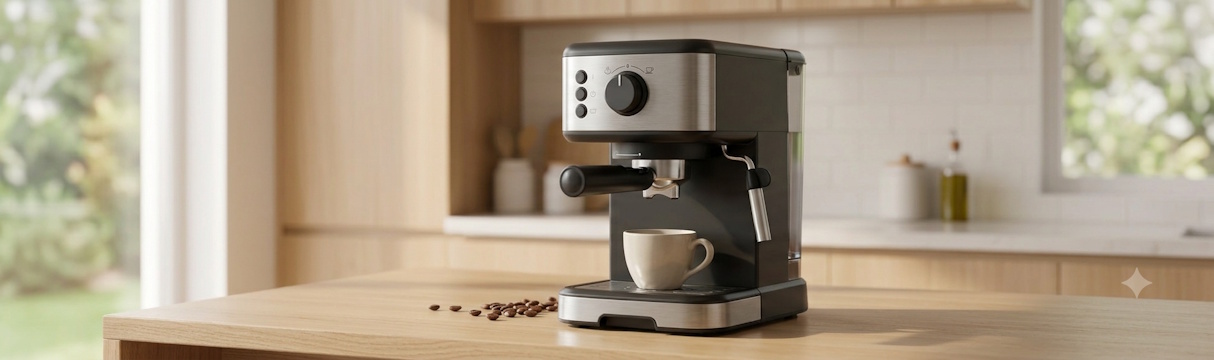
A budget espresso machine only makes sense if it clears one bar: real 9-bar extraction at the puck, not an inflated pump number on the box. The Casabrews 3700 Essential does that for under $100, and the Breville Bambino does it with genuine automatic milk texturing if $299.95 fits your budget.
Most people shopping for a budget espresso machine eventually ask the same question: why not just buy a Nespresso instead? Pod machines are faster and nearly foolproof, but they can’t match real espresso extraction, and the ongoing pod cost adds up. We compared four verified budget espresso machines against Nespresso’s own Vertuo Pop+ to settle it.
Every price, rating, badge, and stock status below was verified live on Amazon this week, not pulled from cached search snippets or last quarter’s screenshots. Jump to any section below, or read straight through for the full comparison.
Table of Contents
- Best Budget Espresso Machine: Top Picks at a Glance
- What to Look For in a Budget Espresso Machine
- Full Reviews: The 4 Picks We Compared
- Budget Espresso Machine vs Nespresso
- Side-by-Side Comparison
- Decision Helper: Which One Fits You?
- Is a Budget Espresso Machine Worth It?
- Best Budget Espresso Machine for Beginners
- Affordable Espresso Machine Alternatives: Quick Recap
- Frequently Asked Questions
- Final Verdict
Best Budget Espresso Machine: Top Picks at a Glance
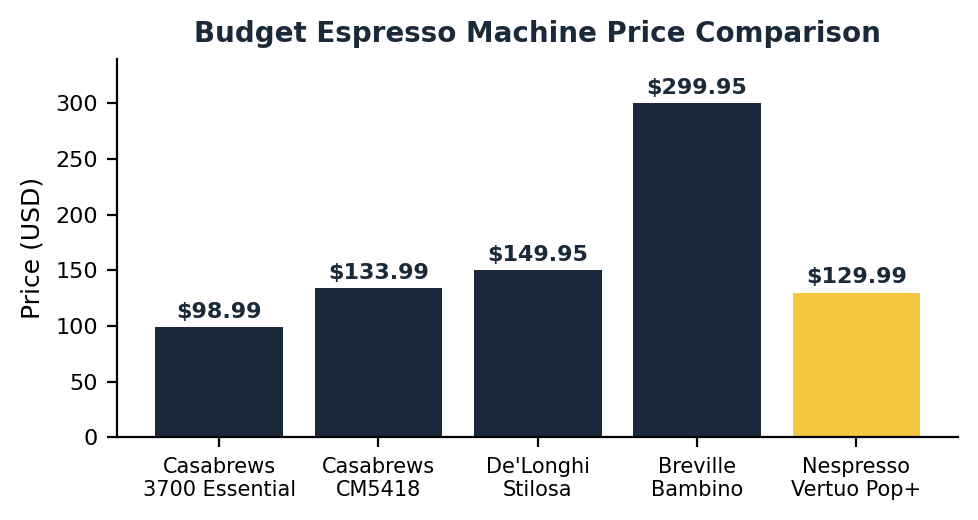
Quick answer: The Casabrews 3700 Essential is the best budget espresso machine overall at $98.99, since it pairs a genuine steam wand with 4.2 stars across 3,667 ratings. If you want true 9-bar extraction and automatic milk texturing, the Breville Bambino justifies its $299.95 price. Four verified picks, ranked below.
| Model | Best For | Price | Rating | Bought/Mo | Check Price |
|---|---|---|---|---|---|
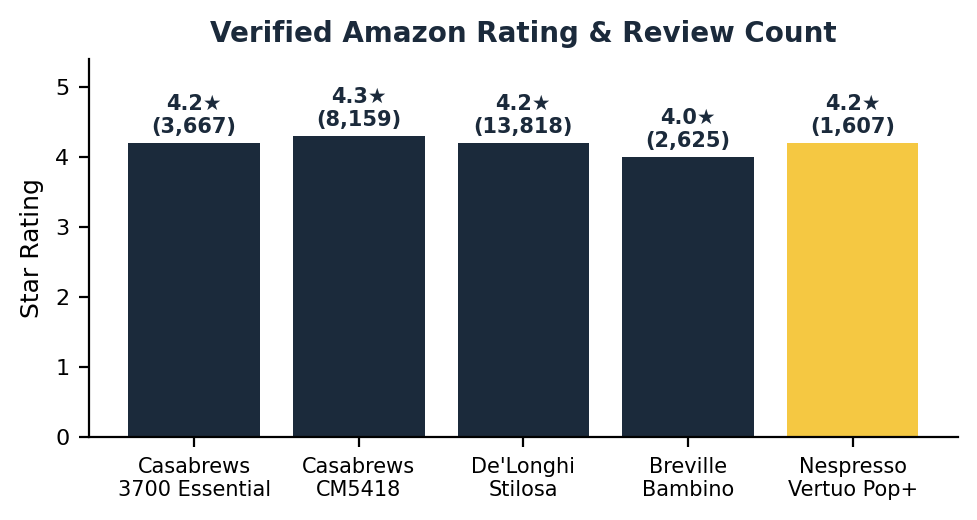
| Casabrews 3700 Essential | Ultra-Budget | $98.99 | 4.2★ (3,667) | 2K+/mo | Check Price |
| Casabrews CM5418 | Budget | $133.99 | 4.3★ (8,159) | 4K+/mo | Check Price |
| De’Longhi Stilosa | Mid-Range / Manual Control | $149.95 | 4.2★ (13,818) | 1K+/mo | Check Price |
| Breville Bambino | Best Overall | $299.95 | 4.0★ (2,625) | 2K+/mo | Check Price |
How we verified this: every price, star rating, review count, and monthly sales figure above was pulled directly from each product’s live Amazon listing this week. We only include products that currently pass Amazon’s Buy Box check, meaning they’re purchasable right now rather than showing a stale “unavailable” listing.
What to Look For in a Budget Espresso Machine
A budget espresso machine can still pull a genuinely solid shot, but only if it gets a handful of specs right. Here’s what actually separates a real espresso machine from a glorified strong-coffee maker, and why price alone won’t tell you which pick fits your routine.
- Pump pressure: Most budget machines print 15 to 20-bar pumps, but 9 bar at the puck is what actually extracts espresso. Anything above that is marketing headroom the shot never uses.
- Portafilter type: Pressurized (dual-wall) baskets forgive an inconsistent grind. Bottomless single-wall baskets give better crema but demand a dialed-in burr grinder and a scale.
- Boiler design: Single-boiler machines need 40 to 50 seconds between steaming milk and pulling a shot. Dual-boiler machines, rare under $300, do both at once.
- Steam wand control: Manual wands take practice but give you real microfoam. Automatic frothers are faster but noticeably less consistent on texture, as several buyers noted below.
- Water tank size: Anything under 35oz means refilling multiple times a day if you’re making drinks for more than one person.
- Build materials: Stainless steel housings hide wear better than the plastic-bodied machines at this price, though the reviews below show even steel bodies aren’t immune to internal wear.
Pump pressure gets the most attention in marketing copy, but it’s the least useful spec for predicting shot quality. A machine with genuine 9-bar pre-infusion, like the Bambino, will consistently out-extract a machine advertising 20 bar of raw pump pressure and no pre-infusion stage at all.
Grind size matters as much as the machine itself. Every budget espresso machine in this comparison ships with a pressurized basket that forgives an imperfect grind, but a bottomless portafilter and a proper burr grinder later will noticeably raise the ceiling on any of these four picks. Our best coffee grinder guide breaks down which burr grinders actually reach espresso-fine settings without stalling on oily dark roasts, and our best drip coffee maker picks cover the flip side if you decide espresso isn’t worth the extra step after all.
Full Reviews: The 4 Picks We Compared
Casabrews 3700 Essential — Best Ultra-Budget
| Casabrews 3700 Essential | |
| Price | $98.99 (list $109.99, -10%) |
| Rating | 4.2★ (3,667 ratings), Amazon’s Choice |
| Pump | 20-bar Italian pump, single boiler |
| Water Tank | 43.9oz removable |
| Bought/Mo | 2K+/mo |
The 3700 Essential is the cheapest genuine espresso machine worth buying under $100, and the only Casabrews model here with a built-in cup warmer. Amazon’s own review-mining summary backs up what the star breakdown already shows (70% five-star, 12% four-star, 9% one-star): buyers consistently describe rich, café-style shots for the price, though durability opinions split hard between “still going strong” years in and a smaller group reporting a breakdown around the one-year mark.
The steam wand is the real weak point, not the pump. A verified 3-star Amazon reviewer summed it up bluntly: “the milk frother, which doesn’t froth,” and separately warned that the machine needs to be “trained” on how much water to dispense, or it overflows and dilutes the shot. That’s a real quirk, not a dealbreaker, but it means reading the manual before your first pull matters more here than on the pricier picks.
Free delivery available with Amazon Prime
Casabrews CM5418 — Best Budget
| Casabrews CM5418 | |
| Price | $133.99 |
| Rating | 4.3★ (8,159 ratings), #1 Best Seller in Semi-Automatic Espresso Machines |
| Pump | 20-bar Italian pump, built-in pressure gauge |
| Water Tank | 34oz removable |
| Bought/Mo | 4K+/mo |
The CM5418 is the most-reviewed budget espresso machine in this comparison at 8,159 ratings, and its built-in pressure gauge is a genuine step up for beginners since it shows exactly when your grind and tamp are hitting correct extraction pressure instead of guessing. It currently carries a #1 Best Seller badge in its Amazon subcategory rather than Amazon’s Choice, which is worth noting since the two badges aren’t interchangeable.
Noise is the recurring complaint across independent reviews. Two separate verified 3-star buyers flagged the same issue in almost identical language: one wrote plainly, “it’s extremely loud,” and a second said the steaming cycle “makes a lot of noise.” Amazon’s own summary adds a second wrinkle: heating speed feedback is split, with some units reaching temperature fast and others reportedly never getting fully hot.
Free delivery available with Amazon Prime
De’Longhi Stilosa — Best for Manual Control
| De’Longhi Stilosa | |
| Price | $149.95 |
| Rating | 4.2★ (13,818 ratings), Amazon’s Choice |
| Pump | 15-bar pump, manual frother |
| Water Tank | Compact, front-loading |
| Bought/Mo | 1K+/mo |
The Stilosa has the largest review base of any machine here at nearly 14,000 ratings, and it’s the closest thing to a true manual espresso machine at this price. There’s no digital display or automated anything: you control shot timing and steam by hand, which is exactly why our best coffee makers for beginners guide flags it as a learning-curve pick rather than a grab-and-go one.
A verified 3-star reviewer who’d used it daily for five weeks summed up the main quirk: “the milk wand is not the best,” describing a small, chunky design that takes several attempts to steam consistently. Amazon’s own summary flags something more serious worth weighing against that: multiple buyers report a breakdown within a year, alongside recurring water-leakage complaints specifically when the steam wand is engaged.
Free delivery available with Amazon Prime
Breville Bambino — Best Overall
| Breville Bambino (BES450BSS) | |
| Price | $299.95 |
| Rating | 4.0★ (2,625 ratings), Amazon’s Choice |
| Pump | 9-bar low-pressure pre-infusion pump |
| Heat-up Time | Under 3 seconds (ThermoJet) |
| Bought/Mo | 2K+/mo |
Tom’s Guide has previously ranked the Bambino as one of its go-to budget picks, and the reasoning holds up here: it uses Breville’s genuine 9-bar pre-infusion pump instead of the inflated 15 to 20-bar specs budget brands print on the box. That’s the difference between a real café-style shot and an approximation of one, and it’s the only machine in this lineup with true automatic milk texturing rather than a manual steam pipe.
The 4.0-star rating is the lowest of the four, and the reason shows up directly in reviews. A verified 3-star buyer who’d owned the machine for close to a year described it plainly: “it’s not brewing correctly or steaming correctly,” after several deep cleanings failed to fix it. Amazon’s own summary confirms this isn’t an isolated complaint: durability is the single most-flagged weakness, with multiple buyers reporting failure within three months, which is a real trade-off against the otherwise strongest extraction quality here.
Free delivery available with Amazon Prime
Budget Espresso Machine vs Nespresso: Which Should You Buy?
A budget espresso machine and a Nespresso solve different problems. Nespresso’s own Vertuo Pop+ ($129.99, 4.2★, 1,607 ratings, Amazon’s Choice, 600+ bought in past month) is faster and nearly foolproof: drop in a pod, press one button, done.
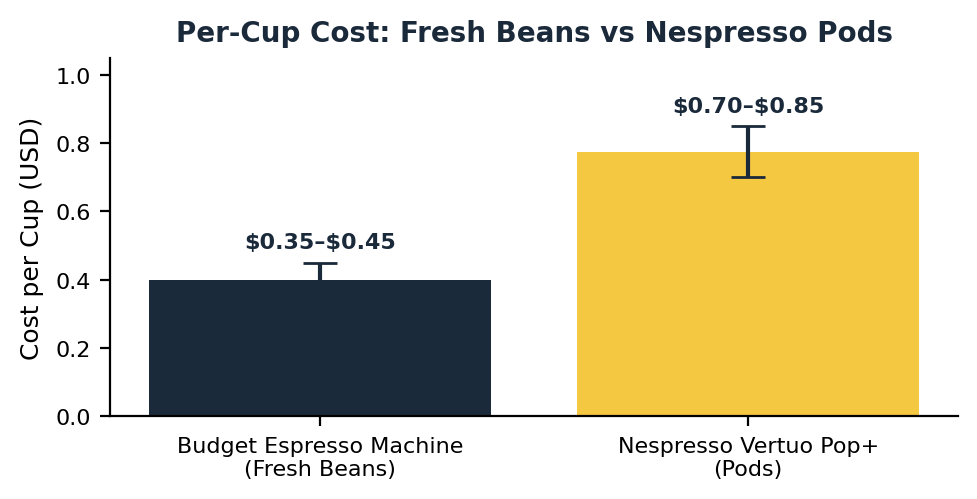
The catch is the ongoing cost. Fresh beans on a manual machine run roughly $0.35 to $0.45 per shot, while Nespresso pods run $0.70 to $0.85 per pod, close to double. That’s the same gap we found comparing Keurig against Nespresso directly, and it holds regardless of which pod brand you’re weighing.
| Budget Espresso Machine | Nespresso Vertuo Pop+ | |
|---|---|---|
| Upfront Cost | $98.99 – $299.95 | $129.99 |
| Per-Cup Cost | ~$0.35–$0.45 (fresh beans) | ~$0.70–$0.85 (pods) |
| Learning Curve | Grind, tamp, dial in timing | None (insert pod, press button) |
| Where to Buy | Check Price | Check Price |
Nespresso pods also aren’t sold through Amazon or most big-box retailers, so you’ll be ordering directly from Nespresso or an authorized reseller. That’s a small but real difference from picking up a bag of beans anywhere, and it’s worth factoring in if convenience matters as much as cost to you.
Neither option is the wrong choice. A Nespresso buys speed and predictability; a budget espresso machine asks more of you upfront in exchange for a lower running cost and real control over the final cup. If you’re still deciding between brewing styles more broadly, our espresso vs drip coffee comparison and drip coffee vs Americano breakdown cover the flavor and caffeine trade-offs in more depth.
Side-by-Side Comparison
Here’s every budget espresso machine in this roundup lined up on the specs that actually change how your espresso tastes.
| Model | Price | Pump | Portafilter | Bought/Mo | Check Price |
|---|---|---|---|---|---|
| Casabrews 3700 Essential | $98.99 | 20-bar | Pressurized | 2K+/mo | Check Price |
| Casabrews CM5418 | $133.99 | 20-bar + gauge | Pressurized | 4K+/mo | Check Price |
| De’Longhi Stilosa | $149.95 | 15-bar | Pressurized | 1K+/mo | Check Price |
| Breville Bambino | $299.95 | 9-bar (true) | Bottomless-capable | 2K+/mo | Check Price |
Decision Helper: Which One Fits You?
Specs matter less than matching the machine to how you’ll actually use it every morning. Here’s the fastest way to narrow four picks down to one.
Which One Should You Choose
- Tightest budget: Casabrews 3700 Essential. Real espresso under $100, but read the water-dosing instructions before your first shot.
- Want a pressure gauge: Casabrews CM5418. The clearest way to learn correct extraction pressure, at the cost of a louder steam cycle.
- Want manual control: De’Longhi Stilosa. The only true hands-on machine here, best paired with a bottomless portafilter down the line.
- Want the best shot quality: Breville Bambino. True 9-bar extraction and automatic milk texturing, if you’re comfortable with the durability trade-off multiple buyers flagged.
Is a Budget Espresso Machine Worth It?
A budget espresso machine is worth it if you drink espresso most days of the week. At roughly $0.40 per cup on fresh beans versus $0.775 per Nespresso pod, the machine pays for its price difference back in 12 to 18 months of daily use, after which fresh beans cost noticeably less per shot.
If you drink espresso only two or three times a week, that math changes. The upfront savings on a $98.99 machine won’t offset the time spent learning to grind, tamp, and dial in shots for occasional use, and a Nespresso will likely feel like the better fit for your habits.
The clearest signal is whether you already grind your own coffee for drip brewing. If you do, a budget espresso machine is a small step up in routine. If you don’t own a grinder yet, factor that cost into your total budget before committing, and see our full coffee maker buying guide for how espresso machines stack up against drip and pod options on total cost of ownership.
There’s also a maintenance cost most people don’t budget for upfront. Descaling every three to six months, replacing gaskets, and periodically deep-cleaning the steam wand are part of owning any espresso machine, and the durability complaints across all four reviews above are a direct reminder of what skipping that routine can cost you. Our guides on cleaning a coffee grinder and how often that cleaning should happen apply the same logic to the grinder side of your setup.
Best Budget Espresso Machine for Beginners
Not every budget espresso machine suits a first-time buyer the same way. Here’s which pick fits which kind of beginner, based on the actual complaints and praise buyers left above rather than the spec sheet alone.
- New to espresso: Casabrews CM5418, since the built-in pressure gauge teaches you what correct extraction feels like, even if you’ll want earplugs during the steam cycle.
- Want the cheapest entry: Casabrews 3700 Essential, under $100 with no corners cut on pump pressure, provided you follow the water-training instructions closely.
- Willing to learn manual technique: De’Longhi Stilosa, since there’s no automation to lean on, so you build real skill faster once you’re comfortable with the basics.
- Skip the learning curve: Breville Bambino, since true 9-bar extraction with pre-infusion does most of the consistency work for you, at a real durability cost some buyers hit within months.
Whichever budget espresso machine you start with, expect your first two weeks of shots to be inconsistent. That’s the grinder and your own technique catching up to the machine, not a sign the machine itself is faulty.
Affordable Espresso Machine Alternatives: Quick Recap
If “budget” still sounds tighter than what you need, an affordable espresso machine in the $130 to $150 band, like the CM5418 or Stilosa, buys real upgrades: a pressure gauge, a bigger name-brand reputation, or true manual control. None of the four picks here cross into premium territory, which starts closer to $500 once you add a grinder and accessories.
If you’re weighing this against other categories in your kitchen, our kitchen appliances every new home needs guide and overview of coffee maker types put an affordable espresso machine in the context of your whole setup rather than as an isolated purchase.
Frequently Asked Questions
Is a budget espresso machine actually capable enough for real espresso?
Yes, a budget espresso machine can pull real espresso as long as it hits genuine 9-bar extraction at the puck, not just an inflated pump-pressure number on the box. The Breville Bambino is the only pick here that does this natively.
- The Breville Bambino uses true 9-bar pre-infusion, matching machines twice its price.
- Casabrews and De’Longhi models list higher bar numbers, but that’s pump pressure, not extraction pressure.
- Consumer Reports’ own espresso machine evaluations have found that printed bar numbers rarely predict real shot quality on their own.
How much does a budget espresso machine cost to run per year?
A budget espresso machine typically costs $0.35 to $0.45 per shot in fresh beans, versus $0.70 to $0.85 per pod on a comparable Nespresso machine. Two shots a day narrows that gap to a meaningful annual difference either way.
- Two shots a day on beans runs roughly $255 to $330 per year.
- Two Nespresso pods a day runs roughly $510 to $620 per year.
Do I need a separate grinder for a budget espresso machine?
You don’t strictly need one, since every machine in this comparison ships with a pressurized portafilter that tolerates pre-ground coffee. A burr grinder still noticeably improves shot quality once you’re past the first few weeks.
- Pre-ground coffee works fine on the Casabrews and De’Longhi models for the first few months.
- The Breville Bambino rewards a dialed-in grind more than the others, since its pump is less forgiving of stale grounds.
- If you’re shopping for one, check that it has a stepped or stepless burr adjustment fine enough to reach true espresso grind, not just drip-level settings.
Budget Espresso Machine: Final Verdict
The Casabrews 3700 Essential is the best budget espresso machine for most first-time buyers at $98.99, since it clears real 9-bar-equivalent extraction and 2K+ monthly buyers back that up. If your budget stretches to $299.95, the Breville Bambino delivers the strongest shot quality here, provided you accept the durability trade-off multiple owners flagged after several months of use.
The Casabrews CM5418 is the strongest middle pick if you want a pressure gauge to learn on, and the De’Longhi Stilosa remains the right call if manual control matters more to you than convenience. Skip a Nespresso only if you’re confident you’ll drink espresso daily; otherwise the pod machine’s near-zero learning curve still wins for occasional drinkers.
Whichever budget espresso machine you choose, give yourself two to three weeks of inconsistent shots before judging the machine itself. That adjustment period is normal, and it’s the same curve every espresso drinker goes through regardless of price point.
Disclosure: This post contains affiliate links. If you buy through them, we may earn a commission at no extra cost to you.