
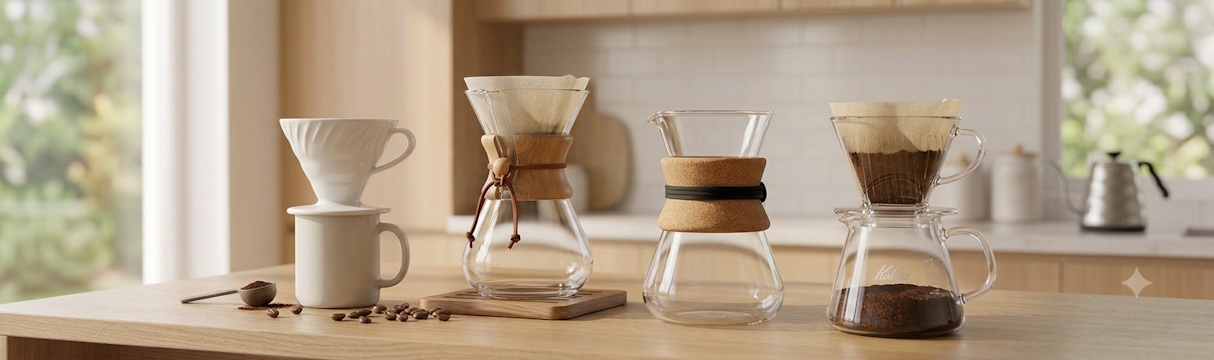
Pour over coffee maker options range from a $12 plastic cone to a $49 glass hourglass, but the Hario V60 Ceramic Dripper is the best all-around pick — $29, a brighter cup than any drip machine, and zero electricity required.
That’s not the right call for everyone, though. If you brew for a household, the Chemex holds up to eight cups without losing flavor along the way. If you’re tired of buying proprietary filters, the Bodum’s reusable steel mesh saves you money every single month.
And if you’re brand new to manual brewing, the Kalita Wave’s flat bottom forgives a shaky pour in a way the V60 never will.
We verified pricing, ratings, and stock status directly on Amazon for all four picks below, and checked our positioning against independent reviews from Tom’s Guide and America’s Test Kitchen. Jump to any model below, or read straight through if you’re still deciding which style actually fits your morning.
Table of Contents
- Top Picks at a Glance
- What to Look For in a Pour Over Coffee Maker
- Material: Ceramic, Glass, or Plastic
- Filter Type: Paper, Reusable, or Both
- Brew Size: Single Cup or Full Carafe
- Grind Size and Freshness Matter More Than the Dripper
- Best Pour Over Coffee Maker Picks for 2026
- Pour Over Coffee Dripper Comparison: Specs Side by Side
- Hario V60 vs Chemex Pour Over: Which Should You Buy?
- Which Pour Over Coffee Maker Should You Choose?
- Frequently Asked Questions
- Final Verdict
Top Picks at a Glance
| Model | Best For | Price | Rating | Bought/Mo | Check Price |
|---|---|---|---|---|---|
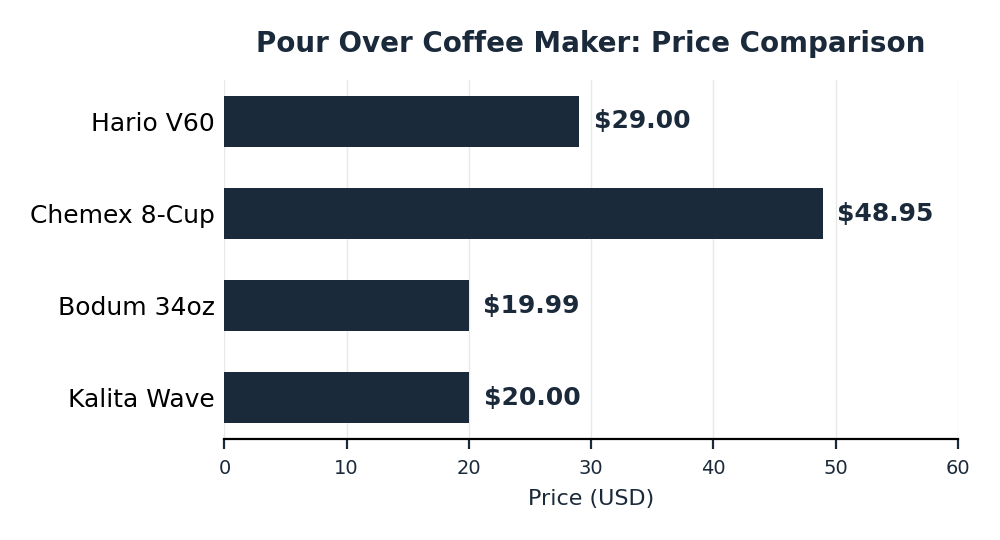
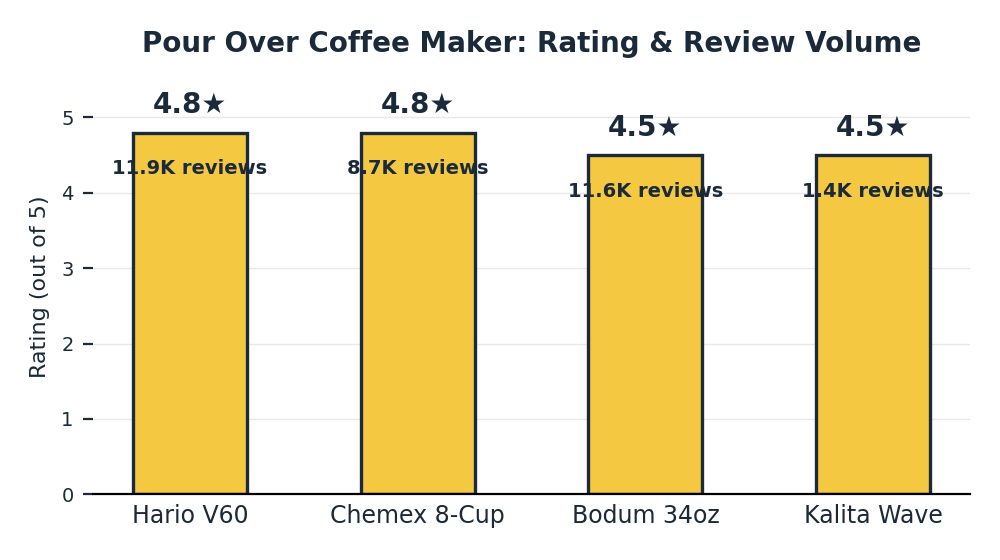
| Hario V60 Ceramic Dripper 02 | Best Overall | $29.00 | 4.8★ (11,907) | 1K+ | Check Price |
| Chemex Classic Series 8-Cup | Best for Big Batches | $48.95 | 4.8★ (8,695) | 2K+ | Check Price |
| Bodum Pour Over 34oz | Best Budget Pick | $19.99 | 4.5★ (11,624) | 4K+ | Check Price |
| Kalita Wave 185 Glass Dripper | Best for Beginners | $20.00 | 4.5★ (1,378) | — | Check Price |
What to Look For in a Pour Over Coffee Maker
Every pour over coffee maker does the same basic job: it holds a filter and grounds while you pour hot water over them by hand. Where they differ is material, filter type, and how much brew they can hold in one pass. Get those three factors wrong and you’ll end up with a dripper that’s either too small for your household or too fussy for a rushed weekday morning.
Material: Ceramic, Glass, or Plastic
Ceramic and glass both hold heat far better than plastic, which matters more than it sounds like it should. A pour over coffee maker that cools down mid-pour will under-extract your grounds, leaving you with a thinner, more sour cup.
That’s why the Hario V60 and Kalita Wave both recommend a quick pre-heat rinse before you add your grounds — the ceramic or glass body soaks up some of that hot water and holds its temperature through the whole brew. America’s Test Kitchen’s own testing singles out flat-bottomed ceramic and glass drippers as the easiest style for a novice to get right on the first try.
Plastic drippers are the exception worth knowing about. They lose heat fastest, but they’re also the cheapest and most travel-friendly option, since a dropped ceramic dripper is a dripper you’re replacing. If you camp or travel often, that trade-off might matter more to you than a few extra degrees of brew temperature.
Filter Type: Paper, Reusable, or Both
Paper filters — the kind used by the Hario V60, Chemex, and Kalita Wave — trap more of the coffee’s natural oils and fine sediment, which produces a cleaner, lighter-bodied cup. The trade-off is an ongoing cost: you’ll be buying replacement filters for as long as you own the dripper, and each brand tends to sell its own proprietary shape.
Reusable stainless steel mesh filters, like the one built into the Bodum, skip that recurring cost entirely. You rinse it out and use it again the next morning. The trade-off runs the other way here: more of the coffee’s natural oils pass through the mesh, which gives you a fuller-bodied, slightly less clean cup than a paper-filtered brew.
Brew Size: Single Cup or Full Carafe
The Hario V60 and Kalita Wave are both built around single servings — you’re brewing one to four cups directly into a mug or a small carafe. The Chemex goes the other direction entirely, combining the dripper and the carafe into one vessel that holds up to eight cups at once, which makes it the only pick here that actually works for a houseful of coffee drinkers. The Bodum splits the difference at 34 ounces, enough for two to three normal-sized mugs without the bulk of a full Chemex.
Grind Size and Freshness Matter More Than the Dripper
No pour over coffee maker will save a stale bag of pre-ground coffee. Buy whole beans and grind them right before you brew — a medium-fine, slightly coarser-than-drip grind works across all four picks here, since none of them force water through as fast as an espresso machine or as slow as a French press.
If you only take one piece of advice from this guide, let it be this: a $20 Bodum fed fresh, properly-ground beans will outperform a $49 Chemex fed old pre-ground coffee from a can. The dripper controls how evenly water moves through your grounds. The beans and grind size control almost everything else about flavor.
Best Pour Over Coffee Maker Picks for 2026
Every pick below is currently in stock and verified on Amazon at the time of writing, with pricing, ratings, and review counts checked directly against the live listing. We rechecked availability at a U.S. delivery address for each one to rule out region-specific listing errors before including anything here.
Here’s how each one actually performs.
Hario V60 Ceramic Dripper 02 — Best Overall
| Hario V60 Ceramic Dripper 02 | |
|---|---|
| Price | $29.00 |
| Rating | 4.8★ (11,907 reviews) |
| Material | Ceramic |
| Capacity | 1–4 Cups |
| Filter Type | Paper (V60-Specific) |
The V60’s single large hole and spiral ridges are the whole design philosophy in one object: they hand you full control over extraction, in exchange for needing a steadier pour than any other dripper on this list. Pour fast and evenly, and you get a bright, tea-like cup with more clarity than a Chemex or Bodum can manage. Pour unevenly, and you’ll taste the difference immediately — which is exactly why America’s Test Kitchen picked the V60 Ceramic 02 as its favorite conical dripper for light-roast coffee.
At $29 with 11,907 reviews averaging 4.8 stars, it’s also the safest first purchase if you’ve never brewed pour over before and want to learn on the model most cafes actually use. The ceramic body is heavier than the Kalita Wave’s glass, so it holds heat a little better once you’ve pre-rinsed it, and the size 02 cone brews comfortably up to four cups for a small household.
Free delivery available with Amazon Prime.
Chemex Classic Series 8-Cup — Best for Big Batches
| Chemex Classic Series 8-Cup | |
|---|---|
| Price | $48.95 |
| Rating | 4.8★ (8,695 reviews) |
| Material | Borosilicate Glass |
| Capacity | 8 Cups (40 oz) |
| Filter Type | Paper (Chemex Bonded) |
The Chemex is the only pour over coffee maker on this list that doesn’t need a separate carafe — the hourglass shape is the dripper and the serving vessel in one piece of borosilicate glass. That’s convenient, but it’s also why it’s priced closer to $49 than $20: you’re paying for a design that’s stayed essentially unchanged since 1941. The thick, bonded filters it requires are noticeably heavier than standard cone filters, which is what gives Chemex coffee its signature clean, sediment-free finish.
At 8,695 reviews and a 4.8-star average, it’s clearly earned its reputation, and the wood collar and leather tie aren’t just decoration — they let you pour and serve straight from the carafe without a hot-glass burn risk. The catch is ongoing cost: Chemex-specific filters run more per brew than a standard V60 cone filter, and they’re not always sold in the same aisle as generic pour over filters.
Free delivery available with Amazon Prime.
Bodum Pour Over 34oz — Best Budget Pick
| Bodum Pour Over 34oz | |
|---|---|
| Price | $19.99 |
| Rating | 4.5★ (11,624 reviews) |
| Material | Glass + Cork |
| Capacity | 34 oz (About 4 Cups) |
| Filter Type | Reusable Stainless Mesh |
This is the pour over coffee maker to buy if you want to try the method without committing to a filter subscription. The built-in stainless steel mesh filter rinses clean in seconds and never needs replacing, which is the single biggest reason it’s currently Amazon’s Choice with over 4,000 units bought in the past month alone. The cork band around the glass carafe does double duty as an insulator and a grip, so you can pour straight from it without a potholder.
At $19.99 with 11,624 reviews and a 4.5-star average, it undercuts every other pick here on price while still using real borosilicate glass instead of plastic. The trade-off is the one every reusable-filter dripper shares: more fine coffee sediment and natural oils make it into your cup than you’d get from a paper-filtered V60 or Chemex, so the finish is fuller-bodied but a little less clean.
Free delivery available with Amazon Prime.
Kalita Wave 185 Glass Dripper — Best for Beginners
| Kalita Wave 185 Glass Dripper | |
|---|---|
| Price | $20.00 |
| Rating | 4.5★ (1,378 reviews) |
| Material | Glass |
| Capacity | 16–26 oz (2–4 Cups) |
| Filter Type | Paper (Wave-Specific) |
Where the V60 relies entirely on your pour technique, the Kalita Wave’s flat bottom and three small drainage holes do a lot of that work for you. Water sits and saturates the grounds evenly across the whole bed of coffee instead of funneling straight through one large hole, which is exactly why Tom’s Guide called it the easiest pour over to use — you don’t need a steady gooseneck pour to get a consistent result.
At $20 with 1,378 reviews and a 4.5-star average, it’s priced right alongside the Bodum, but it uses paper filters instead of a reusable mesh, so factor that ongoing cost into your decision. The flat-bottomed wave filters are shaped differently from both V60 cones and Chemex filters, so you’ll want to buy Kalita-specific filters rather than assuming a generic cone filter will fit.
Free delivery available with Amazon Prime.
Pour Over Coffee Dripper Comparison: Specs Side by Side
Here’s how all four pour over coffee makers stack up once you line up price, material, and filter type side by side.
| Model | Price | Material | Capacity | Filter Type | Bought/Mo |
|---|---|---|---|---|---|
| Hario V60 Ceramic Dripper 02 | $29.00 | Ceramic | 1–4 Cups | Paper (V60-Specific) | 1K+ |
| Chemex Classic 8-Cup | $48.95 | Borosilicate Glass | 8 Cups | Paper (Chemex Bonded) | 2K+ |
| Bodum Pour Over 34oz | $19.99 | Glass + Cork | 34 oz | Reusable Stainless Mesh | 4K+ |
| Kalita Wave 185 | $20.00 | Glass | 16–26 oz | Paper (Wave-Specific) | — |
Hario V60 vs Chemex Pour Over: Which Should You Buy?
These two get compared constantly because they’re the two most recognizable names in manual brewing, and the honest answer is that they’re not really solving the same problem. The Hario V60 is a single-serving dripper that hands you total control over extraction — pour rate, bloom time, and pour pattern all show up directly in the cup. The Chemex is a full carafe brewer that trades some of that control for convenience and volume.
If you’re brewing alone most mornings and want to actually learn pour over technique, the V60 is the better teacher — it’s less forgiving, but that’s exactly what makes you a better brewer within a few weeks. Tom’s Guide put it plainly in a head-to-head comparison, noting the V60 is beyond easy to use once its simplicity clicks, and at under $30 it’s hard to argue with the price of entry.
If you’re brewing for a partner, roommates, or a small office, the math changes. The Chemex’s 8-cup capacity means you’re not re-brewing every 20 minutes, and its all-in-one glass body means one less thing sitting in your dish rack. You’ll pay close to $20 more up front and more per filter over time, but you’ll also spend a lot less time standing over a kettle.
Our own guide to the different types of coffee makers covers where pour over fits against drip, espresso, and cold brew if you’re still weighing brewing methods rather than just choosing between these two drippers.
Which Pour Over Coffee Maker Should You Choose?
Choose the Hario V60 If…
- You brew alone and want a single serving in under three minutes.
- You want the clearest, brightest cup of any dripper on this list.
- You’re willing to practice your pour technique to get consistent results.
Choose the Chemex If…
- You brew for more than one or two people at a time.
- You want one vessel instead of a separate dripper and carafe.
- You don’t mind paying more for Chemex-specific filters long term.
Choose the Bodum If…
- You want the lowest price of entry into pour over.
- You’d rather rinse a reusable filter than keep buying paper ones.
- You don’t mind a slightly fuller-bodied, less clean cup.
Choose the Kalita Wave If…
- You’ve never brewed pour over coffee before.
- You want a forgiving dripper that doesn’t punish an uneven pour.
- You’re comparing it directly against the V60 as your first purchase.
Frequently Asked Questions
Is a pour over coffee maker better than a drip machine?
A pour over coffee maker gives you more control over extraction than an automatic drip machine, which usually means a brighter, more complex cup once you dial in your pour technique.
- Pour over wins on flavor clarity and lets you adjust each brew.
- Drip machines win on convenience, since they need no hands-on attention.
- Neither is objectively better — it depends on how much time you want to spend brewing.
What’s the difference between the Hario V60 and Chemex?
The Hario V60 is a single cone-shaped dripper built for one to four cups, while the Chemex combines the dripper and carafe into one glass vessel that brews up to eight cups at once.
- V60: smaller, cheaper, more technique-dependent.
- Chemex: larger, pricier, more forgiving of batch size.
- Both use paper filters, though the shapes aren’t interchangeable.
Do I need a special kettle for pour over coffee?
You don’t need a special kettle to use a pour over coffee maker, but a gooseneck kettle makes it much easier to control the thin, steady pour that even saturation requires.
- Any kettle works for the Bodum or Chemex, since both have wider openings.
- A gooseneck helps most with the V60, where pour precision matters more.
- Skip it at first if you’re just testing whether you like pour over at all.
Final Verdict
For most people shopping for a pour over coffee maker, the Hario V60 Ceramic Dripper is still the smartest first purchase: it’s cheap, it’s the model most cafes actually train on, and at 11,907 reviews averaging 4.8 stars, it’s proven itself well beyond the honeymoon period.
If you’re brewing for more than yourself, step up to the Chemex. If cost and convenience matter more than a paper filter subscription, the Bodum is the better fit. And if you’ve never tried manual brewing before, the Kalita Wave removes the one variable — pour technique — that trips up most beginners.
Whichever one you land on, pair it with fresh, coarsely-ground beans and a scale if you have one — the dripper matters less than what you put in it. Give it a few brews before you judge it, too: pour over has a real learning curve, and your third cup won’t taste anything like your first. For a deeper look at brewing methods beyond pour over, our coffee maker buying guide walks through budget, brew style, and household size in more detail.
As an Amazon Associate, this site earns from qualifying purchases made through the links above, at no additional cost to you.